Most articles on this keyword are written by agencies telling clients what things cost. This one is for the other side of the table: you run (or are starting) the agency, a lead just asked "charges kya hai?", and you need a number that wins the deal without trapping you in an unprofitable retainer for a year.
I've priced retainers across 63+ brands, from Rudrapur salons to funded D2C — here's the framework I wish someone had given me, with real market ranges to anchor it.
Social media management charges in India per month (2026)
The published market data clusters into three bands. upGrowth's 2026 pricing guide puts freelancers at ₹15,000–₹50,000/month, boutique agencies at ₹30,000–₹1,50,000, and full-service agencies at ₹1,00,000–₹5,00,000+ — with the in-house alternative (a salaried manager) at ₹4–12 lakh a year. For ads, they quote management fees of ₹15,000–₹25,000 at smaller budgets, moving to 15–20% of spend at larger ones.
Those ranges are honest, but notice how wide they are — a 5x spread inside each band. That's because the price isn't really set by "social media management" as a category. It's set by three multipliers: scope (12 statics vs. 8 reels a month are wildly different production costs), city tier (the same deck closes at ₹60k in Mumbai and ₹25k in Indore), and who signs (owner-operator brands negotiate; marketing managers with budgets don't).
The rate card I'd use, by city tier
These are my working ranges from actually closing (and losing) deals — treat them as anchors, not law. "Starter" = one platform, 12–15 posts, stories, community management, monthly report. "Growth" = two platforms, 4–8 reels, shoots quarterly, ads management extra. "Premium" = multi-platform with strategy, monthly shoots and a dedicated account manager.
| City tier | Starter | Growth | Premium |
|---|---|---|---|
| Metro (Mumbai, Delhi NCR, Bengaluru) | ₹25,000–₹40,000 | ₹50,000–₹1,00,000 | ₹1,00,000+ |
| Tier-2 (Jaipur, Indore, Lucknow, Kochi) | ₹15,000–₹25,000 | ₹30,000–₹60,000 | ₹75,000+ |
| Tier-3 / small city (my home market) | ₹8,000–₹15,000 | ₹20,000–₹35,000 | ₹50,000+ |
Two notes on using this. First, the tier is the client's market, not your office location — a Rudrapur agency serving a Mumbai D2C brand charges Mumbai rates, which is exactly why remote-first tier-3 agencies quietly out-earn their local peers. Second, reels move you up a band faster than anything else: they're the most expensive deliverable to produce and the one clients most want in 2026.
Social media handling charges per post, reel and platform
Clients increasingly ask "per post kitna?" before they ask for a package, so it helps to know the per-piece market too. upGrowth's 2026 guide (updated September 2026) publishes these Indian ranges:
| Deliverable or platform | Typical Indian rate (2026) |
|---|---|
| Static image post | ₹500–₹3,000 per post |
| Carousel post | ₹1,500–₹5,000 per post |
| Reel / Short (15–60 sec) | ₹3,000–₹15,000 per video |
| Instagram management, basic tier | ₹20,000–₹40,000 per month |
| Facebook management, basic tier | ₹15,000–₹30,000 per month |
| LinkedIn management, basic tier | ₹15,000–₹35,000 per month |
| YouTube management, basic tier | ₹20,000–₹50,000 per month |
How I use these: per-piece rates are for add-ons and one-off projects — an extra reel during Diwali, a launch carousel, a festive creative pack. They're also a sanity check on your package. If your Growth package promises 8 reels and 12 statics, the per-piece market value of that bundle is well above most tier-2 retainers, which tells you either the package is underpriced or the deliverable count is too generous. Don't sell retainers à la carte, though — once clients price you per post, every invoice becomes a negotiation about volume.
How to calculate your monthly charge in 5 steps
Market ranges tell you where the ceiling and floor are. Your own costs tell you where inside that range you can afford to sit. This is the method I use before quoting any new retainer:
- List the monthly deliverables. Posts, carousels, reels, stories, community replies, ad management, the monthly report, shoot days. Write them as counts, not adjectives.
- Estimate team hours per deliverable — including two revision rounds, approval chasing and posting. Most new founders count only design time and undercount by half.
- Multiply by your loaded hourly cost. Salaries plus software plus rent, divided by the hours your team actually spends on client work (not total office hours).
- Add your margin. I don't take a retainer that pays less than roughly twice its delivery cost; below that, one difficult month wipes out the profit.
- Check it against the market band and the client's city tier (tables above), then quote it as "amount + 18% GST".
A worked example with round numbers: if your loaded team cost comes to ₹500 an hour and a client needs about 40 hours a month, delivery costs ₹20,000 — so you quote ₹40,000 + GST, which sits comfortably in the tier-2 Growth band. If the same client only budgets ₹20,000, you cut deliverables, not margin. If you'd rather not do this on paper, our free social media pricing calculator walks through the same deliverables-to-monthly-price math.
What's included in social media handling charges — and what isn't
Half of all pricing disputes I've seen were really about scope. Spell out both lists in the proposal:
- Usually included in the monthly fee: content strategy and the monthly calendar, design and captions, scheduling or posting, community replies during business hours, a monthly performance report, and a fixed number of revision rounds (I use two).
- Billed separately: ad spend (paid by the client directly to Meta or Google), ad management beyond the agreed scope, shoots — photographer, models, location, props — influencer fees, paid music or stock, extra revision rounds and same-day rush requests.
Put a price next to every "billed separately" item in the proposal, even if you rarely charge it. Clients respect a boundary that has a number on it far more than one that only exists in your head. Our social media agency proposal template has a scope section built this way.
Should you price per platform, per package, or per outcome?
I've tried all three. Packages win, and it's not close:
- Per platform ("Instagram ₹X, add Facebook for ₹Y") sounds logical but invites subtraction — clients cut platforms to cut price, and you end up managing half a presence. Cross-posting costs you almost nothing; bundle it.
- Packages (Starter/Growth/Premium with named deliverables) anchor the conversation on scope instead of price. Most clients pick the middle one — design your middle package to be the retainer you actually want to run.
- Per outcome ("pay per lead/follower") is a trap at retainer scale: you don't control the client's product, pricing or seasonality. Take performance bonuses on top of a base retainer if you like — never instead of one.
Whatever you choose, put the deliverable counts, the revision limit (two rounds, then billable) and an approval turnaround clause in writing — the pricing fails I've seen were scope fails wearing a pricing costume. I covered the rate-card step inside the larger journey in how to start a social media marketing agency in India.
What about GST and TDS?
The two lines Indian pricing articles love to skip, and the two that decide what actually hits your bank:
- GST: once aggregate turnover crosses ₹20 lakh in a financial year (₹10 lakh in special-category states — ClearTax summary of the thresholds), registration is mandatory and you charge 18% on top of your fee (details in our GST invoice guide for digital marketing services). Registered business clients claim it back as input credit — so quote "₹40,000 + GST", never a GST-inclusive number that silently eats 18% of your margin.
- TDS: business clients will deduct tax at source before paying you — advertising and contract work is commonly deducted at 1% (individual/HUF) or 2% (firms and companies). That used to be "Section 194C"; since 1 April 2026 the non-salary TDS rules sit in Section 393 of the Income-tax Act, 2025, with the rates carried over. A ₹40,000 + GST invoice does not arrive as ₹47,200 — reconcile the deduction against Form 26AS and claim it at filing. Budget cash flow accordingly; our TDS on digital marketing services guide has the full rate and threshold table.
- Ad spend: keep it out of your invoice entirely. Client pays Meta directly; you bill only the management fee. Routing spend through your account inflates your turnover (hello, earlier GST registration) and makes you the credit-card float for someone else's ads.
The capacity math: why cheap retainers cap your agency
Here's the arithmetic that took me embarrassingly long to do. One content lead plus one designer can properly serve roughly 6–8 growth-tier clients. At ₹15,000 average, that team tops out at ₹1,20,000/month gross — before salaries, software and your own time. At ₹35,000 average, the same team, same hours grosses ₹2,80,000. The work barely changed; the client selection did.
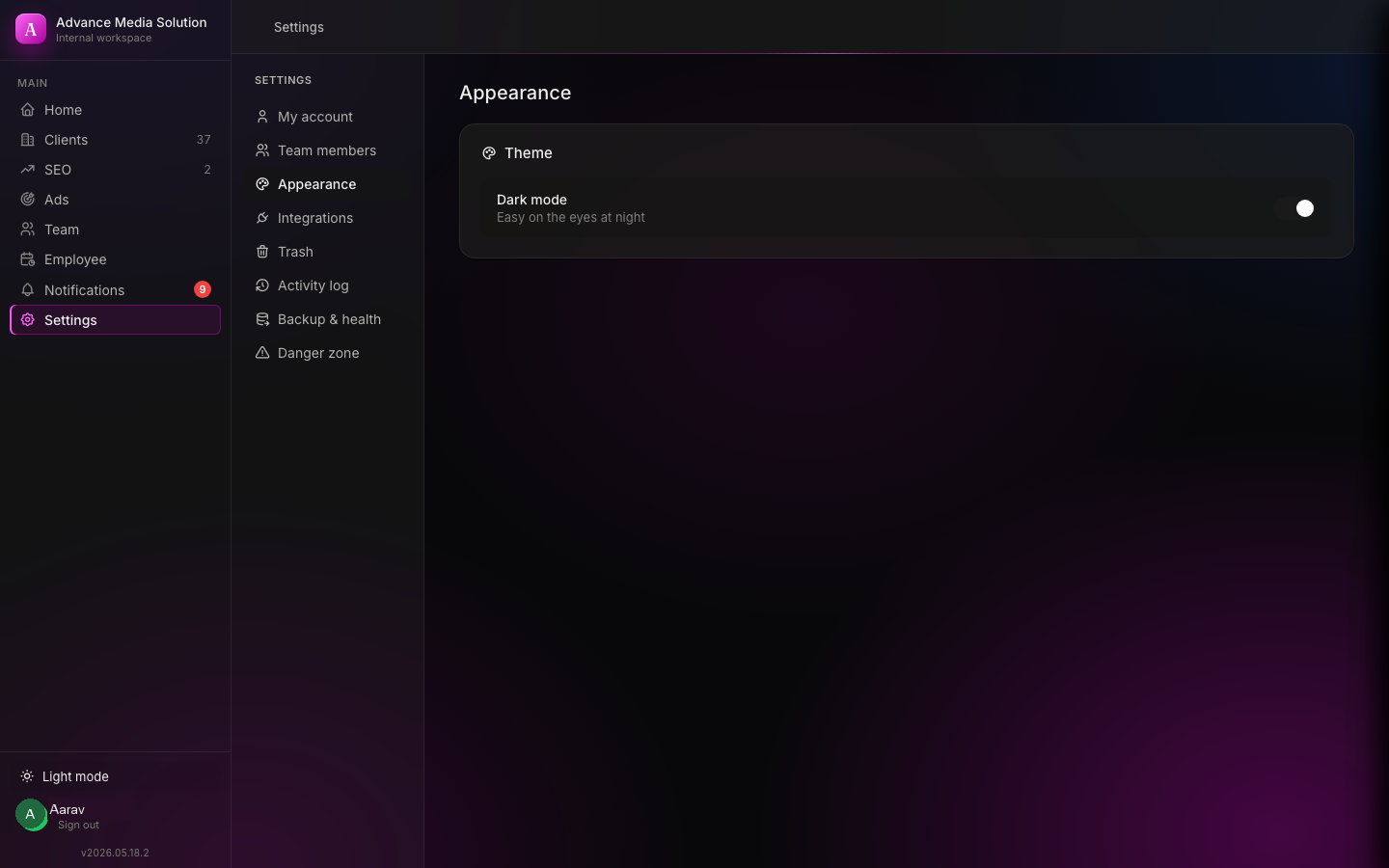
So the real pricing question isn't "what's the market rate?" — it's "what does an hour of my team's delivery cost, and which clients pay 2x that?" Two levers move the answer: raise the average (niche down, sell reels, serve metro clients remotely) and cut the delivery hours per client. The second is where agencies leak silently: approval chases on WhatsApp, manual posting at 9am, month-end report-making marathons, invoice follow-ups. That overhead is 30–40% of delivery time at most agencies I've seen, and it's exactly the layer we built agency management software to delete — approvals in a client app, auto-publishing, self-building reports, GST invoices that chase themselves.
The 60-second version
- Anchor on market bands: ₹15–50k freelancer, ₹30k–1.5L boutique, ₹1L+ full-service (upGrowth 2026).
- Price by the client's city tier, not yours — and let reels push you up a band.
- Use per-post rates (₹500–₹3,000 static, ₹3,000–₹15,000 reel) only for add-ons and one-offs.
- Work out delivery cost per client and quote at least ~2x it.
- Sell three packages; make the middle one the business you want.
- Quote "+ GST", expect TDS deductions, and never route ad spend through your books.
- Raise your average retainer before you raise your headcount.
FAQ
How much to charge for social media management per month in India?
For one platform with 12–15 posts, stories, replies and a monthly report, ₹15,000–₹25,000 a month is a fair tier-2 starting point, and metro clients support ₹25,000–₹40,000 for the same scope. Add reels, a second platform or ad management and you move into the ₹30,000–₹1,00,000 growth band. Always quote plus 18% GST.
How much should a beginner charge for social media management in India?
Start at ₹12,000–₹18,000 per month for one platform with 12–15 posts, community replies and a monthly report. Going below ₹10,000 attracts clients who churn fast and demand the most. Raise rates every two or three clients — your third client should never pay your first client's price.
How much should I charge per Instagram post or reel in India?
upGrowth's 2026 guide puts static posts at ₹500–₹3,000, carousels at ₹1,500–₹5,000 and Reels at ₹3,000–₹15,000 each in India. Use per-piece rates for add-ons and one-off projects, but sell monthly packages for retainers — per-post pricing invites clients to cut volume and haggle over every invoice.
Should ad spend be included in a social media management retainer?
No. Ad spend goes directly from the client to Meta or Google; you charge a separate management fee — commonly a flat ₹10,000–₹25,000 or 15–20% of spend at larger budgets. Mixing spend into your retainer makes you look expensive and eats your margin when budgets rise.
Do I need to charge GST on social media management fees?
Once your turnover crosses ₹20 lakh a year (₹10 lakh in special-category states), GST registration is mandatory and you add 18% to invoices. Registered business clients claim it back as input credit, so quote fees as amount plus GST from day one — never absorb it silently.
Charge more by delivering more, not working more
Approvals, auto-publishing, reports and GST invoicing in one login — the overhead layer, deleted. From ₹999/month, with a 7-day money-back guarantee.