Agencies bill at 18% GST and pay 18% GST on most of what they buy. The difference between those two numbers is your working capital, and I've watched agencies hand back one to two lakh rupees a year in credit they were entitled to — not through any aggressive interpretation, just through invoices in the wrong name and a deadline nobody diarised.
This is the operational version, written from an agency's expense sheet rather than a tax textbook. It is not a substitute for your CA, who should sign off on anything here before you act on it.
When can an agency claim input credit at all?
Section 16 of the CGST Act sets four conditions, and all four must hold:
- You hold a valid tax invoice carrying your GSTIN and the supplier's.
- You have actually received the goods or services.
- The supplier has declared it — the invoice must appear in your GSTR-2B, which only happens once they file their GSTR-1.
- You have filed the return in which you claim it.
Condition three is the one that bites. Your credit depends on someone else's compliance. The freelance video editor who invoices with GST but files their GSTR-1 late has, in effect, lent your money to the government. There is also a fifth rule people forget: pay your supplier within 180 days of the invoice date, or you must reverse the credit and re-claim it when you eventually pay.
What can a digital marketing agency actually claim?
The line that matters is whether the expense is an input to the taxable services you supply. Here's the expense sheet of a typical Indian social media agency, marked up.
| Expense | ITC? | The condition that decides it |
|---|---|---|
| Google Ads / Meta ads billed by the Indian entity | Yes | Your GSTIN must be entered in the ad account's billing settings before the invoice is generated. Add it retroactively and past invoices don't change. |
| Ads billed from a foreign entity (Ireland, Singapore) | Yes, via RCM | Import of service: you pay IGST at 18% yourself, then claim the same amount as credit. |
| Client's ad account, billed to the client | No | Not your invoice, not your credit. The client claims it. |
| Indian SaaS — scheduling, design, storage, accounting | Yes | Give the vendor your GSTIN at signup. Most Indian tools have a field for it in billing settings. |
| Foreign SaaS — Canva, Adobe, US schedulers | Yes, via RCM | Same import-of-service treatment as foreign ad spend. Cash-flow neutral if declared. |
| Freelancers and subcontractors with GSTIN | Yes | Only if they raise a proper tax invoice and file. Unregistered freelancers charge no GST, so there's no credit to claim. |
| Office or coworking rent | Yes | Landlord must be registered and charging GST on a tax invoice in the firm's name. |
| Laptops, cameras, phones, lights | Yes | Business use, invoice in the firm's name. Buying on a personal Amazon account forfeits it. |
| Internet and mobile bills | Conditional | Yes if the connection is in the firm's name with GSTIN registered. Personal postpaid bills, no. |
| Team lunches, snacks, client dinners | Blocked | Section 17(5) blocks food and beverages and outdoor catering. |
| Diwali hampers for clients, free samples | Blocked | Goods disposed of by way of gift or free sample are expressly blocked. |
| Agency car, cab rides, rent-a-cab | Blocked | Motor vehicles for passenger transport and rent-a-cab are blocked, with narrow exceptions. |
| Employee health insurance | Blocked | Unless providing it is obligatory for an employer under a law in force. |
The pass-through ad spend trap
This is the single biggest source of agency GST confusion, and it's worth getting right because it changes both your ITC and your TDS position.
Two structures, very different consequences:
Gross billing. The ad account is in your name, Google or Meta invoices you, you recharge the client. Your invoice to them shows agency fee plus media spend, and you charge 18% on the whole thing. You claim the credit on the ad invoice. Your topline looks bigger, your GST liability is bigger, and the two mostly cancel.
Net billing. The client's card sits on their own ad account, the platform invoices them directly, and you bill only your management fee with 18% on that. No ITC on ad spend for you — it was never your expense — and the client claims it themselves.
Both are legitimate. What is not legitimate is the hybrid I see constantly: the agency pays for the ads on its card, then bills the client a single lump figure described as "social media management" with no split. You've then collected money for media spend without recharging it as such, your ITC and your fee revenue are tangled in one line, and the client's CA cannot work out what to deduct TDS on. Pick a structure, write it into the retainer agreement, and show media spend as a separate line item on every invoice.
What kills claims in practice
Almost none of the credit agencies lose is lost on a point of law. It's lost on housekeeping. Four failure modes, in order of how often I've seen them:
1. The GSTIN wasn't in the ad account
Meta and Google both have a tax-information field in billing settings. If it's blank, invoices generate without your GSTIN, and an invoice without your GSTIN is not a document you can claim against. Agencies discover this in month nine, having spent ₹40 lakh of client budget. Audit every ad account you control this week — yours and any the client has given you admin on.
2. Reverse charge on foreign tools never got declared
A foreign subscription is an import of service. You're supposed to pay IGST on it under reverse charge and claim it back in the same return. Because it nets to zero, small agencies skip it entirely — which is a non-disclosure, not a saving. Total up your foreign card charges: schedulers, Canva, Adobe, storage, AI tools. Most agencies find ₹2–4 lakh a year of undeclared imports sitting there.
3. Nobody reconciled GSTR-2B
Your books say you paid GST on 60 invoices. GSTR-2B shows 51, because nine suppliers filed late or wrong. The Invoice Management System now lets you accept, reject or hold each invoice before it lands in your 2B, which is useful — but only if someone reviews it monthly. Set a recurring task for the 14th.
4. The 30 November deadline passed
Section 16(4) caps ITC for a financial year at the earlier of 30 November following that year, or the date you file the annual return. For FY 2025-26, the practical cut-off is the November 2026 GSTR-3B. Miss it and the credit is gone permanently — no appeal, no carry-forward. Diarise a full ITC reconciliation for October every year, not November, so there's a month to chase suppliers who haven't filed.
A five-line policy that protects the credit
- One business card for all agency spend. Personal cards break the invoice-name chain.
- GSTIN entered at signup for every tool and ad account, before the first rupee is spent.
- Media spend on its own invoice line, always, with the fee separate.
- Monthly 2B reconciliation on a fixed date, with a chase list for non-filing suppliers.
- Prefer GST-registered freelancers at similar rates — an unregistered ₹20,000 invoice costs you more than a registered ₹22,000 one once credit is counted.
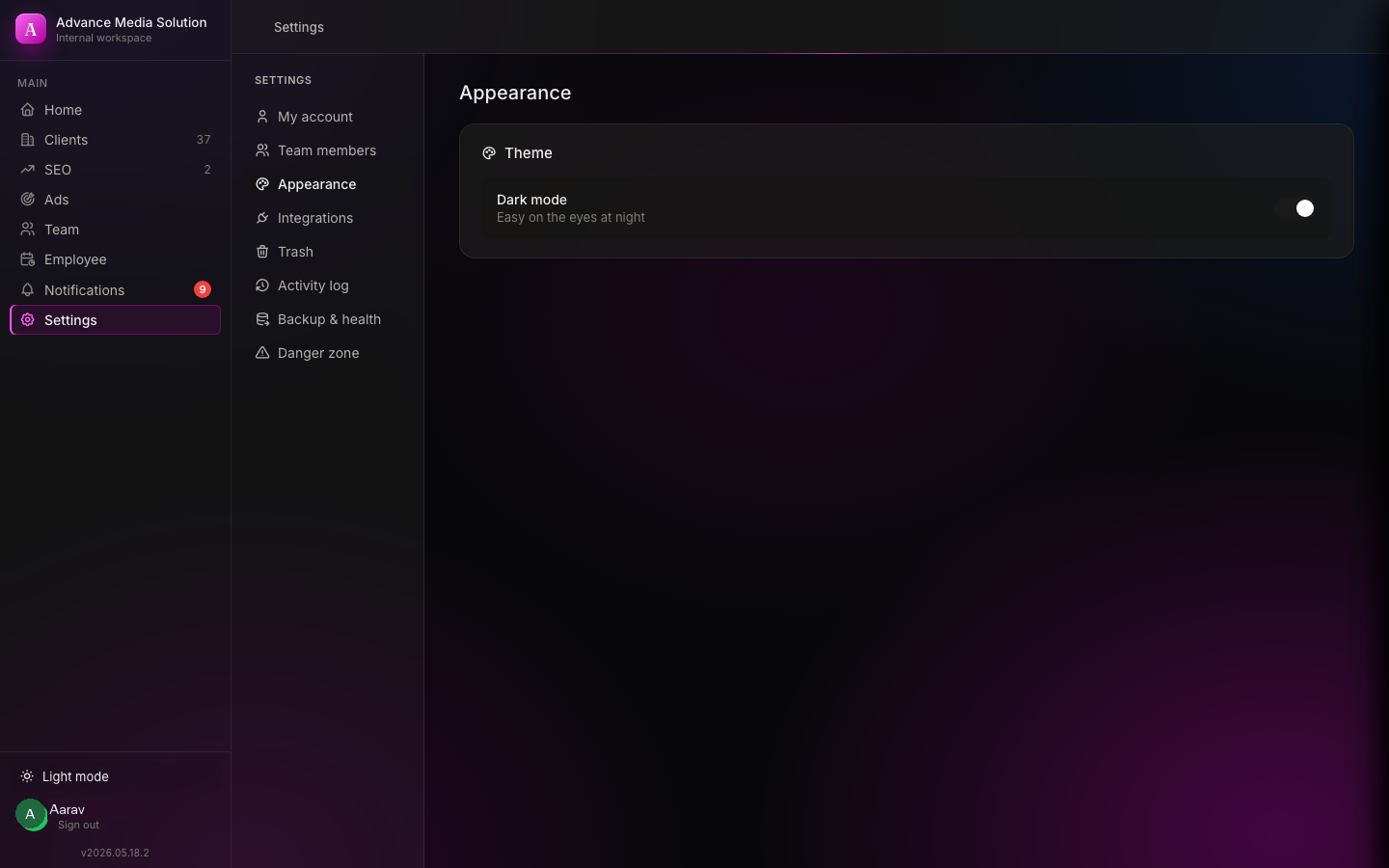
Structurally, most of this comes down to whether your invoices and expenses live in one place where a total can be pulled in a minute. If yours are spread across an invoicing app, a spreadsheet and a folder of PDFs, see how we handle GST-native invoicing inside agency management software, and read the companion pieces on GST invoicing for digital marketing services and when e-invoicing starts applying to you. Agencies scaling past the ₹20 lakh registration threshold in fast-growing markets — our Indore and Jaipur guides cover a few — usually hit these questions within their first two quarters of billing.
FAQ
Can a marketing agency claim GST input credit on client ad spend?
Yes, when the ad account is billed to the agency's own GSTIN and the ads are an input to a taxable supply you make onward. If the client's ad account is billed directly to the client, the credit belongs to the client. You cannot claim credit on an invoice that doesn't carry your GSTIN.
Is GST on foreign software subscriptions claimable?
Yes, but through reverse charge. A subscription bought from a foreign supplier is an import of service, so you pay IGST at 18% yourself in GSTR-3B and claim the same amount as input credit in the same return. It's cash-flow neutral — but only if you actually declare it.
What expenses are blocked for input credit under Section 17(5)?
Food and beverages, outdoor catering, club and gym memberships, rent-a-cab and most motor vehicles, employee health insurance unless legally mandated, and anything given away as a gift or free sample. Team lunches, Diwali hampers for clients and the agency car are the four that catch agencies most often.
What is the deadline to claim input tax credit for a financial year?
Under Section 16(4) of the CGST Act, the earlier of 30 November following the end of that financial year, or the date you file the annual return. In practice, the November GSTR-3B. Credit not claimed by then is permanently lost, with no appeal and no carry-forward.
Sources
- Section 16(4), CGST Act — time limit for availing ITC.
- GSTN revised advisory on the Invoice Management System (PDF) — accept, reject and pending actions feeding GSTR-2B.
- GST on Google and Facebook ads in India — Indian-entity billing vs reverse charge on imports.
Disclaimer: general information for agency owners, current as at September 2026. GST positions turn on facts and change with notifications — confirm your specific case with a chartered accountant before filing.
Invoices that already speak GST
Raise GST-compliant invoices with the fee and media spend split, track TDS deducted by clients, and pull a year of records for your CA in one export. Priced in rupees from ₹999/month.
Start Free Trial