Every "social media contract template" you can download is written for a US or UK agency. They are fine documents — for that jurisdiction. Drop one into an Indian engagement and three things happen: your intellectual property clause does the opposite of what you think, your non-compete is unenforceable, and your payment terms ignore the two deductions that actually determine what lands in your bank account.
I've signed retainers with brands across Uttarakhand, Rajasthan, Madhya Pradesh and Maharashtra. Almost every dispute I've had — and every one I've watched other founders have — traced back to one of the six clauses below. None of them were about creative quality.
I'm an agency founder, not a lawyer. Treat this as a checklist of what to raise with your advocate, not as legal advice. Statutory references are linked so you can read the section yourself.
What should a social media retainer agreement in India include?
Here's the short version, before the detail. Print this and check your current contract against it.
| Clause | What to actually write | Why it matters in India |
|---|---|---|
| Scope | Counted deliverables per month, revision rounds, what carries forward | "Social media management" is not a scope; it's an invitation to scope creep |
| IP assignment | Written assignment naming the works, rights, duration and territory | Copyright Act s.19 — omit duration and it lapses in 5 years |
| Payment | Fee + 18% GST, TDS on taxable value only, due date, late interest | Client deducts TDS whether or not your contract mentions it |
| Approval | A deadline plus a deemed-approval or reschedule fallback | Unapproved posts are the single biggest cause of missed calendars |
| Accounts & access | Client owns Business Manager and ad account; agency gets partner access | Password-sharing engagements end badly on both sides |
| Termination | Notice period, final invoice, credential handover list | Decides whether exit is a week or a three-month standoff |
| Restraint | Confidentiality and non-solicit — not a non-compete | Contract Act s.27 voids restraints on lawful trade |
The IP clause almost every Indian agency gets wrong
Under the Copyright Act, 1957, "the author of a work shall be the first owner of the copyright therein." There's a well-known exception in Section 17(c): for "a work made in the course of the author's employment under a contract of service", the employer is first owner "in the absence of any agreement to the contrary."
Note the phrase — contract of service, meaning employment. An agency on a retainer is on a contract for services. Read plainly, the reels, carousels, copy and design your studio produces do not automatically belong to the client just because they paid the invoice. They belong to you until you assign them.
And assignment is formal. Section 19 says: "No assignment of the copyright in any work shall be valid unless it is in writing signed by the assignor." It must "identify such work, and shall specify the rights assigned and the duration and territorial extent of such assignment." Then two defaults that catch people out:
- Section 19(5): "If the period of assignment is not stated, it shall be deemed to be five years from the date of assignment."
- Section 19(6): "If the territorial extent of assignment of the rights is not specified, it shall be presumed to extend within India."
So a vague line like "all content shall belong to the Client" is a five-year, India-only assignment. If that client is a jewellery brand that runs your creative in a Dubai campaign in year six, the paperwork does not say what everyone assumed it said.
What I write now, on both sides of the table: assignment is perpetual, worldwide, on receipt of full payment for that month's invoice. That last part is the leverage — delivered-but-unpaid content stays yours, a far more civilised remedy than a legal notice, and it pairs with the recovery route in our post on handling late-paying agency clients. Carve out your own reusable assets too — templates, presets, internal tooling — so you're not accidentally assigning your studio's toolkit to a ₹40,000-a-month client.
Why your non-compete clause is probably void
Indian founders copy non-compete language from American contracts constantly. Section 27 of the Indian Contract Act, 1872 is one sentence: "Every agreement by which any one is restrained from exercising a lawful profession, trade or business of any kind, is to that extent void."
There's a narrow exception for the sale of goodwill of a business, with reasonable local limits — not for ordinary service contracts. So a clause saying you won't work with any other brand in your client's category for two years after termination is, in the ordinary case, not going to help you. Worse, a client's lawyer will use its presence to argue your whole document is boilerplate you never read.
Three things do work, and I'd rather have them than a decorative non-compete:
- Confidentiality — strategy documents, audience data, pricing, unpublished campaigns. Protecting genuine confidential information and trade secrets is treated differently from restraining trade.
- Non-solicitation of personnel — neither side hires the other's staff during the term and for a defined period after. This is the one that actually matters; the most common way an agency loses money is a client hiring the designer who worked on their account.
- Exclusivity during the term — a reasonable restriction that operates while the engagement runs, rather than after it ends, sits on much firmer ground.
How should payment terms be written under GST and TDS?
Two deductions sit between your rate card and your bank balance, and a retainer that ignores them creates a monthly reconciliation argument.
GST. Write "Fees are exclusive of GST, which shall be charged at the applicable rate" rather than hard-coding 18% — rates change, contracts don't. The mechanics are in our guide to GST invoices for digital marketing services.
TDS. Your client will withhold tax and pay you net. That's their statutory duty, not a slight, and you claim the credit. Two things must be in the contract: that TDS is deducted on the taxable value only, not on the GST component, and that the client furnishes the withholding certificate within a stated number of days. Chasing certificates in the last week of a filing quarter is a self-inflicted wound. See TDS on digital marketing services for the current section references, which changed with the new Income-tax Act.
Due dates and interest. "Payable within 30 days of invoice" plus a stated interest rate on overdue amounts. If your agency is registered on Udyam as a micro or small enterprise, the MSMED Act adds a statutory timeline and interest that operate regardless of what your contract says — a lever most clients' accounts teams recognise immediately.
Ad spend. Decide explicitly: is media spend passed through the client's own card, or billed via you? If it routes through you, say whether your fee is a flat retainer or a percentage of spend, and treat reimbursed spend separately on the invoice — getting this wrong inflates your turnover on paper and your GST liability with it. Our note on what to charge for social media management in India covers where a percentage-of-spend model makes sense.
Scope: write deliverables as numbers, not adjectives
"Comprehensive social media management" has cost me more money than any other phrase in this business. A scope clause should be countable enough that a stranger could audit it:
- 12 static posts, 8 reels, 20 stories per month — not "regular content".
- Two rounds of revisions per deliverable, with anything beyond that billed at a stated per-item rate. This single line ends the endless-revision problem.
- Unused deliverables do not carry forward — or carry forward for exactly one month. Say which. Otherwise you'll be asked in March to produce January's unused reels on top of March's.
- What is explicitly excluded: influencer fees, paid media budget, photoshoot and travel costs, third-party stock or fonts, festival campaign design outside the monthly count.
- Turnaround times both ways — yours for drafts, theirs for feedback.
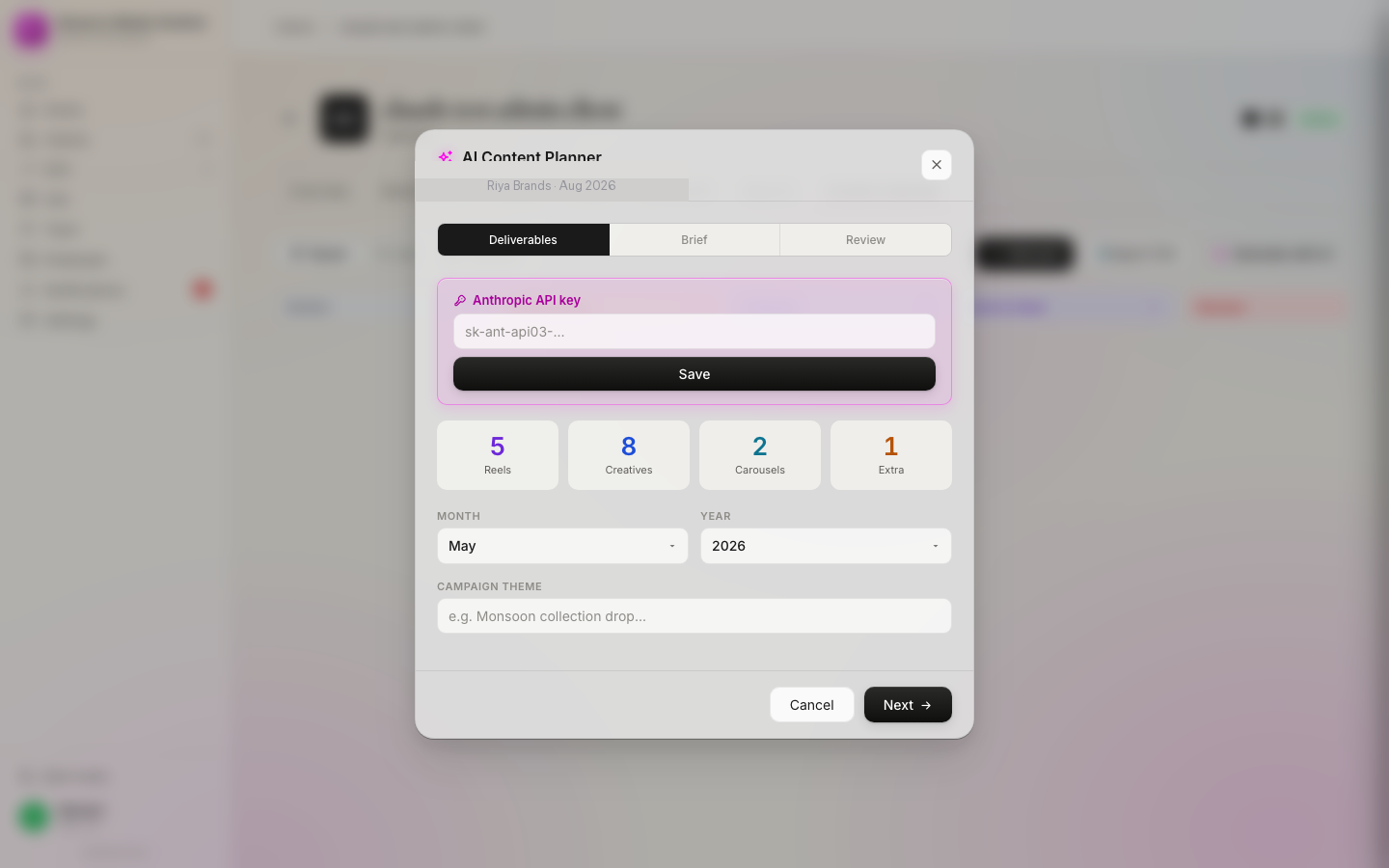
The contract writes the number; the calendar enforces it. If your scope lives only in a PDF nobody opens after signing, you'll over-service by 30% and call it "client relationship".
The approval deadline clause nobody writes
Here's a clause I've never seen in a downloadable template, and it's the one that saves the most calendar slots.
Content goes for approval by a stated date. The client has a stated window — say 48 hours — to approve or request changes. If that window passes with no response, one of three things happens, and your contract must pick one: the post is deemed approved and publishes; the post is held and rescheduled into the next available slot; or the post counts against the month's deliverables regardless of whether it went live.
Most Indian agencies operate on an unwritten fourth option — chase on WhatsApp until someone replies — which is why the calendar slips. Name a single approver and a backup in the contract, because "the client" is usually three people who each think another one is handling it. The workflow side of this is in getting faster client approvals.
Who owns the ad account and the logins?
State plainly that the client owns their Meta Business Manager, Page, Instagram professional account, ad account and any domain or pixel, and that the agency is granted partner or role-based access for the term. Never build an engagement on shared passwords — for the safety argument, see auto-posting without password sharing.
Then add the reverse: assets created inside your systems — the content calendar, your report templates, your internal briefs — are yours, and what the client receives on exit is a defined export, not a login to your workspace. Both halves of that sentence prevent a fight.
Termination and the handover list
Thirty days' written notice from either side is the Indian market norm and it's reasonable. What matters more is what the notice period triggers, because "we're parting ways" is where goodwill evaporates fastest. Write the exit as a list:
- Final invoice raised for work completed and work in progress, payable within the standard term.
- All client-owned account access transferred back or agency roles removed, within a stated number of days.
- Approved content assets delivered in agreed formats — say where, say the format.
- Assignment of copyright confirmed for everything paid for; unpaid work explicitly not assigned.
- Confidentiality survives termination. Say so, or it arguably doesn't.
Add a jurisdiction clause naming your city's courts, and consider arbitration by a sole arbitrator seated there. For a ₹40,000-a-month retainer, the practical value of these clauses isn't litigation — nobody litigates a ₹40,000 dispute. It's that a clean clause ends the argument before it becomes one.
Can you sign a retainer electronically in India?
Yes, and you should. The Information Technology Act, 2000 carves out a specific list of documents in its First Schedule to which the Act does not apply — wills, trust deeds, most negotiable instruments, certain powers of attorney. An ordinary services agreement is not on that list, so it can be executed electronically like any other commercial contract.
Practically: an Aadhaar-based eSign or a documented e-signature flow closes contracts in a day instead of the courier-and-scan ritual that costs Indian agencies a week per client. Stamp duty is state-specific and varies, so check the rate for the state you're contracting in rather than assuming — that's the one part of this I'd hand to a professional every time.
The contract is also the natural start of onboarding: signature, then the brand brief, then credentials into a vault, then the first calendar. When those are four separate tools, clients feel the seams. When they're one flow, you look like a company twice your size — which is the whole point of running your agency on one system, whether you're in Jaipur or Bengaluru.
Frequently asked questions
Does my client automatically own the content my agency creates?
No. Under the Copyright Act 1957 the author is the first owner, and the employer-owns-it rule in Section 17(c) applies to employment under a contract of service, not to an agency engaged as an independent contractor. Ownership passes only through a written assignment under Section 19.
Is a non-compete clause enforceable in an Indian retainer?
Post-termination non-competes are generally not enforceable. Section 27 of the Indian Contract Act 1872 says every agreement restraining anyone from exercising a lawful profession, trade or business is void to that extent. Confidentiality and non-solicitation of staff are the clauses worth drafting instead.
Can a social media retainer be signed electronically in India?
Yes. A services agreement is not among the documents excluded from the Information Technology Act 2000 by its First Schedule, so it can be executed electronically. Wills, trust deeds and most negotiable instruments still need wet ink, but an ordinary retainer does not.
Contracts, onboarding and invoices in one place
Send the agreement, collect the brand brief, store credentials in a vault, then run the calendar, approvals and GST invoicing for that client — from one login. Founding pricing from ₹999/month, with a 7-day money-back guarantee.