At 10:40 one night, a client sent a voice note to one of our video editors. She was 23. He called her "useless" and said a reel had "wasted his whole day". She didn't tell anyone. A week later I heard it by chance, because she was playing it to a colleague and asking whether she should quit.
We didn't fire that client. He paid on time, the account was large, and to be honest the reel did have a problem. But how we worked with him changed that week, and he never had direct access to a junior again. This post covers that middle ground: the client stays, and your team stops being the target. If you've already decided the account has to go, read how to fire a bad client without burning your agency's name instead.
What counts as abuse, and what is just a demanding client?
Get this line right first. If you call every tough client abusive, your team stops trusting the policy. If you call nothing abusive, they stop trusting you. Our test: harsh about the work is fine; harsh about the person is not.
| Demanding (handle it as a business issue) | Abusive (handle it under the policy) |
|---|---|
| "This reel is weak, the hook is too slow." | "You're useless, who hired you?" |
| Tight deadlines that are in the contract | Calls or voice notes to a staff member's personal number at 11 pm |
| Lots of revisions (bill them as add-ons) | Shouting or swearing on calls, or in a WhatsApp group in front of others |
| Asking to escalate to the founder | Threats: "I'll get you fired", "I'll ruin your agency's name" |
| Disagreeing with the strategy | Comments about someone's looks, gender, caste, religion or accent |
| Being curt or impatient | Anything sexual, ever. That goes to a separate legal route (see below) |
Most items in the left column can be fixed with process: written scope, a revision limit, and an add-on price list. Nothing in the right column can, which is why it needs a policy.
Why do agencies let abusive clients get away with it?
Because the client pays. Mark Pollard said it plainly in a Campaign column on abusive client behaviour: leaders often won't call out a client because the agency depends on that client's money. In his informal survey of agency people, over 80% said a client had moved the goalposts on a project in a toxic way.
Indian agencies add some extra pressure of their own:
- The client is "sir". Many of our clients are founders or family-business owners twenty years older than the person making their reels. Juniors find it hard to push back on someone senior.
- Personal WhatsApp numbers. Once a client has your designer's number, the working day never really ends. Most of the abuse I've seen arrived after 9 pm.
- "Thick skin" culture. New hires get told that handling a difficult client is part of the job. So they say nothing until the day they resign.
The founder's job is to take that cost onto the agency and off the individual. A policy is how you do that consistently, on days when you're busy too.
What should a written abusive-client policy say?
One page, in plain language, shared at onboarding and pinned in your team chat. Ours has eight points:
- The definition. The right-hand column above, in your own words.
- Working hours and channels. Clients reach the team between 10 am and 7 pm IST on the agency's business number or the client portal. Staff never share their personal numbers, and they're never required to answer after hours. Real emergencies go to the account lead.
- The right to pause. Anyone can end a call or step out of a chat that turns abusive, using the script below, without asking first. Nobody is ever penalised for using it.
- Report the same day. Send it to the account lead or founder, with screenshots or the voice note. Write down what happened, not how bad it felt.
- The escalation ladder. Who does what after the first, second and third incident (table below).
- Contact changes. After an incident, a senior person becomes the only contact for that client. The junior keeps working on the account but stops dealing with the client directly.
- Records. One incident log per client, kept by the founder. It's dull, and it's the evidence you'll need if you ever exit the account.
- Sexual harassment is separate. It goes straight to your Internal Committee and is never "managed" through the account.
Then put the client's side of it in the contract. A short mutual-respect clause in your retainer agreement works: both sides communicate professionally, through the agreed channels, during the agreed hours, and repeated abusive conduct is grounds for termination on notice. That way, when you raise an incident, you're pointing to something they signed, not giving your own opinion.
The escalation ladder
| Stage | What happens | Who acts |
|---|---|---|
| First incident | The staff member pauses and reports. The account lead calls the client within 24 hours: feedback on the work is welcome, but not like that. The junior comes off direct contact. | Account lead |
| Second incident | The founder calls, then confirms in writing with a reference to the contract clause. All communication now goes only through the account lead. | Founder |
| Third incident, or any threat | A formal written warning, and you start planning the exit. Follow the notice and handover steps in the fire-a-client guide. | Founder |
| Physical threat or sexual misconduct | Skip the ladder. Support the employee, go through the Internal Committee or the police, and stop all contact between that client and the staff member. | Founder + IC |
A ladder matters because it takes the decision out of the moment. Without one, what happens depends on how much the founder needed that month's payment, and your team will notice.
What should staff actually say? (scripts)
People freeze when they're being shouted at. Give them the words in advance.
In a WhatsApp group: Don't reply in the heat of it. Send one line: "Noted. [Account lead] will come back to you on this today." Then screenshot the thread and report it.
Account lead to the client, next day: "We value working with you, and your feedback on the work is always welcome. We'll act on it. But I do need to raise how [name] was spoken to on [date]. We can't have the team spoken to like that. From now on, please bring anything urgent straight to me."
Notice what the client script doesn't do. It doesn't argue about whether the reel was good, and it doesn't apologise for the work. One call, about one thing.
Change the channel, not just the tone
Most abusive behaviour comes through easy, unrecorded, 24x7 access, usually a personal WhatsApp. Making that access harder does more than any warning. Move day-to-day feedback off personal numbers and onto a shared business number, and put content approvals somewhere every comment is tied to a specific post and kept on record. We've written about the trade-offs in WhatsApp vs a client portal for agency communication.
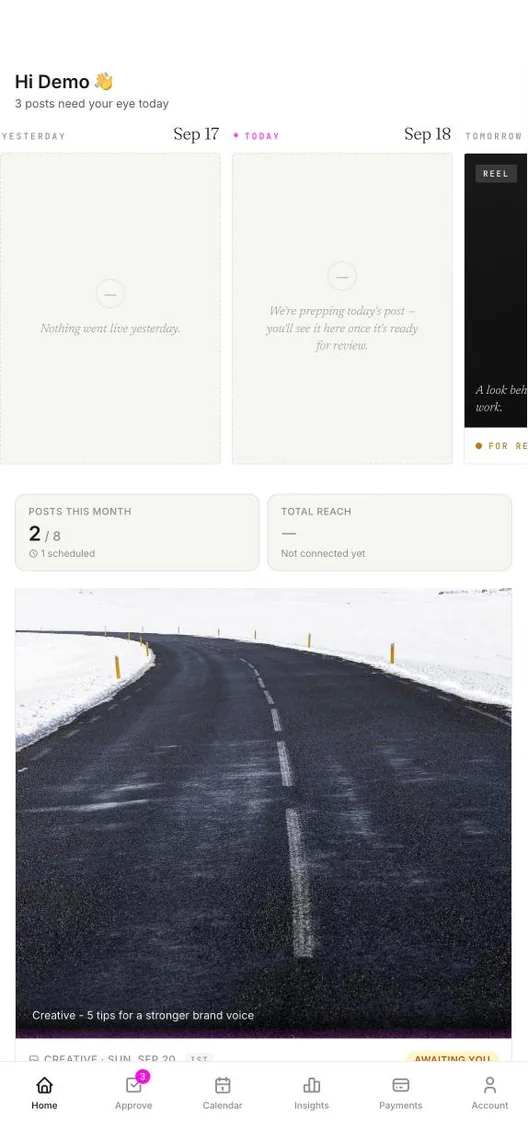
There's a side benefit we didn't expect. Clients write calmer comments when the comment sits under the post, in a place where their own team can also see it. A 10 pm voice note feels private to the sender. A comment on a post doesn't.
What does Indian law say about harassment by a client?
For sexual harassment, the law is clear that a client isn't outside your responsibility. Under Section 19(a) of the Sexual Harassment of Women at Workplace Act, 2013 (the POSH Act), every employer must provide a safe working environment, including "safety from the persons coming into contact at the workplace". Section 19(h) has the employer start legal action against the perpetrator, and it specifically covers cases where the perpetrator is not an employee, if the woman wants that. The Act's definition of "workplace" also includes places an employee visits in the course of work, so a shoot at the client's store or a meeting at their office counts.
In practice: if you have ten or more employees, you need an Internal Committee and your team needs to know it exists. If you're smaller, complaints go to the Local Committee in your district. Either way, a complaint against a client is still your problem to handle. You don't get to wave it away because the client is a customer.
For non-sexual abuse, such as shouting, insults and threats, your main tool is the contract, not the courts. Serious threats can amount to criminal intimidation under the Bharatiya Nyaya Sanhita, and a physical threat is a police matter. This is general information, not legal advice. Talk to a lawyer before you take formal action.
Look after the person, not just the account
The policy protects the next person. The one it already happened to needs something different:
- Debrief the same day. Ten minutes, and the founder is there. Say clearly that it wasn't their fault and that the agency is dealing with it.
- Never punish them for it. Don't take them off good accounts or count the incident against them in their review. Taking them off direct contact with the client is protection, so tell them that's what it is.
- Count the load. A hostile account uses up far more energy than the hours show. Weight it when you plan capacity. Our guide on how many clients one social media manager can handle explains how.
- Write it into your SOPs. The policy belongs next to your other agency SOPs, so it survives when the person who wrote it leaves.
Frequently asked questions
Should an agency fire a client who abuses its staff?
Not always on the first incident. Raise it once, firmly, take the junior off direct contact and confirm it in writing. If it happens again after a clear warning, or it involves a threat or anything sexual, exit the account. A retainer is never worth losing good people or your team's trust in you.
Can a social media manager refuse to talk to an abusive client?
They should be able to pause a call or step out of a chat that turns abusive, and hand it to their account lead, without asking first. A good agency policy says so in writing and promises no penalty. They shouldn't be dropped from the account, just from direct contact with that client.
Does the POSH Act cover harassment by a client in India?
Yes. Section 19 of the POSH Act requires employers to provide safety from people who come into contact with the workplace and to start action against a perpetrator who is not an employee if the woman wants that. Client meetings and shoots count as the workplace. Complaints go to your Internal Committee.
How do you tell a client their behaviour is unacceptable?
Have the account lead or founder call the next day, not the person it happened to. Thank them for their feedback on the work, name the specific incident and date, and say the team can't be spoken to that way. Ask them to bring anything urgent to you directly. Confirm it in a short email.
Sources
- India Code — The Sexual Harassment of Women at Workplace (Prevention, Prohibition and Redressal) Act, 2013: Section 19(a) and 19(h) on employer duties, including where the perpetrator is not an employee; Section 4 on the Internal Committee.
- Campaign Asia — Mark Pollard, "Why is it so hard to speak out about abusive client behaviour?": why the power balance stops agencies speaking up, and survey responses from agency staff.
- dvm360 — Solutions for abusive clients: a written policy that defines unacceptable conduct, plus an ask, repeat, then hand-to-a-manager response for frontline staff.
- The policy, ladder and scripts above come from our own agency practice. Adapt them to your team and contracts.
Keep client feedback out of your team's personal WhatsApp.
Client calendars, one-tap approvals in a client portal, auto-publishing to Instagram, monthly reports and GST invoices with payment links, all in one login. Priced in rupees, from ₹999/month, with a 7-day money-back guarantee. See the agency management software and the Instagram scheduler.