I have sat in a lot of first meetings with small business owners. A boutique in Dehradun, a dental clinic in Lucknow, a machine-parts trader in Ludhiana. The conversation opens the same way almost every time: "We posted for three months and nothing happened."
Then I ask to see the account, and it is always one of three things. They posted twelve times in the first two weeks and twice since. Or they posted consistently but every post was a product photo with a price. Or — most common — they got enquiries and never noticed, because nobody was counting.
This is a plan for avoiding all three. It is written from the agency side of the table, which means it will also tell you honestly when you do not need an agency.
Why does social media matter more for Indian small businesses than for Western ones?
Because the discovery behaviour is different. In most Western markets a small business is found through Google and reviewed on a website. In India, an alarming share of buying decisions start and end inside Instagram and WhatsApp — someone sees a reel, taps the profile, taps the WhatsApp button, and asks "price kya hai?" The website, if it exists at all, is never opened.
The scale backs this up. India is Instagram's largest market on earth: NapoleonCat's July 2026 data counts roughly 551 million Instagram users in India, around 37% of the population, and other trackers put the figure at 472 million or higher. Either number means your customers are already there. Meanwhile Indian social media usage grew about 5% over the last two years while global usage slightly declined — the attention is still moving toward these platforms here, not away.
So the question is never "should we be on social media." It is "what is the smallest version of this we can actually sustain."
Pick one platform. Genuinely one.
The single most expensive mistake I see is a small business opening Instagram, Facebook, LinkedIn, YouTube and X in the same week. Five half-dead accounts signal a dead business more loudly than no account at all.
| Your business | Start here | Why |
|---|---|---|
| Retail, food, salon, boutique, café | Visual, local, reels reach non-followers | |
| Clinic, lawyer, CA, consultant | Instagram + Google Business | Trust content + local search intent |
| B2B, manufacturing, SaaS, exports | Buyers research on LinkedIn, not IG | |
| Real estate, interiors, weddings | High-consideration, portfolio-driven | |
| Coaching, education, admissions | Instagram + YouTube | Long-form builds authority, reels bring reach |
Add a second platform only after the first one is producing enquiries every week without you thinking hard about it. That usually takes four to six months. Nobody wants to hear this, and it is still true.
What should a small business actually post?
Here is the mix that has worked across the brands we run, expressed as a simple weekly rhythm. Four posts a week, one from each bucket:
- Proof. A finished job, a happy customer, a before-and-after, a delivery going out. This is the post that converts. Most businesses under-post it because it feels like bragging.
- Teach. Answer one real question you get on WhatsApp every week. A dentist explaining why a root canal costs what it costs. A trader explaining how to spot a fake bearing. This is what earns saves and shares.
- People. Your team, your workshop, your morning. India buys from people, not logos — especially in tier-2 and tier-3 cities where the owner is the brand.
- Offer. One clear, dated, specific ask. "Festive package, ₹4,999, book by the 30th." One in four posts, no more.
Format matters as much as topic: short vertical video consistently out-reaches static images on Instagram, because reels are shown to non-followers and static posts largely are not. You do not need a camera. A phone, natural light, and a clip under 20 seconds beats a designed static almost every time.
How many posts, and how do you keep it up?
Three to five posts a week, held for six months. That is the whole answer. The trap is that motivation is highest in week one, when you have the least idea what works — so you burn your best energy on your worst content.
The fix is batching, not discipline. Sit down on the 25th of the month and plan the next month in one sitting: topics, festival dates (Indian calendars run on festivals — block Diwali, Raksha Bandhan, regional new years first), and who shoots what. Then produce in two or three sessions instead of daily panic. When we onboard a brand, this is literally the first process we install, before any tool.
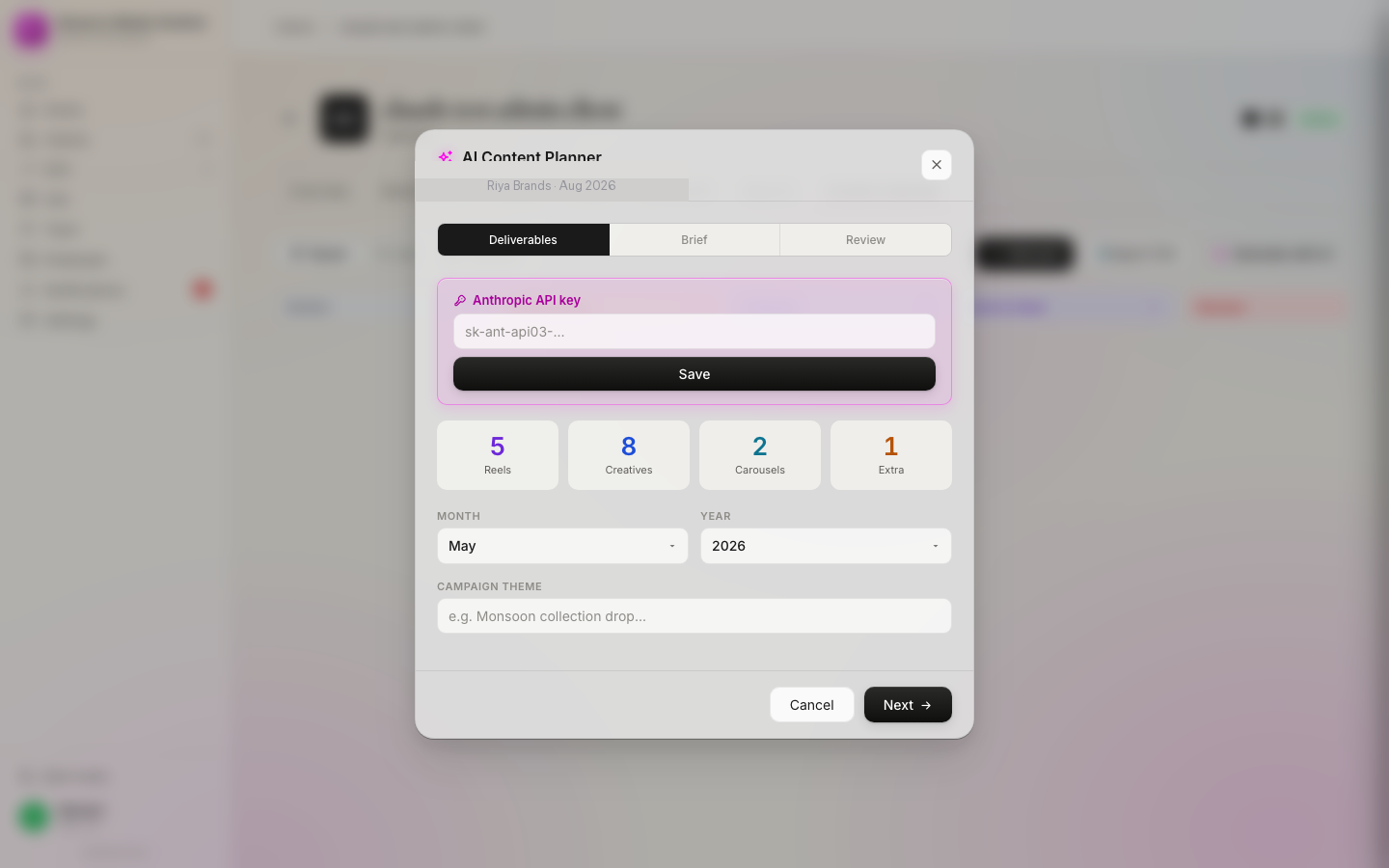
If you are doing this yourself, a shared Google Sheet is enough for the first three months. Past that, when there are two or three people involved and posts start slipping, a proper calendar with approvals earns its keep. That is the same jump agencies make when they move from spreadsheets to an agency management platform — the tool does not create discipline, it just stops good intentions leaking.
What does it cost in India in 2026?
Two honest columns — cash and time. You will pay in one or the other.
| Approach | Monthly cash | Monthly time | Best for |
|---|---|---|---|
| Fully DIY (owner posts) | ₹0–3,000 | 20–30 hrs | First 6 months, learning the audience |
| Freelancer (content only) | ₹8,000–15,000 | 6–10 hrs | You have direction, need hands |
| Agency starter plan | ₹15,000–25,000 | 2–4 hrs | Organic content, consistent output |
| Agency growth plan | ₹25,000–50,000 | 2–4 hrs | Social + email + basic automation |
| With Meta/Google ads | ₹50,000–1,00,000+ | 3–5 hrs | Proven offer, scaling demand |
Those agency bands line up with what published Indian rate cards quote for 2026 — one 2026 India guide puts starter plans at ₹15,000–25,000/month and growth plans at ₹25,000–50,000. If you want the view from the other side of the invoice, we broke down what agencies actually charge for social media management in India and why the same deliverables vary 3x in price.
One warning about the ₹5,000/month offers that flood your DMs: at that price, one person is running twenty accounts from a template. You will get posts. You will not get a strategy, and you will not get someone who knows your festival season.
Measure enquiries, not followers
The most common reason a small business concludes "social media doesn't work" is that they measured the wrong thing for three months. Followers are the vanity metric that gets tracked because it is the easiest to see.
Track these instead, on a single sheet, once a week:
- WhatsApp enquiries that mention Instagram. Ask every enquirer "where did you find us?" — one question, enormous signal. If you use a click-to-WhatsApp link in bio, you can attribute this automatically.
- Profile visits and link taps from Instagram Insights — these move before follower count does, and they move first when content starts working.
- Saves and shares per post. Reach is borrowed; saves are intent. A post with 800 reach and 40 saves is a better post than one with 5,000 reach and 3 saves.
- Walk-ins or calls attributed to social, if you are a physical business. Just a tally on paper at the counter works.
Give it six months before judging. Two months of data on a new account tells you almost nothing except whether you kept your posting promise.
When is it time to hire an agency?
My honest test, as someone who sells the service: hire when the bottleneck is production, not ideas.
If you do not yet know what your audience responds to, an agency will guess on your behalf, expensively. Do it yourself for a few months first — the knowledge you gain is the brief you will eventually hand over, and it is worth more than the polish you are buying. But once you know what works and simply cannot shoot, edit, write, schedule and reply while also running the business, that is exactly the moment outsourcing pays. Same logic applies if you are the agency: the point you start hunting for a scheduler that publishes for every client automatically is the point manual posting stopped being the cheap option.
When you do hire, ask three questions: who exactly writes the captions, what happens if a post underperforms, and can you see the calendar before it goes live. Any agency that cannot answer the third one clearly — with an actual client-facing calendar and approvals, not a WhatsApp forward — is running on hope. Good agencies in markets like Dehradun and Lucknow now show you the month in a portal before a single post is published, and you should expect that as standard.
The 30-day starter, if you want to begin tomorrow
- Days 1–2: Fix the profile. Clear bio saying what you sell and where, click-to-WhatsApp link, highlights for price/FAQ/reviews, business account switched on.
- Days 3–5: Write down the ten questions customers ask you most. That is ten weeks of "teach" content, already solved.
- Days 6–8: Shoot in bulk. Twelve short clips, one afternoon, phone camera, daylight.
- Days 9–10: Build the month's calendar — four posts a week, one from each bucket, festival dates blocked.
- Days 11–30: Publish on schedule. Reply to every comment and DM within a day. Log every enquiry and where it came from.
Then repeat. The second month is where most businesses quit and where almost all the compounding lives.
Frequently asked questions
How much does social media marketing cost for a small business in India?
Published Indian agency rate cards put starter social plans around ₹15,000–25,000/month for organic content, rising to ₹25,000–50,000 when email and automation are added. Doing it in-house costs less cash but roughly 20–30 hours a month of someone's time, which is rarely free.
How many times a week should a small business post?
Three to five posts a week, sustained for six months, beats fifteen posts in one enthusiastic week followed by silence. Pick a cadence you can hold through your busiest season — the algorithm rewards consistency, and your audience notices gaps far more than volume.
Which social platform should an Indian small business start with?
Instagram for anything visual or local consumer-facing, since India is Instagram's largest market by user count. LinkedIn if you sell to businesses or professional services. Start with one platform, get it working, and only then add a second.
Should I hire an agency or do social media myself?
Do it yourself while you are still learning what your audience responds to — that knowledge is worth more than polish. Hire an agency once you know what works and the bottleneck is production capacity rather than ideas, usually around the point where social is generating real enquiries.
Running social for clients, not just yourself?
My Digital Sevak gives agencies one calendar for every brand, client approvals in a portal, auto-publishing to Instagram and GST invoicing in one login. 7-day free trial, from ₹999/month for your whole team.
Start Free Trial