Every explainer on this topic is written for the influencer. That is the wrong reader. In an Indian agency, the person who actually decides whether a post gets a label is the account manager who wrote the brief, the designer who laid out the Reel, and whoever hits approve at 11pm. The Advertising Standards Council of India (ASCI) knows this, which is why its guidelines name the advertiser as jointly responsible. I have run 63+ brand accounts, and the honest confession is that I read the guidelines properly only after a client's gifted-PR post got flagged. This is the version I wish someone had handed me then.
What do the ASCI influencer guidelines actually require?
The guidelines came into force on 14 June 2021 and have been amended twice since: in August 2023 for health and finance content, and by an Addendum dated 7 April 2025 that narrowed those rules to technical advice. The core text is short and worth reading in the original (ASCI's own PDF). Here is the operating summary.
The trigger is a material connection, not money
ASCI defines a material connection as any connection between advertiser and influencer that may affect the weight or credibility of what is said. Its own list of examples includes monetary or other compensation, free products with or without conditions attached, products received unsolicited, discounts, gifts, contest and sweepstakes entries, trips, hotel stays, media barters, coverage, awards, and any family or employment relationship. The guidelines add that disclosure is needed even when the review is unbiased or fully the influencer's own idea. The one carve-out is a product someone bought themselves and happens to like, with no connection at all.
The label must be somewhere a scrolling thumb will see it
Clause 1.2 says disclosures are likely to be missed if they appear only on a profile page or bio, at the end of a post or video, or anywhere that needs a tap on More. They must not be buried in a group of hashtags or links. Using the platform's own tool, such as Instagram's Paid Partnership tag, is to be treated as an addition to the influencer's own label, not a replacement. Stories and any post without text need the label superimposed on the image or video itself.
Video has a clock on it
| Format | What ASCI requires |
|---|---|
| Video of 15 seconds or less | Label on screen for at least 3 seconds |
| Video between 15 seconds and 2 minutes | Label on screen for one-third of the video's length |
| Video of 2 minutes or longer | Label on screen for the entire section in which the brand or its benefits are mentioned |
| Live stream | Announced at the beginning and the end; label added to the caption if the post stays up afterwards |
| Audio (podcasts, audio rooms) | Announced at the beginning, the end, and before and after every break |
| Story or image-only post | Label superimposed on the picture or video, clearly visible |
The permitted labels
Clause 1.3 lists exactly what counts, and says any one or more can be used: Advertisement, Ad, Sponsored, Collaboration, Partnership, Employee, Free gift, Affiliate, the Paid Partnership tag on Instagram, and the Includes Paid Promotion tag on YouTube. The label may be in English or in the language of the ad itself. Notice what is not on the list: a brand tag on its own, a thank-you line, or an emoji. Notice also that Collaboration is on it, which several agency blogs get wrong when they tell you #collab always fails. The word is fine. It fails on placement far more often than on wording.
Why is this the agency's problem and not the influencer's?
Clause 1.5 is the sentence to read twice. Responsibility for the disclosure and for the content of the ad sits on the advertiser for whose product it is, and also on the influencer. Where the advertiser has a material connection with the influencer, the advertiser's responsibility is to ensure the post is in line with the ASCI code, and the advertiser shall, where needed, call upon the influencer to delete or edit the post or the label.
Read that as an agency. Your client is the advertiser. You are the one who briefed the creator, approved the draft, and in most Indian engagements also manages the brand's own handle that reposts or collabs on the content. When a complaint lands, it lands on the brand, and the brand's first call is to you. The Addendum makes the burden concrete: if a brand disputes that a post is an ad at all, ASCI wants a signed declaration from a senior person at the advertiser, such as the marketing or legal head, stating there was no material connection on the date of the post. That is a document your client will expect you to have the facts for.
Three situations trip agencies up because they do not feel like influencer marketing:
- PR seeding and barter. Most micro-creator work in India is gifted product, not a cheque. ASCI treats unsolicited free product as a material connection, so a creator's unprompted Story about the hamper needs a label, and your client's brief should say so.
- Giveaways and contests. Contest and sweepstakes entries are on ASCI's list. A creator posting to enter your client's giveaway has a material connection.
- Employee and founder accounts. Employment is on the list too. A staff member posting about the product from a personal handle needs the Employee label. The founder's personal brand account is the most common uncaught case I see.
How real is enforcement?
ASCI is a self-regulatory body. It cannot fine anyone. Its process is a letter, a chance to modify or withdraw, then a Consumer Complaints Committee ruling, and non-compliance gets referred onward to the relevant regulator. What has changed is the volume and the machinery. ASCI's 2024-25 annual complaints report (28 May 2025) says it scrutinised 7,199 ads across the year and 98% needed some modification. It investigated 1,015 influencer ads, again with 98% requiring modification, and issued a targeted advisory for LinkedIn after finding 121 undisclosed paid partnerships there. Digital was 94.4% of everything processed, and 89% of cases came from ASCI's own monitoring rather than public complaints.
The half-yearly report for April to September 2025 moves the same numbers up: 1,173 influencer ads processed, 98% requiring modification, and a dipstick study reporting 76% of top influencers failing to disclose paid collaborations, against 69% in the prior year's study. Within digital, Meta's platforms accounted for roughly 79% of violations. If your client's creators are on Instagram, they are inside the part of the internet ASCI's monitoring is pointed at.
The fines sit one level up. The CCPA Guidelines for Prevention of Misleading Advertisements and Endorsements, 2022, notified on 9 June 2022, put a due-diligence duty on endorsers and require disclosure of material connections as a matter of law, not self-regulation. Under section 21 of the Consumer Protection Act, 2019, the Central Consumer Protection Authority can impose up to ₹10 lakh on a manufacturer or endorser for a first misleading ad and up to ₹50 lakh for subsequent ones, and can bar an endorser from endorsing anything for up to a year, or three years for repeats. The Department of Consumer Affairs followed with its Endorsements Know-hows guide on 20 January 2023, which is the plain-English version brands are expected to have read. So the chain is: ASCI finds it, ASCI asks nicely, and if the brand argues, the file can end up somewhere that does have a penalty schedule.
The health and finance rule most agencies apply wrongly
The August 2023 update said health and finance influencers must hold and display qualifications: a SEBI registration number for investment advice, or an IRDAI licence, CA or CS for other financial content; a medical degree, nursing, nutrition, dietetics, physiotherapy or psychology qualification for health content. The April 2025 Addendum II narrowed this to content that gives technical information or advice. Generic promotion or a public-service style message no longer needs the credential.
The wrong application goes both ways. Some agencies still refuse a fitness creator for a protein brand because she is not a dietician, when a lifestyle post that makes no technical claim is fine. Others let a creator explain why a client's ULIP beats a mutual fund with no qualification in the frame, which is exactly the case the rule exists for. The test is whether the words would be read as expert advice. If yes, the credential goes on screen alongside the label. This matters most for the clinic and hospital accounts we covered in our post on marketing for doctors, where the creator is often the doctor.
How do you build the disclosure into the workflow?
The fix is not a training session. It is a field. Agencies that stay compliant have made the label part of the same approval step that already checks the caption for typos. Here is the version we run.
- Put the material connection in the brief. One line: paid, barter, gifted, contest, affiliate, employee. If it is anything but none, the brief states the label and where it goes.
- Make the label the first line of the caption template. Not the last hashtag. The creator can write around it.
- Give video a duration check. For a 30-second Reel the text overlay must be up for 10 seconds. Put the number in the edit note so the editor does not guess.
- Use both the platform tag and the written label. ASCI says the platform tool is in addition, and Instagram's Paid Partnership tag also gives the brand the post's insights.
- Approve against a checklist, not a vibe. Label present, label upfront, duration met, credential shown if the content is technical, platform tag on. Five boxes, thirty seconds.
- Archive the approved version. A screenshot of the post as published, with the timestamp, is what you hand the client when a letter arrives.
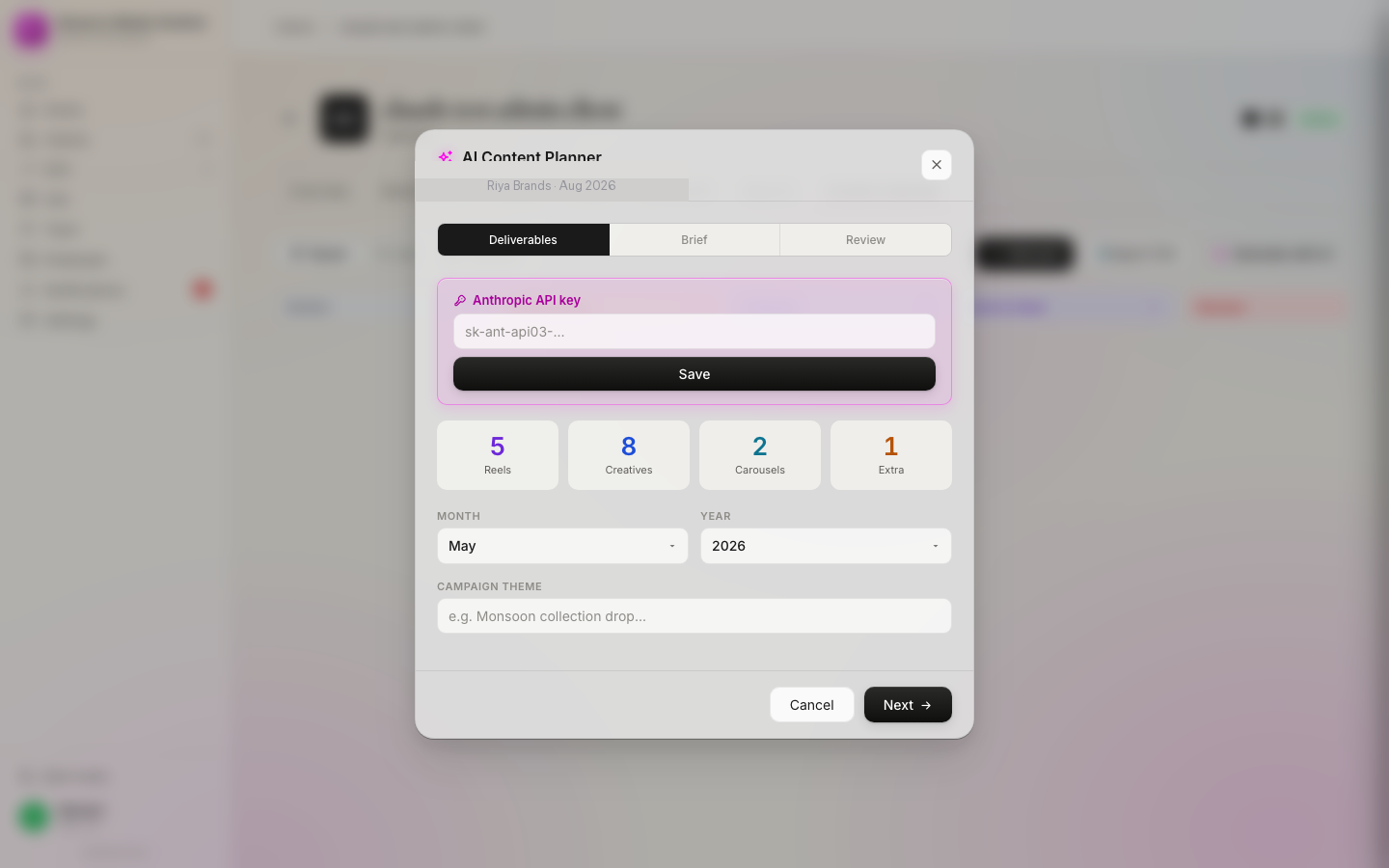
If your approval flow is a WhatsApp forward, none of this sticks, because there is nowhere for the checklist to live. Our approval workflow template shows the stages; the point for ASCI is that the disclosure check becomes a gate between draft and scheduled, and the scheduler does not fire until it has passed. On a client's own handle, that is the whole compliance system: one field, one gate, one archive.
Put it in the contract
Two clauses close the loop. In the creator agreement, the creator undertakes to carry the ASCI label as specified in the brief and to edit or take down on request, which mirrors clause 1.5. In the client retainer, the agency undertakes to brief and check for ASCI compliance, and the client undertakes to disclose every material connection it has with the creators it introduces, including gifting done directly by the brand's own team, which is where most surprises come from. The retainer agreement post has the surrounding structure. If you run accounts for brands headquartered in Mumbai, where ASCI itself sits and where most of the large-advertiser complaints originate, treat this as table stakes rather than a nice-to-have.
Frequently asked questions
Is #collab enough as an ASCI disclosure on Instagram?
ASCI's permitted list includes Collaboration, Partnership, Ad, Advertisement, Sponsored, Employee, Free gift, Affiliate and the platform tags. So the word passes. The placement usually fails: the label must be upfront, not behind the more fold, not in a hashtag cluster. Put it in the first line and use Instagram's Paid Partnership tag as well.
Do barter and gifted posts need an ASCI disclosure?
Yes. ASCI defines a material connection to include free products, whether or not conditions are attached and including those received unsolicited, plus discounts, trips, hotel stays, media barters and contest entries. A gifted post without a label is treated like an undisclosed paid one. Only a genuine unprompted purchase with no connection is exempt.
Can ASCI fine an influencer or a brand?
No. ASCI is a self-regulatory body that issues recommendations and refers non-compliance onward. Fines come under the Consumer Protection Act, 2019, enforced by the Central Consumer Protection Authority: up to ₹10 lakh for a first misleading advertisement and up to ₹50 lakh for later ones, plus an endorsement ban of up to one year, three for repeats.
How long must the ad label stay on a Reel?
For a video of 15 seconds or less, the label must stay on screen for at least three seconds. Between 15 seconds and two minutes, it must stay for a third of the video's length. At two minutes or longer, it must stay for the whole section in which the brand or its benefits are mentioned. Live streams need it announced at the start and the end.
Make the disclosure a gate, not a memory.
Brief, caption, approval checklist and scheduler in one workspace, so the label is checked before the post can go out. 7-day free trial, founding pricing from ₹999/month.
Start Free TrialThis post summarises public guidelines and law as at September 2026 for agency operators. It is not legal advice; for a specific campaign or complaint, speak to an advertising lawyer.