Healthcare is the most profitable niche most Indian agencies refuse to touch, and the reason they give is always the same: "medical marketing rules are confusing." They're not confusing. They're just written somewhere nobody in our industry reads, and almost every blog post ranking for this keyword gets the current status of the law wrong.
So before the content strategy, the law — because in this niche a compliance mistake doesn't cost you the client, it costs the client their registration.
Which rules actually apply to doctors on social media in India?
Search this topic and you will find dozens of pages about the "NMC's 11 commandments for doctors on social media," drawn from the National Medical Commission's Registered Medical Practitioner (Professional Conduct) Regulations, 2023. Those pages are describing rules that are not in force.
The NMC notified those regulations on 2 August 2023 and, after a storm of objections (mostly about the mandatory generic-prescription clause), kept them in abeyance on 23 August 2023 — not operative until a further gazette notification. As Cyril Amarchand's healthcare team noted in 2024, the NMC withdrew the 2023 regulations, leaving the older framework in place.
What governs your client today is the 2002 code. Three provisions do almost all the work:
- Clause 6.1 — advertising. Soliciting patients directly or indirectly, by a physician or by an institution, is unethical. So is using your name or photograph to invite attention to your professional position, skill or achievements, and "boasting of cases, operations, cures or remedies" through any medium. A self-photograph on a letterhead or signboard is expressly named as self-advertisement. Anatomical sketches and diagrams are expressly fine.
- Clause 7.17 — patient imagery. A physician shall not publish photographs or case reports of patients, in journals or elsewhere, in a manner by which their identity could be made out, without permission.
- The Drugs and Magic Remedies (Objectionable Advertisements) Act, 1954. A separate statute — and a criminal one. Its Schedule lists conditions (cancer, diabetes, epilepsy, obesity, sexual impotence, cataract and dozens more) for which advertising a remedy is flatly prohibited. This one binds the clinic, the ad agency and the platform, not just the doctor.
Read together, the line is not "healthcare brands can't post." The line is: you may teach, you may not sell. An endocrinologist explaining how HbA1c works is education. The same doctor saying "reverse your diabetes at our clinic — ₹4,999 package" is potentially two violations and a criminal offence.
What can a doctor post — and what gets them in trouble?
This is the table I put in front of every healthcare client at kickoff, and it settles 90% of arguments before they start.
| Safe to post | Do not post |
|---|---|
| Symptom explainers, myth-busting, procedure walkthroughs | Patient testimonials, reviews, recommendation reels |
| Anatomical diagrams, illustrations, X-ray literacy (non-patient) | Identifiable patient photos, scans, case reports |
| Preventive and seasonal health advice | Before-and-after results of any procedure |
| Clinic facilities, timings, team, location, fees | Success rates, "best in city," "100% cure" |
| Formal announcements: new practice, change of address, absence, resumption of practice | Discounts, festive offers, limited-period packages |
| Conference talks, published papers, CME sessions | Endorsements of any drug or commercial product |
Two India-specific traps agencies fall into. First, the festive offer. A "Diwali dental checkup at ₹499" post is second nature to every social media manager in this country — and it is exactly the solicitation the 2002 code targets. Second, the Google review campaign. Chasing patient reviews is standard local-SEO practice, but soliciting testimonials from patients is precisely what the regulator objects to. Let reviews happen; don't run a campaign for them.
Why clinic accounts and doctor accounts need different rules
Here is the asymmetry almost nobody writes about, and it changes how you structure the engagement.
The 2002 regulations bind registered medical practitioners — individual humans with a registration number to lose. Clinics, nursing homes and hospitals are regulated as clinical establishments under the Clinical Establishments (Registration and Regulation) Act, 2010, which is largely silent on advertising. That's the regulatory gap the 2023 regulations were meant to close, and didn't. Cyril Amarchand's piece records ASCI documenting 190 instances of misleading advertisements by clinics and hospitals, and a Supreme Court notice in October 2023 seeking a framework for corporate hospital advertising.
So the practical position in 2026: the clinic entity has more room than the doctor does. But "the regulator hasn't written the rule yet" is a terrible foundation for a client's brand — the Consumer Protection Act's misleading-advertisement provisions and ASCI's code both still apply, the gap is under active judicial attention, and a Dr-Sharma-owned clinic that markets aggressively is still trading on Dr Sharma's registration.
How I'd actually split it:
- Doctor's personal handle — education only, in the doctor's face and voice. No offers, no results, ever. This is the account that builds the practice.
- Clinic handle — facilities, timings, team, health-camp announcements, location. Operational information a patient needs, not persuasion.
- Paid media — run it from the clinic entity, keep creatives factual, and never touch a condition in the DMR Act Schedule.
The content that actually fills OPD slots
Compliance tells you what not to do; it doesn't get anyone into the waiting room. What does, in my experience across healthcare accounts, is narrower than agencies expect:
- The 45-second symptom explainer, shot on a phone, in the doctor's own voice. Patients book with a person, not a logo. A dermatologist explaining why monsoon humidity triggers fungal infections outperforms every designed carousel we've ever made for the same account — and it's pure education, so it's clean.
- Language matters more than production. Hinglish, or the local language, beats polished English in tier-2 and tier-3 towns by a distance. A Lucknow paediatrician speaking Hindi in a Reel is not "lower production value" — it's the reason the mother watching at 10 PM trusts the advice.
- Answer the questions asked in the OPD. Ask the client's front desk for the ten questions patients ask most. That is your content calendar for the quarter, and it is guaranteed to be relevant, because real patients generated it.
- Google Business Profile is the conversion engine. Instagram builds recall; the Business Profile catches the person who already typed "gynaecologist near me." Photos, accurate timings, and a working call button do more for bookings than a month of Reels.
- WhatsApp closes the loop. A bio link to WhatsApp with a pre-filled "I'd like to book an appointment" message converts far better than a form. Appointment reminders on WhatsApp cut no-shows. Just keep the broadcasts to health information — not offers.
How do agencies run healthcare clients without risking the doctor's registration?
The operational answer is boring and it is the whole job: the doctor must approve every single post, and you must be able to prove it.
In most niches, approvals are a courtesy. In healthcare they're a medico-legal record. If a caption ever makes a claim it shouldn't, the difference between an awkward conversation and a professional-misconduct complaint is whether there's a timestamped approval showing the practitioner reviewed the exact words that went out. A WhatsApp thread of screenshots is not that record — it's unsearchable within a week, and it's the reason I've argued elsewhere that WhatsApp breaks as a client-communication system long before agencies admit it.
What I'd insist on for any medical account:
- Doctor-level approval, not marketing-manager approval. The registration at risk belongs to the practitioner; the sign-off must too.
- A compliance checklist in the brief. No testimonial, no result claim, no superlative, no Schedule condition, no discount. Four checks, thirty seconds, applied by the writer before it reaches the doctor.
- Approval-gated publishing. The post cannot go live until it's approved — so a scheduling slip can never publish unreviewed medical copy. This is the same approval discipline that speeds every other client up; here it's non-negotiable.
- An indemnity clause in the contract. You write to the doctor's approved medical positions; the doctor warrants their clinical accuracy. Get it in the retainer agreement, not in an email.
- An exportable audit trail. Who approved what, when, with what caption. If it can't be exported, it doesn't exist.
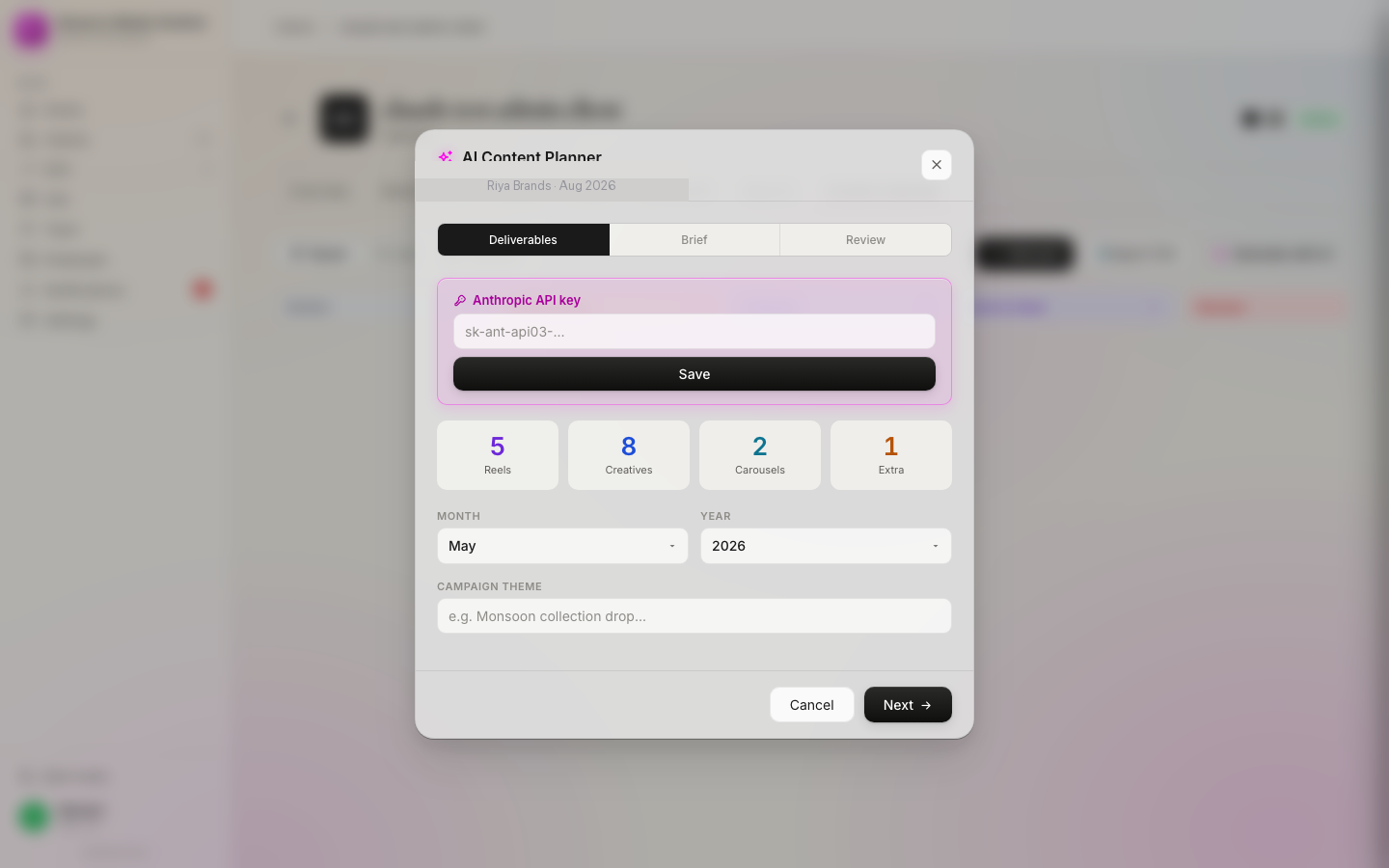
That's exactly the shape of the workflow we built into My Digital Sevak: the client sees the month, approves post by post in their own portal, every approval is timestamped, and nothing publishes without one. For an agency running healthcare accounts in a market like Lucknow or Indore — where one specialist referral brings you three more clinics — that record is the thing that lets you take the niche at all.
Frequently asked questions
Can doctors advertise on social media in India?
Doctors can publish educational content, but not advertise. Clause 6.1 of the Indian Medical Council (Professional Conduct, Etiquette and Ethics) Regulations, 2002 makes soliciting patients directly or indirectly unethical, and treats boasting of cures and self-publicity as misconduct. Teaching is allowed; selling a treatment is not.
Are the NMC 2023 social media guidelines for doctors in force?
No. The National Medical Commission notified the Registered Medical Practitioner (Professional Conduct) Regulations, 2023 on 2 August 2023 and kept them in abeyance on 23 August 2023. They are not operative until a further gazette notification. The 2002 Code of Medical Ethics governs conduct in the meantime.
Can a clinic post patient before-and-after photos on Instagram?
Treat it as off-limits. The 2002 regulations bar publishing patient photographs or case reports in a manner by which the patient's identity could be made out without permission, and result-led before-and-afters read as boasting of cures. Written consent narrows the risk but does not remove it.
Which platform works best for doctors and clinics in India?
Instagram Reels for reach and Google Business Profile for intent. Reels build recall with patients under 45; the Business Profile captures people already searching a symptom plus your city. WhatsApp handles the follow-up. Facebook still carries weight for patients above 40 in tier-2 and tier-3 towns.
Run healthcare clients with a real approval trail.
One calendar per clinic, doctor-level approvals that are timestamped and exportable, and nothing publishes until it's signed off. 7-day free trial, from ₹999/month for your whole team.
Start Free Trial