I went to write this as a normal comparison and hit a problem: almost every "Buffer vs Later 2026" article currently ranking quotes Later's plans as Growth $40 and Advanced $80. Later's own pricing page today lists Starter, Growth and Scale. The tier names in those articles don't exist anymore.
So everything below comes from each vendor's own live pricing page, pulled on 6 August 2026, with the rupee conversion done at the rate on the same day. Where I couldn't verify something, I say so.
What does Buffer actually cost in 2026?
From buffer.com/pricing, the structure is simple and unusual: you pay per connected account, and people are free.
- Essentials — $5/month per channel ($60 billed yearly). One user account.
- Team — $10/month per channel ($120 billed yearly). Unlimited team members and content approval workflows.
- Free — up to 3 channels, 10 scheduled posts per channel.
Buffer defines the billing unit plainly: "A channel is one social account you connect to Buffer... If you run five brands with an Instagram and a Facebook page each, that's 10 channels." Its FAQ also confirms the agency case directly — "you pay per channel rather than per brand or per client — so a portfolio of 30 accounts costs the same whether it's one brand or 15."
Two details buried in the FAQ that matter at agency scale. First, there's a volume break: "channels 1–10 are priced at the standard rate, and any channels above 10 cost less per channel." Buffer doesn't publish the discounted rate, so the numbers below are an upper bound — your real bill at 36 channels will be lower by an unstated amount. Second, annual billing carries a 20% discount, so paying monthly costs more than the headline.
What does Later actually cost in 2026?
From later.com/pricing, and this is where the ranking listicles are out of date. The current tiers, priced in USD and shown billed yearly:
| Plan | Price (billed yearly) | What you get | Post cap |
|---|---|---|---|
| Starter | $18.75/mo | 1 social set (8 profiles), 1 user. No extras available. | 30 posts per profile |
| Growth | $37.50/mo | 2 social sets (16 profiles), 2 users, internal & external approvals, social inbox | 180 posts per profile |
| Scale | $82.50/mo | 6 social sets (48 profiles), 4 users, 2 years of analytics | — |
Add-ons on Growth and above: extra social sets at $11.25/month each and extra users at $3.75/month each on those annual rates. Later's FAQ separately notes additional users at "$5 per additional user" and that "Starter plans are limited to 1 user". Annual billing saves 25%, so monthly billing runs meaningfully higher.
Now the part that decides everything for an agency — what a "social set" is. Later's plan cards define it as 8 profiles, "1 of each". One set holds one Instagram, one Facebook, one LinkedIn and so on. It does not hold two Instagram accounts.
And a constraint I've not seen mentioned in any comparison: Later caps posts per profile per month, and its FAQ states that "posts count when they're scheduled — not when they're published." If you plan a month in one sitting the way I recommend in bulk scheduling a month of Instagram content, the cap is charged against you the moment you load the queue, not across the month.
So which one is cheaper for an agency?
Here's the insight the pricing tables hide: Buffer and Later bill in different units, so the cheaper tool depends on the shape of your client roster, not its size.
- Clients with one handle per platform (one Instagram + one Facebook each) fit one social set per client. Later is dramatically cheaper — you're buying a client, not six accounts.
- Clients with several handles on the same platform — a restaurant group with four outlet Instagrams, a builder with project-wise pages — need a separate social set each on Later, while Buffer just counts four channels. Buffer wins, and the gap widens fast.
Run it on the same scenario I've used across these comparisons — 12 clients, about 3 accounts each (36 accounts), 4 people needing logins — converted at ₹95.17 to the dollar (checked 6 August 2026):
| Tool / plan | Billing unit | Monthly cost, 36 accounts & 4 users | Client approvals? |
|---|---|---|---|
| Buffer Essentials | $5 per channel/mo | ≈ ₹17,100 — but 1 user account only | No |
| Buffer Team | $10 per channel/mo, unlimited users | ≈ ₹34,300 (less above 10 channels) | Yes |
| Later Growth + 10 extra sets | $37.50 + $11.25 per extra set | ≈ ₹15,000 (incl. 2 extra users) | Yes |
| Later Scale + 6 extra sets | $82.50 + $11.25 per extra set | ≈ ₹14,300 (4 users included) | Yes |
| SocialPilot Premium | ₹6,000/mo + ₹200 per extra account/user | ≈ ₹7,400 | Yes |
| My Digital Sevak | Flat, in rupees | from ₹999 | Yes |
Two honest caveats on that table. Buffer's row is an upper bound because of the unpublished volume discount above 10 channels. Later's rows assume each of your 12 clients fits inside one social set — if even three of them run a second Instagram handle, add ₹1,070 a month per extra handle and the ranking starts moving toward Buffer. SocialPilot's figures are from its India pricing page served in rupees (₹2,000 Standard, ₹6,000 Premium for 30 accounts with Client Approval, extra accounts ₹200/month, and a tooltip offering bundles of 5 at ₹1,000/month).
The 18% that isn't on either pricing page
Buffer quotes dollars. Later writes "USD/month" directly into its plan cards. Neither bills an Indian agency in rupees, which means you're importing a service and the GST liability generally shifts to you under reverse charge, commonly at 18%. If you're registered you claim it back as input tax credit; you still fund it every month, and an unregistered studio can be pushed into registration by the subscription itself. I covered the mechanics and sources in the Hootsuite alternative post, and the invoicing side in the GST invoice guide for digital marketing services.
So add roughly 18% to every dollar row above before comparing it with a rupee-priced tool — and add the exchange-rate risk, which is not a rounding error on an annual commitment.
What is each one genuinely good at?
Neither of these is a bad product, and an agency choosing on price alone usually regrets it.
- Later is the better visual planner. It grew up as an Instagram-first tool and it shows: grid preview, UGC collection, Link in Bio, and approvals on Growth rather than gated at the top tier. For a brand-led agency doing fashion, food, jewellery or travel, the visual planning is a real workflow advantage, not a demo feature.
- Buffer is the better team tool at small channel counts. Unlimited team members on Team means hiring your fifth person costs nothing, which inverts the per-seat economics of most suites. It's also the cleanest, fastest publishing UI in this bracket.
- SocialPilot is the pricing outlier because it actually bills in rupees, with client approval and white-label reports on a ₹6,000 plan. On cost per account, it's hard to beat.
If scheduling is genuinely your only problem, pick from that list, pay, and stop reading comparison posts. That's a real recommendation.
What none of them do for an Indian agency
Here's what I got wrong for two years running my own agency: I kept switching schedulers, when scheduling was the one part of my month that already worked.
What didn't work was everything around it. The calendar lived in a spreadsheet. Approvals lived in WhatsApp voice notes, which is where they break around the fifth client. Reports got rebuilt by hand in Canva every month-end. Invoices came out of separate accounting software, GST and TDS were reconciled somewhere else, and no single screen could tell me the true status of any client. Buffer and Later solve one slice of that — the publish step — and are honest about being schedulers. But the seams between the slices are where an agency's hours actually go.
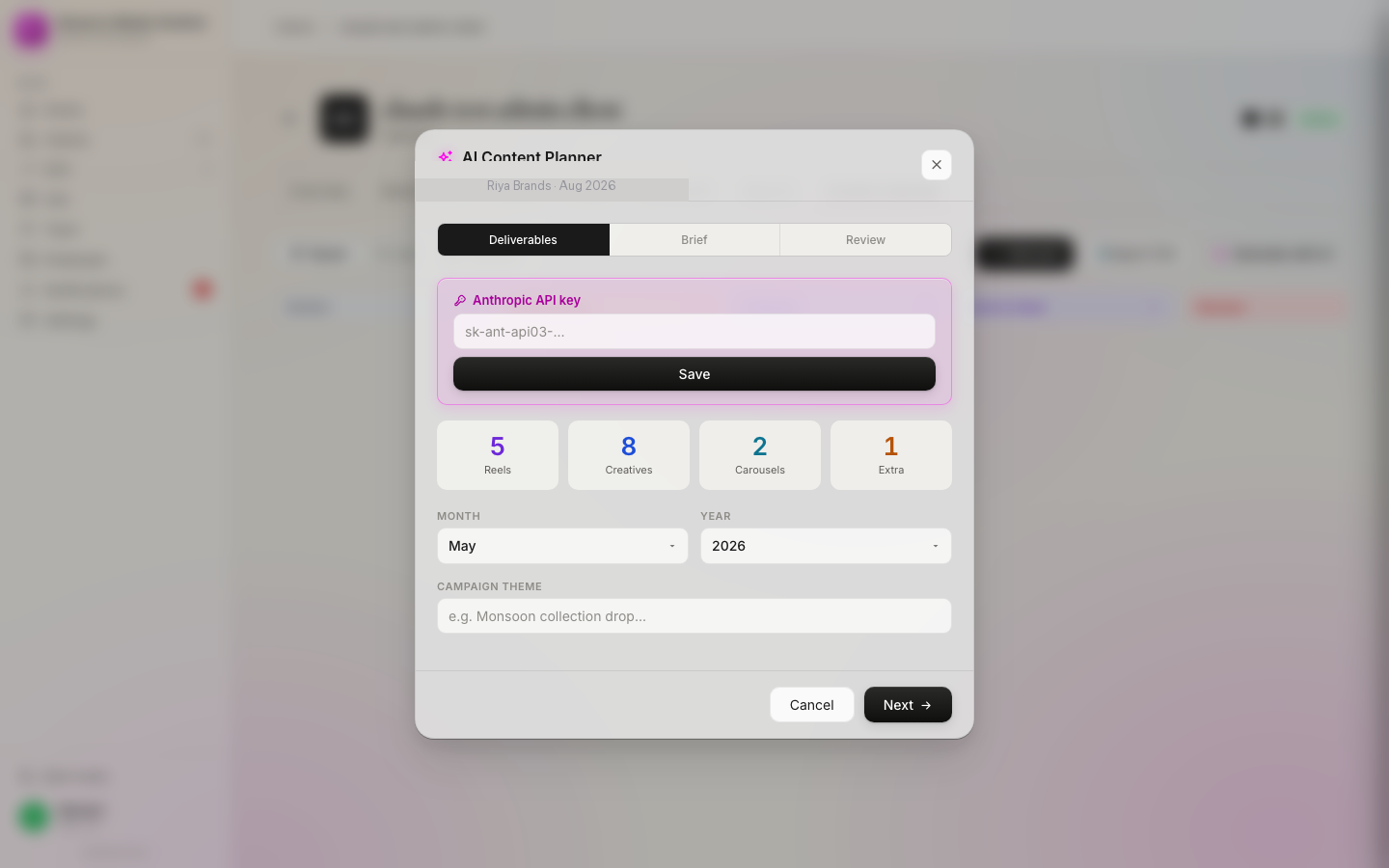
My Digital Sevak was built for that gap, for my own agency, before it was a product: content calendar and Instagram scheduling for every client, a mobile portal where clients approve on their phone, monthly reports that assemble themselves, and GST-compliant invoicing with Razorpay payments and TDS tracking — one login, priced in rupees from ₹999 a month, with no exchange rate and no reverse-charge GST. It's what agencies from Jaipur to Kochi run on.
The fair caveat: if what you want is Later's grid preview and UGC collection, or Buffer's publishing polish, we're not trying to be those tools and you should buy the one you want.
Frequently asked questions
Is Buffer or Later cheaper for an agency?
It depends on the shape of your accounts. Buffer charges per social channel, so cost rises with every account. Later charges per social set, which holds only one profile per platform. Clients with one handle each favour Later; clients with several handles on the same platform favour Buffer.
How much does Later cost per month in 2026?
Later's own pricing page lists Starter at 18.75 dollars, Growth at 37.50 dollars and Scale at 82.50 dollars per month billed yearly, in US dollars. Extra social sets are 11.25 dollars each per month and extra users 3.75 dollars each on the annual rate.
Do Indian agencies pay GST on Buffer or Later subscriptions?
Both bill in US dollars, so an Indian business is importing a service. GST generally falls on the Indian recipient under reverse charge, commonly at 18 percent. Registered businesses can claim it as input tax credit, but it is still cash out every month.
All prices were read from each vendor's own pricing page on 6 August 2026 and converted at approximately ₹95.17 to the US dollar. Later and Buffer figures are the annual-billing rates their pages display by default; monthly billing costs more at both. Software pricing changes often — verify on the live pages before committing. I'm an agency founder, not a tax professional; confirm the GST treatment of foreign subscriptions with your CA.
Priced in rupees, built for Indian agencies
Content calendar, client approvals on mobile, monthly reports, GST invoicing and Razorpay payments — every client, one login, no exchange rate. Founding pricing from ₹999/month, with a 7-day money-back guarantee.