Every second Indian agency I talk to runs on Notion. It's the default answer to "how do you manage clients?" and for good reason — it's cheap, it's fast to start, and there are a hundred "Agency OS" templates on Gumroad promising to hand you a finished operating system for ₹2,000.
I'm not going to tell you Notion is bad. We used it for two years, and parts of our agency still live in it. What I want to give you is the thing the comparison posts skip: the specific, named points where a Notion setup stops holding, so you can see them coming instead of discovering them during a client dispute.
What does Notion genuinely do well for an agency?
Credit where it's due, because two of these are better than what most paid agency tools offer.
- Guests are free, and unlimited on paid plans. Notion's pricing page caps the Free plan at 10 guests but marks Plus, Business and Enterprise as unlimited guests, and guests don't count toward your seat charge. Compare that to schedulers that put client seats behind a $100/month tier. On pure client-access economics, Notion wins outright.
- Docs and databases in one place. A brand's tone-of-voice doc, its hashtag bank, the competitor notes and the content calendar sit in the same workspace and link to each other. Purpose-built tools are usually worse at this — they have a calendar and nowhere to put the thinking behind it.
- It's the best SOP tool you'll find at the price. Onboarding a new designer, documenting how reels get exported, keeping your client onboarding process written down — Notion is genuinely excellent at this and I'd keep using it for exactly this.
- It bends to your process. No tool forces you into its opinion. For an agency with an unusual workflow, that flexibility is real.
So the honest framing isn't "Notion vs agency management software". It's: which layer of your agency belongs in a flexible document tool, and which layer needs software that knows what a client, a post and an invoice are?
Where does a Notion agency setup break past 8 clients?
Five failure points, in the order they usually arrive.
1. Notion plans. It does not publish.
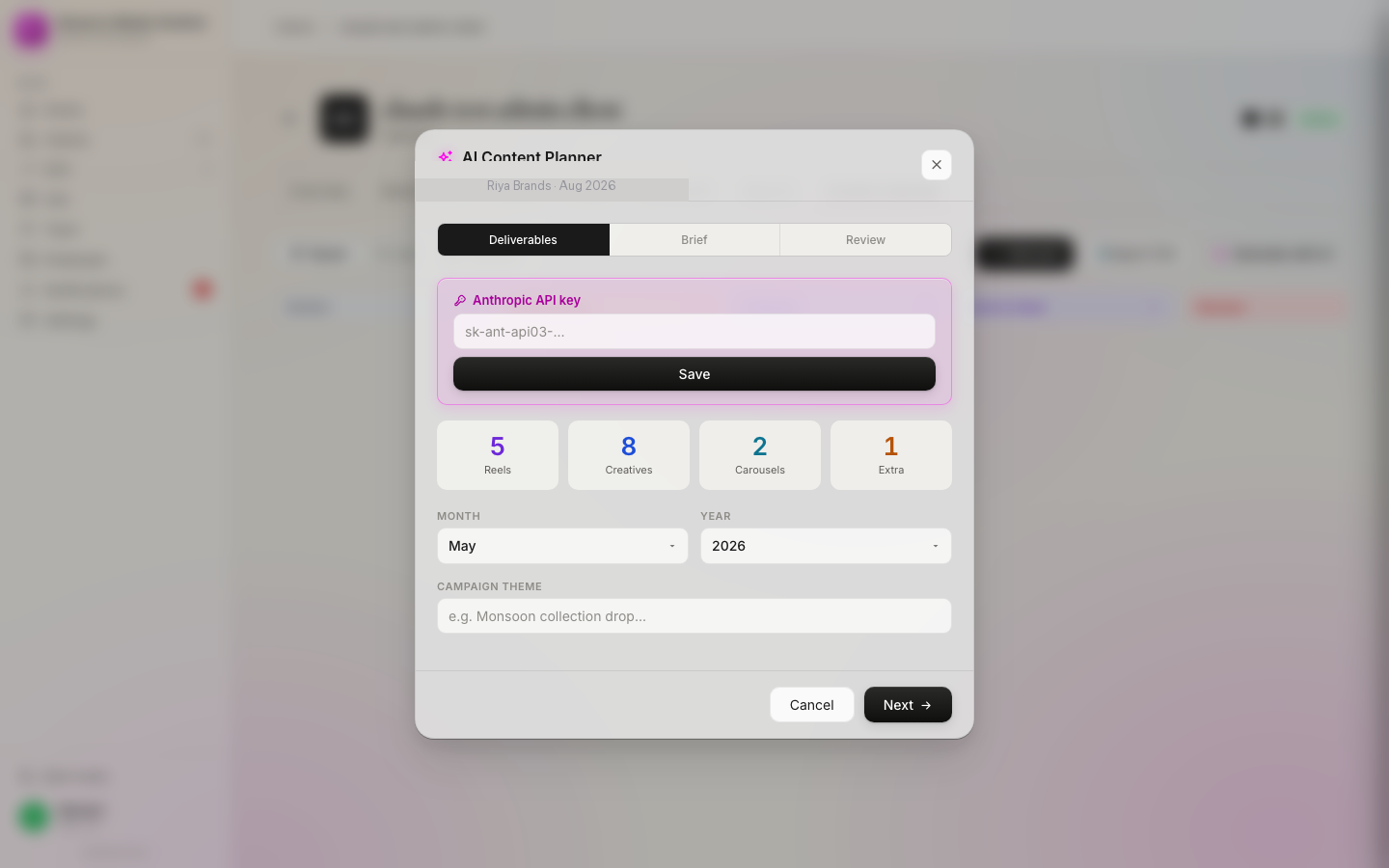
This is the big one and it never shows up in a template demo. Notion has no connection to Instagram, Facebook or LinkedIn. Your calendar can say "Reel — 7:00 PM, Tuesday" and nothing happens at 7:00 PM. Someone opens the app, finds the file in Drive, copies the caption out of Notion, and posts.
At three clients that's a five-minute daily habit. At twelve clients with festive campaigns, it's a person — and it's the job that fails at the worst time, because 7 PM IST on a Friday is exactly when nobody wants to be the one holding the phone. You can bridge it with a third-party automation, but now you're maintaining a connector, and when a Meta token expires your calendar quietly stops publishing with no error anyone sees. (If this is the part that hurts, it's what our Instagram scheduler exists for.)
2. Your approval evidence expires
Here's the one that cost us real money, and it's verifiable on Notion's own pricing page: page history is 7 days on Free, 30 days on Plus, 90 days on Business, unlimited only on Enterprise.
Think about what that means. A client's marketing manager approves a campaign in June by flipping a status property to "Approved". In October, a new CMO asks who signed off on that post, or a client disputes a month's deliverables before paying. Your Notion database says "Approved" — it does not say who, or on which version of the caption, because the page history that held that answer aged out in July.
A status field is a state, not an audit trail. Every agency I know has had at least one "we never approved that" conversation, and in revision-heavy accounts the version matters more than the approval — the client approved caption v2, you published v4 after their WhatsApp tweak. Notion will not reconstruct that for you four months later.
3. Permissions are page-shaped, and clients are row-shaped
This is the structural limit nobody mentions when they sell you an Agency OS template. Those templates are built around one master content database with a "Client" property. It's elegant until you invite the client.
Notion grants access at page and database level, not per row. A filtered linked view is a presentation — it is not an access control. A guest with access to the underlying database can reach what the filter hides. So if Brand A and Brand B both sit in your master calendar, you cannot safely hand Brand A a slice of it, and Brand A and Brand B in the same category is not a hypothetical — half of an agency's client list is competitors of the other half.
What agencies actually end up doing is one duplicated database per client. That works, and it also means your "single source of truth" is now fourteen sources of truth, none of which roll up. You can't answer "how many posts are pending approval across all clients today?" without opening fourteen pages.
4. There is no money layer at all
Notion does not raise an invoice with your GSTIN on it, does not compute 18% GST, does not track the 2% TDS your client deducted under section 194C, does not send a payment link, and does not know that Brand C's retainer renews on the 1st. So the Notion agency runs Notion plus a billing tool plus a payments account plus a spreadsheet reconciling them — and the reconciliation is manual, monthly, and wrong about twice a year.
If you've read our posts on GST invoicing for agencies and TDS on digital marketing services, you know the actual pain isn't raising the invoice — it's matching a bank credit of ₹49,000 against an invoice of ₹50,000 and remembering which client deducted what. A document tool has no opinion about that, which is the correct behaviour for a document tool.
5. The config tax, and the person who pays it
Someone at your agency built the Notion system. It's usually you, usually over three weekends, and it is genuinely good. The problem is that it's a person, not a product.
When that person leaves — or just gets busy — nothing maintains the formulas, the relations, the rollups. New joiners get a workspace nobody can fully explain. And if you've automated around it, the Notion API allows 180 requests per minute (about 3 per second) on plans below Business, and 600 per minute on Business and Enterprise, which is a real ceiling once a sync script is walking fourteen client databases every morning.
Purpose-built software has a version number and a support email. Your Notion workspace has neither. That's not a criticism of Notion — it's what "flexible" costs, and it is the same trade we covered in Asana vs agency management software: a generic tool asks you to build the agency-shaped part yourself, and then keep building it forever.
Is it actually cheaper to stay on Notion?
Take a realistic agency: six people, twelve clients. Notion's published rates are $10 per seat per month for Plus and $20 for Business, with up to 20% off on yearly billing. At roughly ₹88 to the dollar:
| Layer | On Notion | Monthly cost |
|---|---|---|
| Workspace, briefs, calendar | Notion Plus, 6 seats | $60 ≈ ₹5,280 |
| 90-day history + better API limits | Notion Business, 6 seats | $120 ≈ ₹10,560 |
| Actually publishing to Instagram | A scheduler, separately | $20–100 ≈ ₹1,760–8,800 |
| Client-facing monthly reports | A reporting tool, or your time | Varies, or 6–8 hours/month |
| GST invoices, TDS, payment links | Billing software + payment gateway | ₹500–2,000 + gateway fees |
| Keeping the system alive | Your weekends | Unpriced, and the expensive one |
The Notion line item is cheap. The stack is not, and none of the four tools knows the others exist — so the client who hasn't approved anything for nine days doesn't show up on your invoice, and the invoice that hasn't been paid for 40 days doesn't show up on your calendar. That gap is the actual product an agency tool sells. It's the same argument we made about running the whole agency from one dashboard, and it holds here more strongly than in any other comparison, because Notion is the most capable of the generic tools.
When should you stay in Notion?
Genuinely — and I mean this, not as a throat-clearing before a sales pitch:
- Under five clients. The manual publishing habit is small, approvals are conversational, and you have no compliance exposure worth building around. Stay. Spend the money on a designer instead.
- You're a content or strategy shop, not a posting shop. If you deliver decks, scripts and strategy rather than a daily feed, publishing isn't your bottleneck and Notion is close to ideal.
- Your clients already live in Notion. A few Indian startups genuinely do, especially SaaS and D2C teams in Bengaluru. Working inside their workspace beats forcing them into yours.
- As the layer alongside. This is what we do now: SOPs, brand books, strategy docs and internal wiki in Notion; calendar, approvals, publishing, reports and billing in the system built for it. That's not a compromise, it's the correct split.
The 30-second decision
- 1–5 clients, informal approvals → Notion. Don't overthink it.
- 6–10 clients, you publish daily → Notion for docs, a real scheduler for the calendar.
- Competing brands on your client list → stop putting them in one database today, whatever else you decide.
- Retainer disputes or clients who deduct TDS → you need an audit trail that outlives 30 days and a billing layer. Notion can't be either.
- 10+ clients, 5+ staff → price the whole stack, not the Notion seat. Our agency management software page lays out what the consolidated version looks like in rupees.
FAQ
Can Notion schedule and publish Instagram posts?
No. Notion has no native connection to Instagram, Facebook or LinkedIn, so a Notion content calendar is a plan rather than a schedule. Someone on your team still opens the app at the posting time and publishes manually, or you build and maintain an automation through a third-party connector.
Can I give each client access to only their own rows in Notion?
Not reliably. Notion permissions are granted at page and database level, not row level. A filtered linked view is a presentation layer, so a guest who has access to the source database can reach rows the filter hides. Agencies usually end up with one separate database per client instead.
How much does Notion cost for an agency team?
Notion publishes Plus at $10 and Business at $20 per seat per month, with up to 20% off on yearly billing. Guests are free and unlimited on paid plans. For a six-person agency that's roughly $60–120 a month before any scheduling, reporting or invoicing tool sits on top.
Does Notion keep a record of client approvals?
Only for a limited window. Notion's published page history is 7 days on Free, 30 days on Plus and 90 days on Business. A status property tells you a post is approved now, but the evidence of who approved which version ages out before most billing disputes arrive.
Sources
- Notion pricing page — plan rates, guest limits, page history retention, file upload limits.
- Notion API request limits — 180 requests/minute on plans below Business, 600 on Business and Enterprise.
- Notion help: custom database permissions — how database and linked-view access is granted.
Keep the wiki. Move the delivery.
Calendar, one-tap client approval on a phone, auto-publishing to Instagram, monthly reports, GST invoices and UPI collection — in one login, priced in rupees from ₹999/month.
Start Free Trial