This is not a post trying to talk you out of Canva. Our designers open it every single working day, and if you removed it from an Indian social media agency on a Monday, output would halve by Friday. The argument here is narrower and more useful: Canva is excellent at the half of the job it was built for, and agencies keep asking it to do the other half — the half with clients in it.
That other half is where the money and the arguments live. So it is worth being precise about exactly where the seam is.
What Canva Teams is genuinely best at
Credit where it is due, because most comparison posts skip this part and go straight to the sales pitch.
- Brand kits and brand templates. A freelance designer you onboarded on Tuesday cannot wander off-brand by Thursday. For an agency running eight brands with eight different palettes, this alone is worth the subscription.
- Real-time co-editing with comments on the artwork. Your senior can drop a note on the exact element instead of typing "logo thoda upar karo" in a group.
- Version history. Canva's help centre documents restoring earlier versions of a design, which has saved more than one of our reels from a confident junior.
- Volume production. Resize, bulk create, a template per format. For statics and carousels at Indian agency volumes, nothing else at the price is close.
None of that is in dispute. Keep it.
Where does the agency handoff actually break?
It breaks at the boundary between an asset and a post. Four seams, in the order agencies usually hit them.
1. A design is not a post
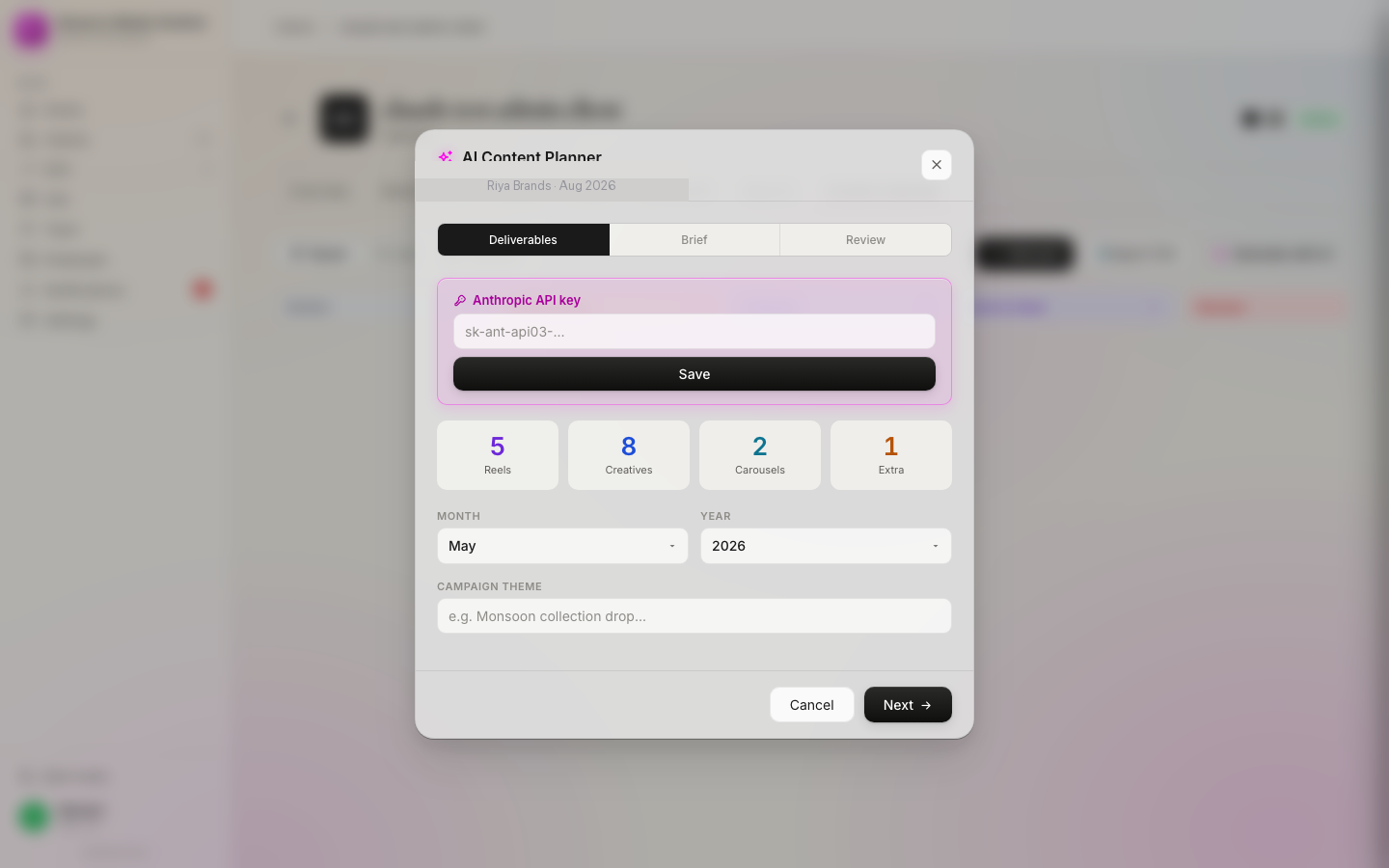
Write down what a single Instagram post actually is in your agency: the client, the brand, the month, the format (reel, static, carousel), the creative file, the caption, the hashtags, the first comment, the publish date and time in IST, the channel, the approval state, the revision number, and who approved it. That is thirteen fields. Canva stores one of them properly — the file — and the file name is asked to carry the rest.
Which is how every agency ends up with Client_Jan_Post3_final_v2_FINALapproved.png. It works at two clients. At six clients and twenty posts each, your folder tree has become a database that you cannot query: there is no way to ask Canva "what is pending client approval for Tuesday", because Canva has never heard of Tuesday, approval, or the client. A spreadsheet fails the same way for the same reason, which I broke down in Google Sheets vs content calendar software.
2. The client has to become a Canva user to say yes
Canva's help centre explains external sharing clearly: you can share a link set to "can view" or "can comment", and someone with a comment link can open the design and read the existing comments without logging in — but to add a comment or reply to one, they need to log in or sign up. Guests do not have to join your team, but they do need an account.
Now picture the actual client. A restaurant owner in Indore, a marketing executive at a jewellery brand, a doctor between OPD slots. They are not creating a Canva login to type "approved". They will screenshot the design and send it back on WhatsApp with a voice note. Which means the decision — the single most contested artefact in the entire agency relationship — has left your system and entered a chat thread that scrolls. We wrote about that specific failure in WhatsApp vs a client portal.
3. Canva's approval is brand governance, not client sign-off
Canva does have design approval, and this is where most listicles stop reading. Look at whose approval it is. Canva's help documentation describes Canva Teams as supporting individual reviewers, with group approvers, approval rules and a downloadable record of approval activity reserved for Canva Enterprise — where an admin can export approval history as a CSV containing the design, the requester and the approver.
That is a well-designed feature for a corporate brand team gatekeeping its own designers. It is the wrong shape for an agency for two reasons. The approver you need is outside your team. And the record you need is not "which designs cleared brand review", it is "on which date did this client approve this exact post for this month" — the question that gets asked 40 days later when someone says they never saw it. Our take on what that record should contain is in the content approval workflow template, and the client-side of it in why approvals belong in an app.
4. The design keeps moving after the yes
A Canva design link is live. The artwork the client approved and the artwork as it stands right now share one URL. Version history lets you restore an earlier state, but nothing binds the client's approval to a particular version — so if someone nudges a headline on Thursday, the approved post and the published post quietly stop being the same thing.
The rule we settled on: once a post is approved, export the file and publish the export. Never schedule a live design. It costs ten seconds and removes an entire category of client argument — the one where you are both right. Related: how to handle client revisions without losing the plot.
Can Canva's Content Planner replace a scheduler for an agency?
For one or two accounts, honestly, yes. Canva's Content Planner connects social accounts and publishes on a schedule, and if you are a solo creator posting for yourself, adding a second tool is a waste of money.
For a multi-client agency, three things stop it:
- Connections live at the account and team level, not the client level. Twelve clients means twelve brands' publishing rights sitting behind one workspace login. Canva's help describes scheduling as available to plan admins and brand designers, so publishing rights follow your Canva roles — which were never designed to be a client boundary.
- Nothing stands between the schedule and the client. There is no gate that says this post cannot publish until the brand has approved it. In an agency, that gate is the workflow.
- What went out is not recorded anywhere useful. Post insights inside a planner are not a monthly client report, and they are certainly not an invoice line that says 22 posts delivered in August.
If you want the mechanics of scheduling across many client accounts properly, that is what our Instagram scheduler exists for, and the traps are listed in Instagram scheduling mistakes agencies make.
The split that actually works
Stop trying to make one tool do both. Draw the line at the file boundary and everything gets calmer.
| Layer | Belongs in Canva | Belongs in your workflow tool |
|---|---|---|
| Artwork, brand kit, templates | Yes — this is the whole point | No |
| The post record (client, month, format, date) | No | Yes |
| Caption, hashtags, first comment | No | Yes |
| Internal design review | Yes — comments on the artwork | Optional |
| Client approval and the record of it | No | Yes |
| Revision count per post | No | Yes — it decides scope arguments |
| Publishing to Instagram and Facebook | Only at 1–2 accounts | Yes at 3+ clients |
| Monthly report and GST invoice | No | Yes |
What does this cost, honestly?
Canva Teams is priced per seat with a minimum team size, and Canva's India pricing is not the same as its US pricing. I am deliberately not printing a figure here: Canva's pricing and help pages block automated access, which means every rupee number you read in a comparison listicle — including numbers written confidently to two decimal places — is second-hand. Open canva.com/pricing on your own Indian connection and read it there.
The cost that actually hurts is quieter: seats bought for people who only ever need to approve something, and the hour a week your account manager spends being a human router between a Canva folder, a WhatsApp group and a spreadsheet. At six clients that hour is a full working day a month. Price that against any subscription and the maths stops being close — the same conclusion we reached comparing Notion and ClickUp, each of which breaks at a different seam.
The 30-second version
- Keep Canva. It is the best production layer an Indian agency can buy at this price.
- Stop storing workflow state in file names. A post has a dozen fields; a file has one.
- Do not make clients sign up to approve. Their approval must be one tap and must be recorded against the post.
- Publish the export, not the live design, so approved and published stay identical.
- Add a workflow layer once you cross three clients — before that, you genuinely do not need one.
FAQ
Can a client approve a Canva design without a Canva account?
Not fully. Canva's help centre describes comment access this way: someone with a comment link can open the design and read existing comments without logging in, but to add a comment or reply they have to log in or sign up. So the client's yes either costs them an account, or it happens on WhatsApp, away from the design.
Does Canva keep a record of who approved which design?
It has design approval, but built for internal brand governance. Canva's help documentation describes Teams as supporting individual reviewers, while group approvers and an admin download of approval history as a CSV are Canva Enterprise features. In every case the reviewer is a member of your team, not your client.
Should an agency stop using Canva Teams?
No. Canva is the fastest way an Indian agency can produce on-brand creatives at volume, and brand kits keep juniors inside the guidelines. Keep it as the artwork layer and move the post record, client approval, scheduling, reporting and invoicing into a workflow tool built around clients rather than files.
Sources
- Canva Help Centre: share your design and collaborate with anyone — view and comment links, and when a guest has to log in.
- Canva Help Centre: change design approval settings and setting up design approval for organizations — reviewers, group approvers and the Enterprise approval-history export.
- Canva Help Centre: schedule posts on Facebook, Pinterest and more — connecting social accounts and who can schedule.
- Canva Help Centre: review and restore older versions of designs.
Canva's own pages return an automated-access block to tools like ours, so the statements above are attributed to Canva's documentation and linked for you to verify rather than quoted as page copy. Product behaviour changes; check before you buy seats.
Keep Canva. Move the workflow.
Per-client content calendars, captions and creatives on one post record, one-tap client approval with a dated log, auto-publishing to Instagram and Facebook, monthly reports and GST invoices. 7-day free trial, from ₹999/month for your whole team — used by agencies from Mumbai to Lucknow.
Start Free Trial