Short answer: Buy a CRM only for the pipeline before a client signs. For most Indian social media agencies that means Zoho CRM — rupee-billed, free for three users, ₹1,400/user/month at Professional. HubSpot is the nicer product and costs about six times more once you convert. Neither one runs your delivery, and that is where agencies actually lose money.
Every roundup ranking for this query answers a different question than the one you're asking. They compare "social CRMs" — tools that pull Instagram DMs into a contact record, mostly built for brands managing their own audience. That is not the problem a 6-person agency in Indore has. Your problem is that eleven half-warm leads are sitting in three WhatsApp threads, one Gmail label and a founder's memory, and two of them have gone cold since Tuesday.
I'll be upfront about my side: we build agency management software, and it is not a sales CRM. We handle what happens after the contract is signed. So this post has an unusual property for its SERP — the recommendation is to buy someone else's product, and my only argument is about where you draw the line between the two.
Why does an agency need two systems, not one?
Agency work splits cleanly at the signature, and the two halves have almost nothing in common.
Before signature is sales: a lead arrives from a referral, an Instagram DM, a Meta lead-gen ad or your website form. It needs a follow-up sequence, a proposal, a rate quote, a negotiation, and — the part everyone skips — a recorded reason when it dies. That is a CRM. Deal stages, reminders, a pipeline value you can look at on the 28th of the month and feel something about.
After signature is delivery: onboarding the brand, building a content calendar, getting captions and creatives approved, publishing on time, reporting monthly, and raising a GST invoice that the client's accountant will pay minus TDS. A CRM knows none of this. Ask HubSpot to show you which of Nooré's October reels are still awaiting client approval and it will look at you blankly, because "approval" in CRM language means a discount authorisation.
Agencies get into trouble forcing one tool across the seam. I've watched founders build pipelines where the stages after "Won" are "Onboarding", "Calendar shared", "Posts live" — abandoned by month three, because a deal record has no concept of a recurring monthly cycle. Retainers aren't deals; they're subscriptions with a delivery obligation attached, which is why recurring billing is its own problem.
What do the main CRMs actually cost an Indian agency?
All prices below were read off each vendor's own pricing page on 20 August 2026, and prices move — verify before you buy. Dollar conversions use the USD/INR spot rate of about 95.77 on the same day (the day's range was roughly 95.69–95.85).
| Tool | Billed in | Entry / working tier | The catch for an agency |
|---|---|---|---|
| Zoho CRM | ₹ (India page) | Free for 3 users; Standard ₹800/user/mo; Professional ₹1,400; Enterprise ₹2,400 | Interface density. Local taxes charged on top. Annual billing discounts up to 34%. |
| HubSpot Sales Hub | $ | Free for 2 users; Starter $7/seat/mo annual ($20 monthly); Professional $90/seat/mo annual | Professional carries a required one-time $1,500 onboarding fee. Enterprise $150/seat plus $3,500 onboarding. |
| Freshsales | $ (Indian company, dollar page) | Growth $9/user/mo annual; Pro $39; Enterprise $59 | Add-ons stack: branded documents $19/user/mo, Freddy AI $49 per 100 sessions. 21-day trial, no free tier listed. |
| Kylas | ₹ | Free "Embark" tier (10,000 records, 5 GB); paid tier is flat-rate | Priced per company, not per user — unusual and good for a growing team. Several capabilities are paid add-ons. |
Now the arithmetic that decides it. This is my calculation, not a vendor claim. A four-person agency team on HubSpot Sales Hub Professional: 4 × $90 = $360/month, roughly ₹34,500/month, about ₹4.14 lakh a year — plus a one-time $1,500 onboarding, roughly ₹1.44 lakh. Add your card's 2–3.5% forex markup, and 18% IGST under reverse charge on the import of services (claimable as input credit if you're registered).
The same four people on Zoho CRM Professional: 4 × ₹1,400 = ₹5,600/month plus GST, on annual billing less than that. You are not paying six times more for six times the pipeline. You are paying for a better-designed product and a US support org, which is a real thing to want and a hard thing to justify at eight leads a month.
So which one should you actually pick?
- Under 10 leads a month, one or two people selling: don't buy a CRM. A Google Sheet with six columns — name, source, stage, last touch, next action, amount — beats an unused CRM. Set a calendar reminder for Monday 11am to work the sheet. Most agencies I know should be here and aren't.
- 3–15 people, India-only clients, cost matters: Zoho CRM. Free tier for three users to prove the habit, then Standard or Professional. It bills in rupees, gives you a proper Indian tax invoice, and plugs into the rest of the Zoho estate if you already use Books or Mail.
- You sell to international clients and your buyers expect polish: HubSpot Starter at $7/seat is genuinely good value and skips the onboarding fee. Jump to Professional only when someone on your team is actually running sequences and reporting daily.
- You want unlimited seats without per-user maths: look at Kylas. Flat-rate pricing for an Indian SMB is rare, and if your team grows to fifteen the per-seat models start hurting.
- Your bottleneck is delivery, not sales: then a CRM is the wrong purchase entirely, and no amount of pipeline hygiene will fix a client who is angry about last week's approvals. That's the case we handle.
The India layer nobody's roundup mentions: DPDP
Your CRM is a database of Indian citizens' names, phone numbers and email addresses. That is digital personal data, and the rules around it changed. The DPDP Rules, 2025 were notified on 14 November 2025, giving full effect to the Digital Personal Data Protection Act, 2023 (enacted 11 August 2023). The government's own explainer describes "an eighteen-month period for phased compliance" — so this is not urgent today and it is entirely foreseeable.
Three consequences that land directly on an agency CRM:
- Consent notice. "Every Data Fiduciary must issue a separate consent notice that is clear and easy to understand," explaining the specific purpose. The one-line "I agree to the privacy policy" checkbox under your website's lead form is the thing to fix.
- Withdrawal and rights. Individuals "may withdraw their consent at any time", and access, correction, update or erasure requests must be answered "within a maximum of ninety days". If your pipeline lives across WhatsApp, a spreadsheet and one person's phone contacts, you cannot honestly answer an erasure request. A CRM is how you become able to.
- Whose data is it? When you run Meta lead-gen ads for a client and the leads flow to you, you're processing personal data on their behalf — closer to a Data Processor than a Data Fiduciary. Who holds it, for how long, and what happens at exit belongs in the contract. Add a clause; our retainer agreement guide covers where it fits. I'm a founder, not a lawyer — get yours to read it.
Where the CRM hands off — and what breaks there
The handoff is the expensive part. A deal flips to Won, and someone has to collect brand assets, logins, a tone-of-voice brief and a Drive folder, then build a first month's calendar. If that lives in a CRM note, it evaporates — the long version is in how to onboard a new social media client.
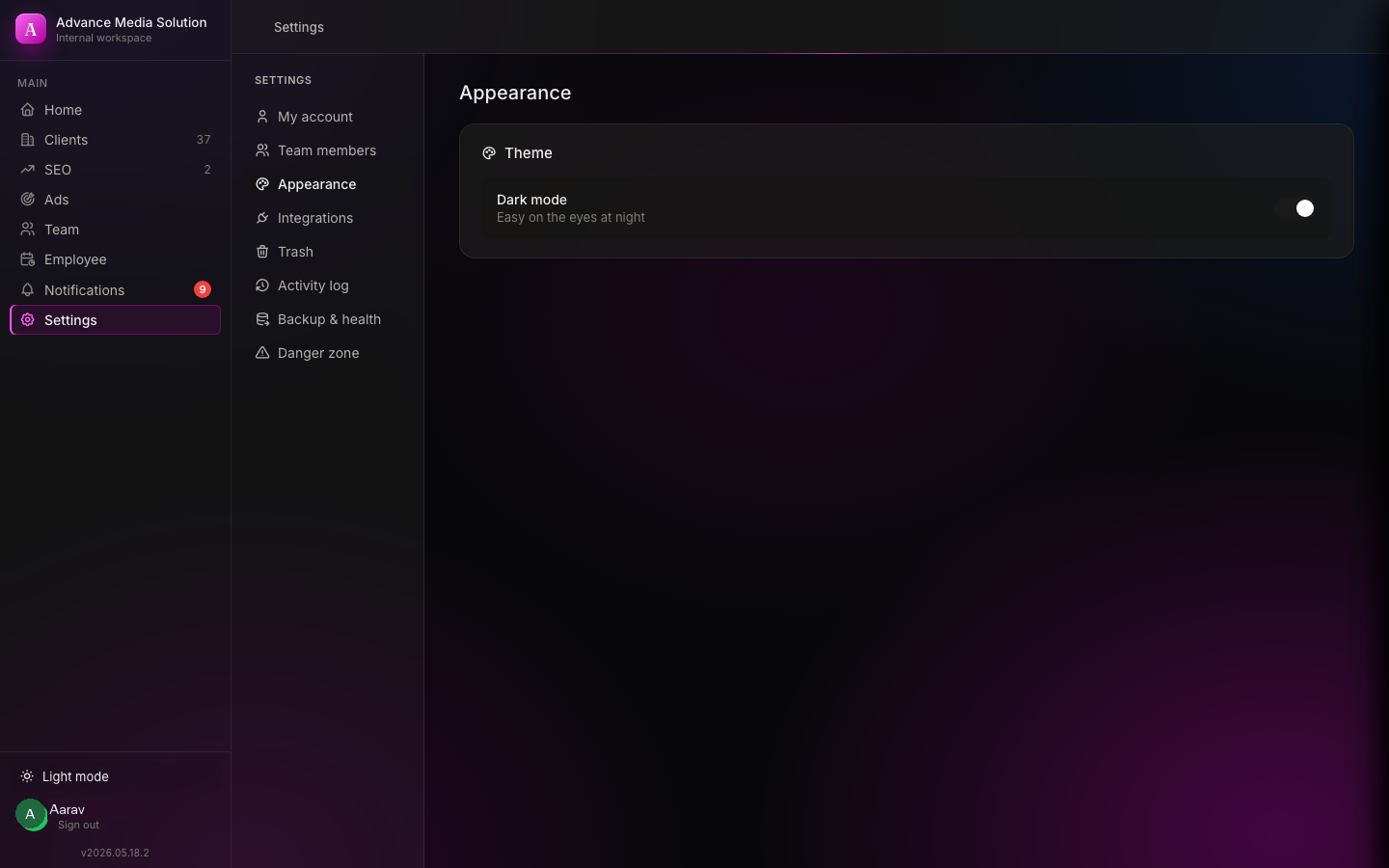
Four things a sales CRM will never do for you, in rough order of how much they cost when missing:
- Client approvals. Sign-off on captions and creatives, with a timestamp and a revision history. This is the loop that eats your week — see faster client approvals.
- Publishing. Scheduled posts going live at the right IST time without anyone opening the app at 7pm. Our Instagram scheduler exists for exactly that.
- Monthly reporting. The artefact that renews the retainer. A CRM reports on your pipeline, not on the client's reach — monthly reports for clients covers what to put in it.
- Invoicing with GST and TDS. A ₹50,000 invoice paid as ₹45,000 because the client deducted TDS is not a short payment, and a CRM's "amount" field cannot model that. See TDS on digital marketing services.
One more thing specific to India: a large share of your pipeline arrives and lives on WhatsApp. Most CRMs treat it as an integration you buy. Be realistic about whether your team will actually log those chats — if they won't, pick the CRM your team will open, not the one with the best feature matrix. The same discipline question shows up on the delivery side, which is why we compared WhatsApp against a client portal.
How to roll one out without wasting a quarter
- Week 1: list every live lead on paper. If the count is under ten, stop here and use a sheet.
- Week 2: pick five stages and no more — New, Contacted, Proposal Sent, Negotiation, Won/Lost. Every extra stage is a field someone will lie in.
- Week 3: one non-negotiable rule — no lead is closed without a reason code. Six months of lost-reasons is the most valuable report an agency owns, and it's how you fix pricing rather than guess at it.
- Week 4: connect the website form and the Meta lead form, define the handoff a Won deal must trigger, and leave WhatsApp manual until the habit sticks.
If you're still building the sales motion itself rather than the tooling around it, starting a social media agency in India and what to charge are the two posts to read before you buy any software. And if you're weighing what agencies in your city are paying for their stack, the Indore agency page has local context.
Frequently asked questions
Which CRM is best for a social media agency in India?
For most Indian social media agencies under fifteen people, Zoho CRM is the sensible default because it is billed in rupees, starts free for three users and issues a GST invoice locally. HubSpot wins on usability but is priced in dollars and adds a mandatory onboarding fee at Professional tier.
Do social media agencies even need a CRM?
You need one only for the pipeline before a client signs: leads, follow-ups, proposals and lost-deal reasons. After signature the work is delivery, and a sales CRM has nothing to say about calendars, approvals, reports or invoices. Agencies with under ten leads a month can start with a spreadsheet.
What does HubSpot cost an Indian agency compared to Zoho?
HubSpot lists Sales Hub Professional at $90 per seat per month billed annually plus a required $1,500 onboarding fee. Four seats is about ₹34,500 a month at an exchange rate near 95.8. Zoho CRM Professional lists at ₹1,400 per user per month, so four users is ₹5,600.
Does the DPDP Act apply to an agency's CRM data?
Yes. Lead names, phone numbers and emails in your CRM are digital personal data. The DPDP Rules 2025, notified on 14 November 2025, require a separate, clearly worded consent notice, allow withdrawal at any time, and give you ninety days to answer access, correction or erasure requests.
Can one tool do both sales CRM and agency delivery?
A few claim to, and the result is usually weak at both. We deliberately don't sell a sales CRM. Run a cheap CRM for the pipeline, agency software for delivery, and define one clear handoff step between them — that combination costs less than most single all-in-one platforms.
Your CRM ends at "Won". We start there.
Content calendar, client approvals, Instagram scheduling, monthly reports and GST-ready invoicing — one login for the whole team, priced in rupees. From ₹999/month, with a 7-day money-back guarantee.