Every guide on content pillars uses the same examples: a SaaS startup with "thought leadership" and "company culture," or an ethical T-shirt brand with "sustainability stories." Useful, but not much help when your new client is a sweet shop in Lucknow, a dental clinic in Dehradun or a coaching institute in Kota.
This is how our agency picks pillars for Indian small and mid-sized brands, with worked examples by category, a monthly mix you can copy, and the mistakes that turn pillars into a slide nobody opens after the kickoff call.
What are content pillars, really?
A content pillar is a bucket, not a topic. "Our new kaju katli box" is a topic. "Behind the counter" (how things are made, who makes them, what a day in the shop looks like) is a pillar that can hold fifty topics.
Pillars do three jobs for an agency:
- They stop the blank-page problem. When the strategist plans 16 posts for December, they fill four buckets, not 16 empty slots.
- They make the feed recognisable. Followers learn what a brand posts about. That's the difference between a brand page and a noticeboard.
- They make reporting honest. Once every post carries a pillar, you can see which bucket earns saves, shares and enquiries, and which one only earns likes from staff.
How many content pillars should a brand have?
Three to five is the range most guides land on. Siteimprove says most brands do well with three to five, and Bazaarvoice warns that going past five or six dilutes the message.
For Indian SMB clients we go further and work backwards from volume. A typical local retainer is 12 to 16 posts a month. With four pillars, each one gets three or four posts, which is enough for followers to notice a pattern. With seven pillars, each gets two posts, and nobody notices anything. So: four pillars by default, three for brands posting under 12 times a month, five only for brands with a big team and a big budget.
How do you pick content pillars for a client?
We do it in the first two weeks of onboarding, using five questions. (The full kickoff checklist is in our guide to onboarding a new social media client.)
- What makes the money? List the three products or services that bring in most of the revenue. At least one pillar must show these directly, or the page becomes entertainment with no sales.
- What do customers ask before they buy? Read the brand's last 50 WhatsApp enquiries and Instagram DMs. "Do you deliver to Haldwani?", "Is the EMI option available?", "How many sittings will it take?" Repeated questions are the best pillar material you'll ever get, and they're free.
- What proof exists? Reviews, before-and-after photos, customer videos, awards, numbers served. If proof is thin, the pillar becomes "collect proof" for the first two months.
- What can the team actually produce? A "chef's recipes" pillar is useless if the chef refuses to be on camera. Pick pillars the client's people will show up for every month, not once.
- What should the brand be known for in a year? One pillar can be aspirational: the clinic that explains things clearly, the jeweller who knows hallmarking, the institute whose toppers talk.
If you've already done a social media audit for the pitch, use it here: the brand's existing posts usually show one pillar that works by accident and three habits that don't.
Content pillar examples for Indian businesses
These are pillar sets we've used or adapted for clients. Treat them as starting points, then rewrite them in the brand's own words.
| Business | Pillar 1 | Pillar 2 | Pillar 3 | Pillar 4 |
|---|---|---|---|---|
| Café / restaurant | The menu, shot to make people hungry | Behind the kitchen | Guests and occasions | Neighbourhood and events |
| Sweet shop / bakery | Bestsellers and seasonal boxes | How it's made | Gifting ideas | Family story and heritage |
| Dental or skin clinic | Treatments explained simply | Patient questions answered | Meet the doctors and team | Hygiene and technology |
| Jeweller | Pieces worn, not just displayed | Buying guidance (purity, hallmarking, making charges) | Bridal and occasion stories | Craft and karigars |
| Coaching institute / school | Exam tips and short lessons | Results and student voices | Faculty | Campus life and parent information |
| Real estate developer | The project and the views | Location and connectivity | Construction progress | Buyer guidance (loans, RERA, possession) |
| Gym / fitness studio | Workouts and form tips | Member transformations | Trainers | Nutrition and recovery |
| D2C fashion brand | New drops and styling | Fabric and fit | Customer photos and reviews | Behind the brand |
Notice what's missing: no "Festivals" pillar and no "Offers" pillar. That's deliberate.
Regulated categories need extra care in pillar wording. A clinic's "Patient questions" pillar must stay educational, not promise results, and CAs and lawyers have stricter rules on what counts as advertising. Our guides for clinics and coaching institutes go deeper on what each category can and can't say.
Where do festivals and offers fit?
In India this is the question that breaks most pillar plans. Between Navratri and the New Year, half the calendar becomes "Happy Dhanteras" and "Diwali sale: 20% off" posts with the logo in the corner, and the pillars disappear.
Our rule: festivals are moments, offers are a layer, and both run through an existing pillar. A sweet shop's Diwali post sits in "How it's made" (the kaju katli being cut at 5 a.m.) or "Gifting ideas" (three boxes for three budgets). A jeweller's Akshaya Tritiya post sits in "Buying guidance" (what to check on a gold coin's hallmark). The festival is the reason for the post; the pillar decides what the post is about.
Offers work the same way. Brandwatch notes that most brands keep promotional posts to around 20% of output. We use that as a ceiling for SMB clients, not a target: if more than one post in five is an offer, the audience learns to scroll past the brand until the next sale. Our Indian festival marketing calendar for 2027 lists the dates and lead times so festive posts can be planned into pillars rather than bolted on.
A monthly pillar mix you can copy
For a 16-post month with four pillars, this is the split we start from, using a café as the example:
| Pillar | Posts | Format mix | Job |
|---|---|---|---|
| The menu | 5 | 2 reels, 2 carousels, 1 static | Drive visits and orders |
| Behind the kitchen | 4 | 3 reels, 1 carousel | Build trust and shares |
| Guests and occasions | 4 | 2 reels, 2 statics (customer photos) | Social proof |
| Neighbourhood and events | 3 | 1 reel, 2 statics | Local discovery |
The pillar with the most direct link to revenue gets the most posts. The weakest pillar gets the fewest until it proves itself. Every pillar gets at least one reel, because a pillar that only ever appears as a static graphic never reaches non-followers.
Mistakes that make pillars useless
- Pillars written for the pitch deck. "Brand Storytelling, Engagement, Awareness" are goals, not buckets. If a designer can't turn the pillar name into a post idea in ten seconds, rewrite it.
- Pillars nobody tags. If posts in the calendar don't carry a pillar, you'll never know which bucket works. Add a pillar column to the calendar and fill it for every post.
- Changing pillars every month. The audience needs a quarter to notice a pattern. Review quarterly, change rarely.
- Copying a competitor's pillars. Their pillars fit their proof and their people. Yours need to fit your client's.
- Pillars the editors never see. If the pillars live in a strategy PDF, the designer making the 14th post of the month won't know which bucket it belongs to.
Keep pillars in the workspace, not in a deck
We used to write pillars into the onboarding deck and then never look at them again. Now they live on the client's profile in our workspace. Each brand has a content pillars field, the AI content planner reads those pillars when it drafts the month and tags every post with one, and designers and editors see the pillars on the brand's guideline page next to its colours, fonts and voice.
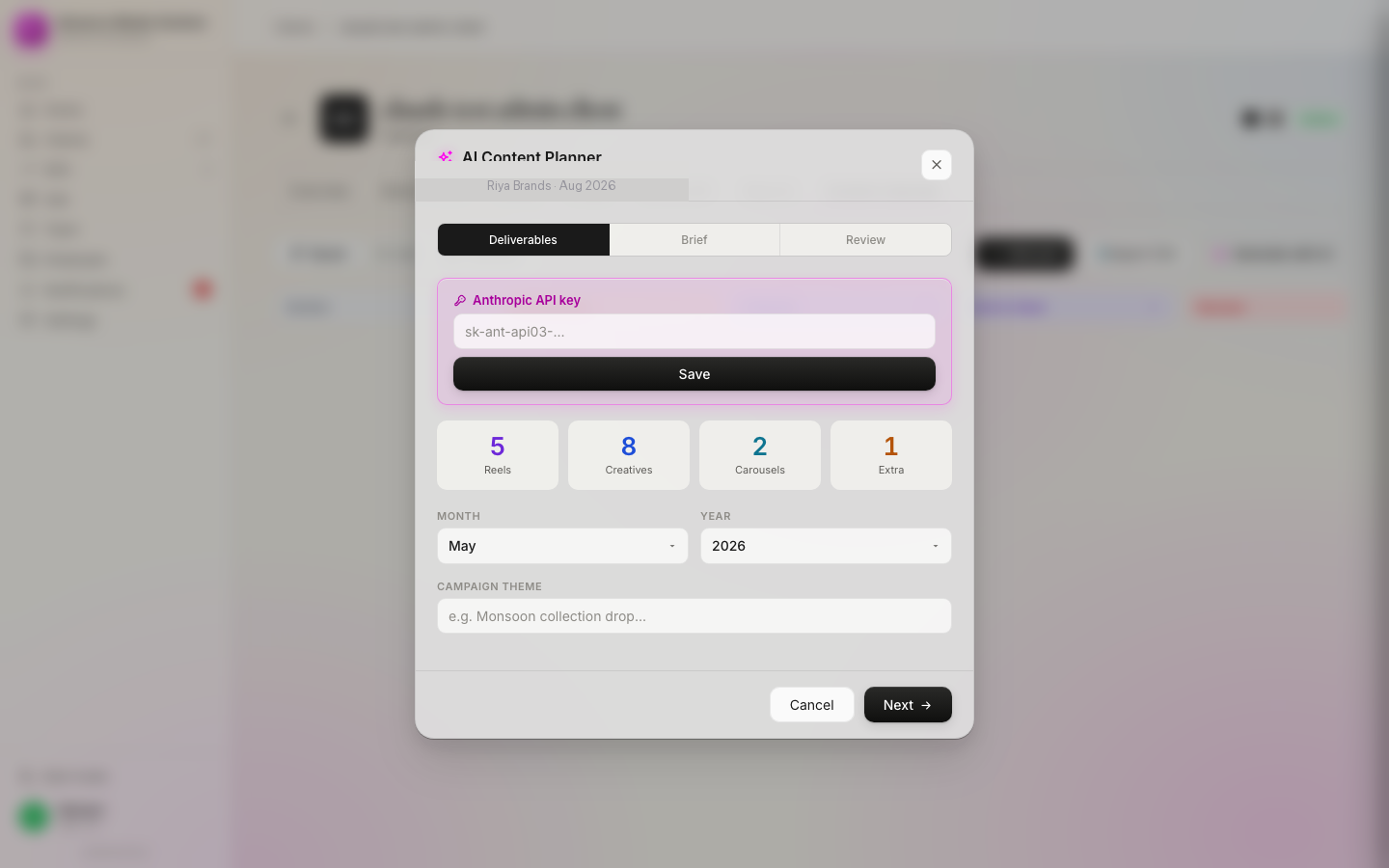
When the calendar is approved, the posts move through client approval and scheduled publishing with the pillar still attached, so the quarterly review is a filter, not a spreadsheet exercise. Whether your clients are cafés in Lucknow or clinics in Dehradun, the habit is the same: four buckets, every post tagged, reviewed once a quarter.
Frequently asked questions
How many content pillars should a brand have?
Three to five. Fewer than three and a small brand runs out of ideas by the second month. More than five and each pillar gets one or two posts a month, which is too thin for the audience to notice a pattern. A local business posting 12 to 16 times a month is usually best served by four.
Are festivals and offers a content pillar?
No. Festivals are moments on the calendar and offers are a sales layer. Both should be expressed through an existing pillar: a Diwali post becomes a product, process or customer story with festive styling. Treating festivals as their own pillar is how calendars end up full of generic greeting posts with the logo in the corner.
How often should an agency change a client's content pillars?
Review them every quarter and change them rarely. Look at three months of reach, saves, shares and enquiries per pillar. Drop or reshape a pillar only when it has underperformed for a full quarter or the business itself has changed, such as a new service line, a new location or a new target customer.
Plan every month from the brand's own pillars
Store each client's pillars on their profile, draft the month with the AI planner, get client approval in one place and auto-publish to Instagram and Facebook, in the same agency workspace as your reports and GST invoices. From ₹999/month. Try it free for 3 days, no card needed, with a 7-day money-back guarantee.