Type "AI content calendar generator" into Google and you'll get a dozen free tools that all do the same trick: give them a niche, get back thirty post ideas. The trick works. It's genuinely impressive the first time. And then you sit there with thirty ideas in a browser tab and realise the actual month hasn't moved an inch.
I plan content for a living. Here's what these tools really do, where the time actually goes, and how to make AI planning survive contact with a paying client.
What does an AI content calendar generator actually do?
Almost all of them do one job — idea generation — and they're honest about it if you read the page. Optimo's free tool says it can "create entire month's calendars for you from a single keyword" and gives you ideas in seconds, free and unlimited; it doesn't schedule or publish anything. Wideo's generator produces captions, video scripts and suggested posting times for Instagram, TikTok and LinkedIn, lets you edit them, and then exports "everything as a CSV or DOCX to adjust it before publishing" — publishing being somebody else's problem.
A few go further. Predis.ai generates the creative alongside the caption and publishes directly to Instagram, Facebook, LinkedIn, Pinterest, YouTube, TikTok, GMB and Twitter, and usefully for India, states that "any important dates or festivals will automatically show up in your content calendar."
So the category splits cleanly in two, and the split matters far more than which tool writes the nicer caption:
| One-shot generator (free tools) | AI planner inside your workflow | |
|---|---|---|
| Input | A keyword or niche | The client's stored brand brief, past posts, offers |
| Output | Ideas, captions, suggested dates | Draft posts already sitting on dated calendar slots |
| Getting it out | Copy-paste, CSV or DOCX | Nothing to export — it's already there |
| Remembers the brand next month | No | Yes |
| Client approval | Separate — WhatsApp, email, deck | Same screen, one tap, logged |
| Publishing | Manual, elsewhere | Auto-publish at the scheduled time |
| Real cost | Free + 3–4 hours of re-keying per client | Subscription, no re-keying |
Generation was never the expensive part. Ask any agency where a month actually goes and it's re-keying, chasing approvals and production — not thinking up post ideas. A free generator optimises the cheap step.
Why does AI-generated content sound so generic?
Because the input was generic. A tool handed the word "bakery" can only produce the average bakery post — behind-the-scenes reel, "which one would you pick?", a national-days list. That output isn't wrong, it's just indistinguishable from every other bakery's feed, which is the one thing a client is paying you to avoid.
The fix is boring and it works: write the client a brand brief once, and feed that brief to the AI every time instead of a niche keyword. Ours has eight fields, and the difference in output quality is not subtle.
- What they actually sell, with price points. "Bridal jewellery, ₹40,000–₹3 lakh" produces different content from "jewellery".
- Who buys, in one sentence. Age, city, who signs off the purchase — often not the person browsing.
- The top three objections the client hears before a sale. This is where the best content comes from, and AI can't guess it.
- Voice rules. Formal or friendly, Hindi-English mix or pure English, emoji or none, what the founder refuses to say.
- Five past winners — the posts that actually performed, pasted in as examples to imitate.
- Banned claims. Every regulated vertical has them. If you work in coaching, real estate or healthcare, this field keeps a generated caption from becoming a compliance problem.
- The format mix for the month — how many reels, carousels, statics, stories.
- This month's business goal. Footfall for a new outlet is not the same brief as festive sales.
Ten minutes to write per client, reused every month forever. This is the single highest-leverage thing you can do with AI planning, and almost nobody does it because the free tools never ask.
The India layer that AI misses by default
Indian calendars live and die by dates, and generic models handle them badly. Three corrections we make on every plan:
- Block festivals first, generate second. Auto-populated festival lists cover the national ones and miss the local ones that actually drive business — Chhath in Patna, Onam in Kochi, Gudi Padwa in Nashik, Teej across Rajasthan. Put your client's real revenue dates on the calendar manually, then let AI fill the gaps between them.
- Watch the tone on religious occasions. AI's default festival caption is a greeting card. For a brand with an actual point of view it reads as filler, and for some occasions — a solemn one, a regional sentiment — it reads as tone-deaf. Human writes those. Always.
- Language mix is a business decision, not a style one. A Ludhiana retailer and a Bengaluru SaaS brand need different English. State it in the brief, or you'll get American English with Indian nouns.
Posting times deserve the same scepticism. AI's "suggested posting time" is a genre convention, not your client's audience — use their own insights instead, which we broke down in the best time to post on Instagram for an Indian audience.
The 45-minute AI planning workflow
This is the loop we run per client per month once the brief exists.
- Block the fixed dates (5 min). Festivals, launches, offers, client events. Non-negotiable slots first.
- Generate around them (5 min). Brief plus format mix plus this month's goal, in. A full draft month, out.
- Cut a third (10 min). The fastest quality gain available. Delete every draft that could belong to any brand in the category — that's usually 8–10 of 30. Don't replace them; a 20-post month of specific content beats a 30-post month of filler.
- Rewrite the hooks by hand (15 min). Keep AI's structure and body, replace the first line. First lines are where generic content announces itself, and they're 80% of the scroll decision.
- Send the whole month for approval in one batch (5 min). Not post by post — that's what turns approvals into a two-week WhatsApp thread. Our guide to faster client approvals covers the batching mechanics.
- Queue everything approved (5 min). Approved posts go into the publishing queue with their slots and publish themselves. The month-in-a-day bulk scheduling workflow has the pre-flight checklist for a 30-post batch.
Forty-five minutes of human attention per client per month, spent entirely on the parts a machine is bad at. At twelve clients that's a single working day for the whole roster's planning — which is the actual promise of AI planning, and it has almost nothing to do with caption quality.
What AI should never decide
- Any factual claim about the client. Prices, offers, timings, awards, "India's No. 1". A model will invent a plausible one, and it's your agency's name on the post.
- Regulated claims. Selection rates, medical outcomes, project registration details, returns on investment. These get written by a human against the client's approved language.
- Crisis or sensitive-moment posts. Scheduled festive content going out on a bad news day is the classic scheduling failure — someone has to be watching, and that someone is a person.
- The final approval. AI drafts, humans approve, clients sign off. That chain is also what protects you in a dispute.
Social media is where the money is going — dentsu's 2026 report puts India's social media ad spend at ₹21,057 crore in 2025, with digital overall at 59% of all Indian ad spends. Clients aren't paying for volume of posts; they're paying for a plan that's specific to them. AI makes producing that plan cheap. It does not make it specific. That part is still your job, and it's the part worth charging for.
Frequently asked questions
Are free AI content calendar generators any good?
They're good at the first draft and nothing else. Free generators take a keyword or niche and return a month of post ideas, often exportable as CSV or DOCX. None of them hold your client's brand voice between sessions, route posts for approval, or publish anything — so the plan still has to be re-entered somewhere.
Why does AI-generated social media content sound generic?
Because the input was generic. A tool given only a niche can only write the average post for that niche. Feed it the client's actual offers, price points, city, audience objections, past winners and banned claims, and the output changes from filler to a usable first draft in one pass.
Can AI plan a month of Indian festival content?
Partly. Some tools auto-populate major festival dates, but they miss the regional ones that matter locally and they get the tone wrong on religious occasions. Block your festival and campaign dates manually first, then let AI fill the gaps around them.
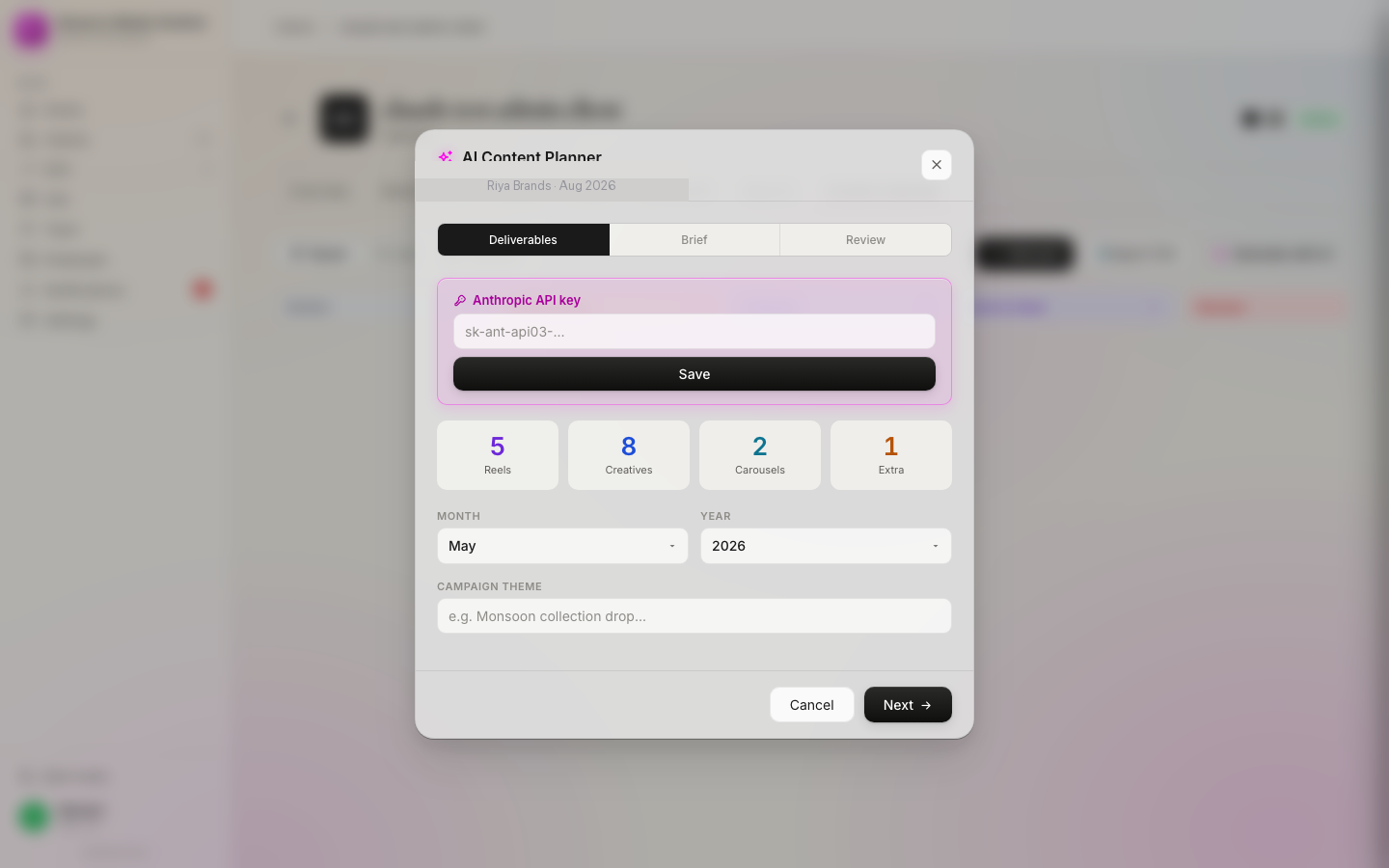
An AI planner that drafts into the calendar you publish from.
Per-client brand briefs, a month drafted in seconds, client approval in one tap, and approved posts that auto-publish on schedule — one login for the whole agency. Built in India, priced in rupees, from ₹999/month.