Every agency I know has done this. A reel is due, the editor drops the sound that is doing numbers this week, it goes live, it performs, nobody thinks about it again. I have signed off on that reel myself more times than I would like to write down.
Then in April 2026 Zee Entertainment took Nykaa's parent company to the Delhi High Court over exactly this, and the question stopped being theoretical for Indian brands. This post is what I now tell every client and every editor on my team: what the actual rule is, what changed, who carries the risk, and what to do on Monday morning. I am a practitioner, not a lawyer — if you have a claim in hand, get counsel.
Why can't a brand account use the trending audio?
Because two different things get confused: availability and permission.
Instagram licenses a large music catalogue from labels so that ordinary users can soundtrack their personal posts. That licence is for personal, non-commercial use. The moment the post is promoting a product, a service, a sale or a brand, it falls outside what the platform negotiated on your behalf. The song being right there in the picker changes nothing about the scope of that licence — as one legal analysis of the Zee case put it plainly, the fact that a song appears in the app's library is not authorisation.
Meta already builds this distinction into the product. Business and professional accounts are shown the Meta Sound Collection — over 14,000 royalty-free tracks and sound effects cleared for commercial use on Meta's platforms — rather than the full consumer catalogue. If your client's account suddenly "lost the good music" after you switched it to a professional account, that is not a bug. That is the licence boundary made visible.
Here is the trap I see most in India, and it is specific to how our market sets up accounts. A very large number of Indian brand pages are still running as personal or creator accounts, often because they were set up by the founder years ago and never converted. Those accounts still see the full library. Agencies read that as permission. It is not. The account type does not decide whether the use is commercial — the content does. A sponsored reel posted from a personal account is still a sponsored reel.
What actually happened in Zee v. Nykaa?
The short version, because it is the case every Indian brand lawyer is now citing:
- In April 2026, Zee Entertainment Enterprises moved the Delhi High Court against FSN E-Commerce Ventures, Nykaa's parent, alleging unauthorised use of Zee-owned songs in promotional Instagram reels.
- The claim covered twelve reels and sought damages of roughly ₹2 crore (reported at around $210,000).
- Zee's position was that its licensing arrangement with Meta permits individuals to use its music for non-commercial purposes — and that Nykaa's promotional reels, reaching millions of followers, were not that.
- The disputed reels were taken down.
- In a filing dated 19 May 2026, Nykaa applied to implead Meta, arguing that only the platform can authoritatively state whether the use breached any licence terms — because the tracks came from Instagram's own library.
The case has not been decided. Nothing here is a ruling, and I am not going to pretend otherwise. But you do not need a judgment to learn the operational lesson, which is this: a large, well-advised, publicly listed Indian company used library audio on brand reels, and it cost them a court appearance and a takedown. If Nykaa's legal team did not catch it, your client's marketing executive certainly will not.
Note also that pulling the reels did not end the matter. A takedown stops ongoing use; it does not undo the use that already happened.
The two copyrights hiding in every song
This is the part that explains why "but I paid for a music app" is usually not a defence. Every recorded track carries two separate rights:
- The sound recording — the specific recorded performance. In India this typically sits with the label.
- The underlying musical work and lyrics — the composition itself, which sits with the composer, lyricist and their publisher.
Clearing a commercial campaign means clearing both. That is why a proper sync licence for a known Hindi film track is a negotiation with more than one party and rarely cheap — and why nobody does it for a Tuesday reel. The realistic answer for agency work is not to license the hit; it is to stop needing it.
And while we are killing myths: under the Copyright Act, 1957, the exceptions in Section 52 are an enumerated list, not a broad American-style fair use defence. "I credited the artist," "it was only fifteen seconds," "it was already viral" and "Instagram let me" are none of them.
What is actually safe to use?
Ranked from safest to most dangerous, for an Indian brand reel:
| Audio source | Safe for a brand reel? | What you should know |
|---|---|---|
| Original or commissioned music | Yes | Safest of all, provided you have a written assignment or licence from whoever made it |
| Meta Sound Collection | Yes, within Meta's terms | 14,000+ royalty-free tracks cleared for commercial use on Meta platforms; what business accounts see by default |
| Paid stock music library | Yes, if the licence says commercial | Read the tier — many libraries sell a cheaper personal licence that excludes advertising |
| Direct sync licence from label + publisher | Yes | The only route to a real hit song. Expensive, slow, worth it for a campaign film |
| Voiceover, ambient or no audio | Yes | Underrated. Most high-intent product reels perform fine on a voiceover |
| Trending audio from the consumer library | No | Personal, non-commercial licence. This is the Zee v. Nykaa fact pattern |
| A creator's remix or viral clip | No | Usually unlicensed at source too — you inherit their problem on top of yours |
| Audio "borrowed" from a competitor's reel | No | Same rights issue, plus it is somebody else's creative |
Who is liable — the brand or the agency?
This is the question agency owners should care about most, and it is the one every article on the Zee case skips.
The brand is the obvious defendant: it owns the handle and gets the commercial benefit. But the agency picked the track, cut the reel and pressed publish. Under Section 51 of the Copyright Act, infringement is not limited to the person whose name is on the account, and knowledge matters — which cuts against you, not for you, once you have read an article like this one.
In practice the exposure lands wherever your paperwork says it lands, and most Indian agency paperwork says nothing. If your retainer has no clause on who clears music, you are one aggressive legal notice away from a conversation with a client who will say, accurately, that they hired you for exactly this expertise. Fix it in the contract before you fix it in the workflow — our retainer agreement guide covers where that clause sits, and the influencer contract template covers the equivalent warranty when a creator supplies the reel.
The same logic applies to disclosure. If you are already handling ASCI labels correctly — and if you are not, read the ASCI guidelines for agencies — you already have the habit of treating a promotional reel as a regulated object rather than a post. Audio is the same category of problem.
What to change in your workflow this week
- Audit what is already live. Go through the last six months of reels for every client. List anything promotional that used library audio. You are not necessarily taking them down — you are finding out how big the number is.
- Convert client accounts properly. Every brand account should be a business or professional account. Yes, this shrinks the music picker. That is the point.
- Build an approved sound list per client. Ten to fifteen tracks from the Meta Sound Collection or a licensed library that fit the brand. Editors pick from the list, not from the trending tab.
- Record the audio decision against the post. Which track, from which source, approved by whom. If a notice ever arrives, the difference between a bad week and a bad quarter is whether you can produce that record.
- Put a music clause in the retainer. Who selects, who clears, who indemnifies. One paragraph.
- Brief the client, in writing, once. Especially the ones who forward you a competitor's reel and say "iske jaisa banao". They need to hear that the trending sound is the part you cannot copy.
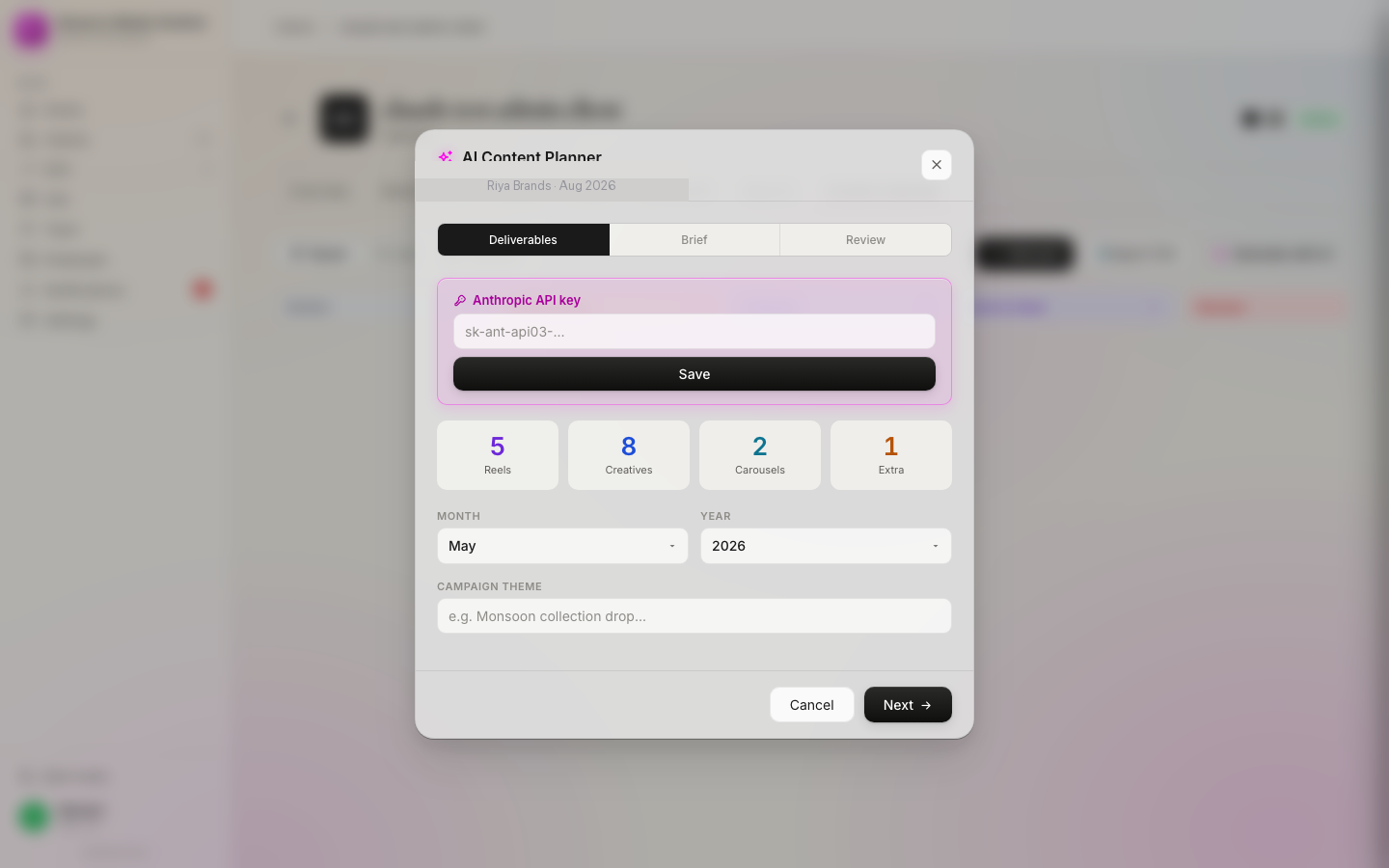
Point four is the one agencies underrate. Scheduling a reel through the official API instead of a phone reminder is not only about convenience — it means every published reel has a record attached to it, with a timestamp and a named approver. When the risk is legal rather than aesthetic, a paper trail is worth more than a good eye. We made the same argument about approvals in handling client revisions, and it applies here with sharper teeth.
Is this going to hurt your reach?
Honestly, a little, and I would rather say so than pretend otherwise. Trending audio is a distribution lever; giving it up costs something. Three things soften it:
- Voiceover-led reels travel well. For most of the categories Indian agencies actually serve — restaurants, clinics, real estate, D2C — a clear hook spoken over the footage outperforms a trending sound the viewer has heard forty times.
- The trending sound was never the whole reason a reel worked. Hook, pacing and the first two seconds do more.
- The downside is asymmetric. A reel that underperforms costs you a day. A legal notice on twelve reels costs a client relationship.
Whether you run a studio in Mumbai with listed clients or a three-person team in Lucknow, the calculation is the same: the audio is the cheapest part of the reel to replace and the most expensive part to get wrong.
Frequently asked questions
Can a brand use trending audio on Instagram Reels in India?
Generally no. Instagram's full music library is licensed for personal, non-commercial use. A reel that promotes a product or service is commercial, so the platform licence does not cover it. Business and professional accounts are shown the Meta Sound Collection instead, which is cleared for commercial use on Meta's platforms.
What is the Zee v. Nykaa case about?
In April 2026 Zee Entertainment moved the Delhi High Court against Nykaa's parent, FSN E-Commerce Ventures, alleging that twelve promotional Instagram reels used Zee's songs without a licence, and seeking roughly ₹2 crore in damages. The reels came down. Nykaa has applied to implead Meta. The matter is still pending.
Is the agency or the client liable if a reel infringes?
Both can be exposed. The brand owns the account and gets the commercial benefit, so it is the obvious defendant. The agency chose the audio, produced the reel and published it, which is why sensible retainers now carry an explicit clause on who clears music and who indemnifies whom if a claim arrives.
What music is safe for a brand reel in India?
The Meta Sound Collection, which Meta describes as over 14,000 royalty-free tracks and effects cleared for commercial use on its platforms. A paid licence from a stock music library with commercial rights. Original or commissioned music with a written assignment. Or a sync licence negotiated directly with the label and the publisher.
Does deleting the reel fix the problem?
It stops the ongoing use, which matters, but it does not undo the past use. A takedown is damage control, not a defence, and it does not remove exposure to a claim for the period the reel was live. Auditing what is already published is the more useful first step.
Every reel, with a record attached.
Plan reels on a client calendar, capture the approval and the audio decision against the post, publish through the official Instagram API, and raise the GST invoice from the same client record. Flat pricing from ₹999/month, 7-day free trial.
Start Free Trial