Restaurants are one of the best social media clients an Indian agency can take. The product is photogenic, the buying cycle is hours rather than months, and the owner can see the result walk through the door. They're also easy to run badly, because "post nice food photos" produces likes from other cities and empty tables at 8 PM on a Tuesday.
This is the playbook I'd hand a team taking on a restaurant client — what to post, how to make it convert, what it costs to deliver, and the two Indian regulators whose rules touch food content and almost never appear in guides on this topic.
What should a restaurant actually post on Instagram?
The failure mode is monotony: thirty photographs of food, shot in the same corner, at the same time of day. A restaurant's real audience is local, and locals need a reason to come back to the profile more than once. The rotation that has worked for our food clients, per week:
| Slot | Format | Job it does |
|---|---|---|
| 2× per week | Food reel — the dish being made, plated or cut | Reach beyond followers; the sound and steam do the selling |
| 1× per week | People — chef, staff, a regular, the kitchen at 7 AM | Trust and personality; the reason to follow rather than just watch |
| 1× per week | Offer, event or new item, with a clear action | The post that produces bookings; keep it to one ask |
| Daily | Stories — today's specials, what's running out, reposts of guest tags | Same-day footfall; this is where walk-ins actually come from |
| Monthly | One carousel — full menu section, or a guide to the area | Saves and shares; the post people send to a friend |
Two things that consistently outperform for Indian restaurants, and cost nothing to produce: guest-tagged content reposted to Stories with permission, and staff-led reels. A thirty-second clip of a chef explaining why the biryani rests for twenty minutes will out-perform a studio-grade plating shot, because it is the only version of that content nobody else can post.
Timing matters more here than in most categories — a dinner post at 3 PM is wasted. Our data-backed breakdown of IST posting windows by niche covers the food-and-beverage pattern; the short version is that you're posting into the gap just before people decide where to eat, not while they're eating.
Why do food reels get views but no tables?
Because nothing in the post tells a hungry person nearby what to do next. It's the most common thing I fix on a restaurant account, and it has nothing to do with content quality. The conversion path a restaurant profile needs, in order:
- Location tag on every single post and story. Not the city — the venue's own tagged location. It's how people browsing an area find the place, and it's free.
- A bio link that isn't a link-in-bio maze. Two destinations at most: table booking or WhatsApp, and the delivery listing. Every extra tap loses people who were three seconds from ordering.
- WhatsApp as the booking channel. In India this converts better than a form, every time. A "Message" button on the profile and a WhatsApp CTA in offer posts turns interest into a table without anyone answering a phone during service.
- Google Business Profile kept current. Instagram creates the craving; Maps captures the search that follows. Hours, photos, menu link and the FSSAI-registered name should match what's on Instagram, or you lose people at the last step.
- Delivery listings linked, not hidden. Owners often resist promoting aggregator links because of commissions. Fine — then give the audience a direct-order or call option in the same post. What doesn't work is offering no path at all.
Measure the account on saves, shares, profile visits and direction requests — not follower count. A restaurant with 4,000 engaged locals beats one with 40,000 followers spread across the country, and the second one is far easier to accidentally build with generic food content.
The compliance layer nobody in this niche writes about
Food is a regulated category in India, and two sets of rules land squarely on the work an agency does. Neither is difficult; both are embarrassing to discover after a client gets a notice.
Influencer collaborations: ASCI's disclosure rules
Restaurant marketing runs on food bloggers, and most of those collaborations are quietly non-compliant. Under ASCI's Guidelines for Influencer Advertising in Digital Media, a material connection includes "benefits and incentives, such as monetary or other compensation, free products with or without any conditions attached including those received unsolicited, discounts, gifts, contest and sweepstakes entries, trips or hotel stays, media barters".
Read that again with a restaurant in mind: the complimentary tasting is a material connection. The guidelines are explicit that disclosure is required "even if the evaluations are unbiased or fully originated by the influencer". The rules on how it must appear are equally specific:
- Disclosure "must be upfront and prominent so that it is not missed by an average consumer" — and is "likely to be missed" if it sits only in a bio, at the end of a post, or behind a MORE click.
- It "should not be buried in a group of hashtags or links".
- On picture or video posts without text — Stories, for instance — the label must be superimposed on the visual.
- Duration rules for video: at least 3 seconds on videos of 15 seconds or less; one-third of the length for videos between 15 seconds and 2 minutes; for the whole relevant section on videos of 2 minutes or more.
- Permitted labels reported from the guidelines include #ad, #advertisement, #sponsored, #collaboration, #partnership, #employee and #free gift, with English as the primary language of disclosure.
Responsibility sits with both the advertiser and the influencer — so it's your client's exposure, not just the blogger's. Put the disclosure requirement into the collaboration message itself, along with the deliverable and the date. It takes one line and removes the argument entirely.
FSSAI: menu labelling and the licence number
The Food Safety and Standards (Labelling and Display) Regulations, 2020 brought in menu labelling for food service establishments with a central licence or ten or more outlets across India, with effect from 1 January 2022 — calorific values against each item, allergen declarations, and the veg/non-veg symbols, on menu cards, boards and booklets, and on websites or apps where food is listed online.
For a single neighbourhood café this doesn't apply. For a chain client it very much does, and the graphic your designer makes for a menu revamp can land inside the requirement. Separately, FSSAI requires the licence or registration number to be displayed at the premises, and food businesses are required to declare the 14-digit FSSAI number on bills and cash memos — worth confirming your client has this in order before you build a campaign that sends new customers their way. FSSAI's own food safety display board page is the reference to send them.
Health and nutrition claims deserve the same caution. "Healthy", "immunity-boosting" and "sugar-free" are claim territory, not copywriting flourishes. If the client can't evidence it, don't write it. This is the same discipline that applies across India's regulated verticals — I've written up the equivalent rules for real estate, coaching and healthcare clients, and food belongs in that list.
I'm an agency founder, not a lawyer. Treat this as the practical version and check anything consequential with a professional.
What should you charge a restaurant?
The variable that decides the retainer isn't post count — it's who shoots. A restaurant account can't run on client-supplied phone photos for long; the menu changes, the seasons change, and you'll be dry by month three. So price around a shoot cadence:
- Client-supplied footage. You plan, write, design and schedule; the restaurant's team shoots to your brief. Bottom of your city band, and honestly the hardest version to keep good — expect to spend real time coaching whoever holds the phone.
- Monthly shoot day. One half-day at the venue every month, producing enough for four weeks of reels and statics. This is the model I'd default to, and the retainer has to carry the shooter, the editor and the travel with margin left over.
- Fortnightly or event-driven. For chains, festival menus and launches. Priced as retainer plus production, quoted separately, never absorbed.
Two commercial rules I'd hold. First, quote ad spend separately and never absorb it — the pricing bands in my India rate card by city tier are management fees only. Second, agree the festival calendar at onboarding: for a food client, Diwali, Navratri, Christmas–New Year and the local festival that matters in their city are your four biggest months, and the menu, the shoot and the ad budget all need to be planned weeks earlier than the client will naturally think of it. A restaurant in Indore and one in Mumbai won't have the same list.
The operating rhythm that keeps a restaurant account alive
Restaurant owners are the hardest clients to get approvals from, and it isn't rudeness — they're on the floor during service, which is exactly when you need an answer. Build for that. The rhythm that survives contact with an actual restaurant:
- Shoot day, once a month, scheduled around service — mid-morning is usually the only sane window.
- Batch the month in one sitting while the footage is fresh. Doing this weekly is how agencies lose money on food clients. The month-in-a-day workflow is built for exactly this shape of account.
- One approval round, on their phone. Not a WhatsApp thread with fourteen screenshots — a calendar the owner can swipe through and approve between lunch and dinner service.
- Auto-publish on the schedule, so nobody has to remember to post at 7:30 PM. Manual posting is how a Friday offer goes live on Saturday.
- Leave two open slots a week for reactive content — a full house, a queue outside, an unexpectedly good review. Rigid calendars die in this category.
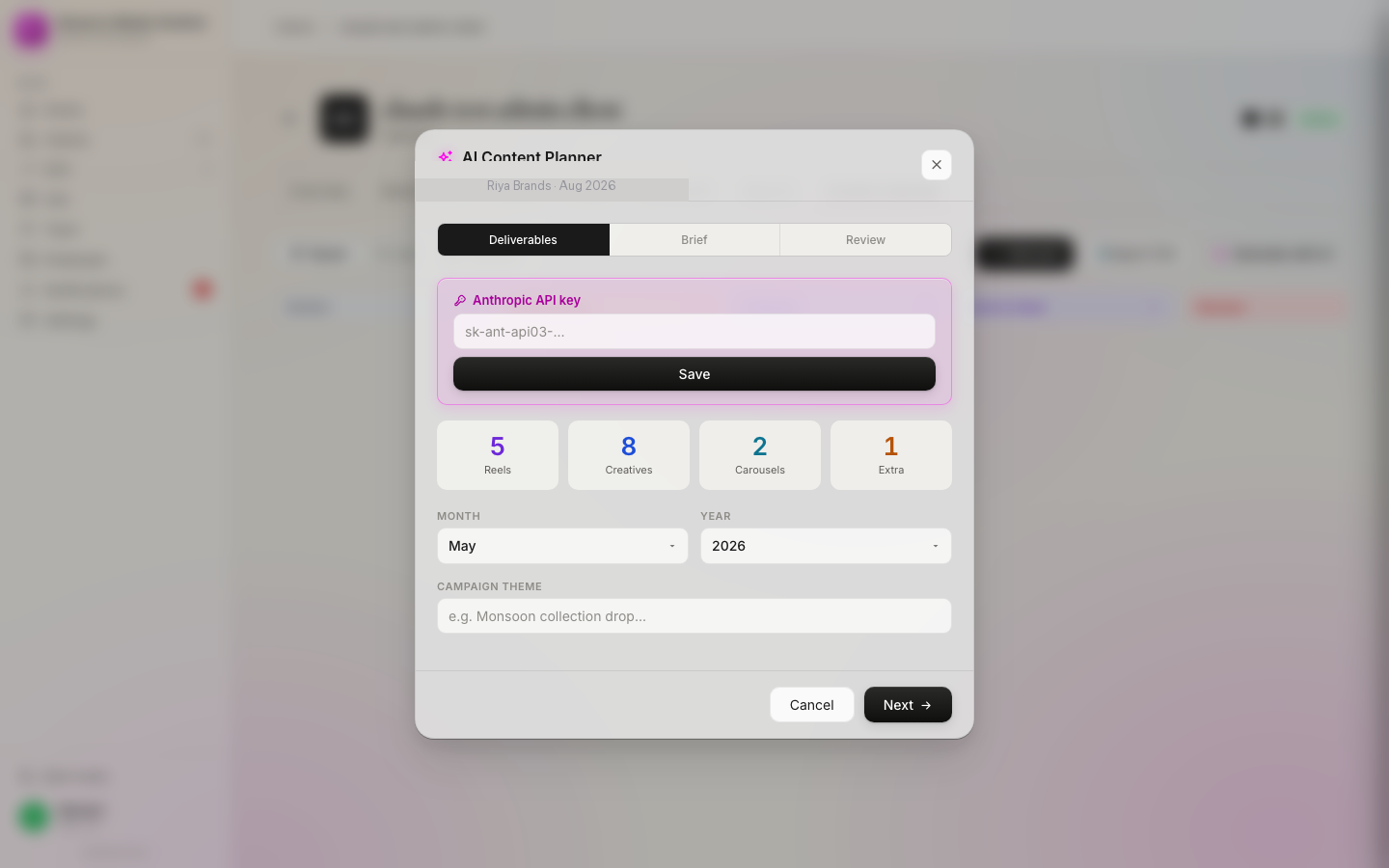
Handle those five and the account largely runs itself between shoot days, which is what makes restaurants profitable to serve rather than a permanent fire. The Instagram scheduler and one-tap client approvals in our agency workspace exist because this exact pattern — batch, approve once, publish automatically — is what separates a food client you make money on from one you don't.
Frequently asked questions
Does an influencer need to disclose a free meal in India?
Yes. ASCI defines a material connection as including free products received with or without conditions, so a complimentary tasting triggers a disclosure even when no money changes hands and even when the review is genuinely the influencer's own opinion. The label must be upfront, not buried in hashtags.
How much should an agency charge a restaurant per month in India?
The deciding factor is the shoot, not the posting. A content-only retainer using footage the restaurant supplies sits at the bottom of your city band; a retainer where you send a shooter monthly has to carry that production cost plus margin, which usually means a meaningfully higher number in metros.
Do FSSAI menu-labelling rules apply to Instagram posts?
The calorie and allergen display rules attach to menus, boards and online listings for establishments with a central licence or ten or more outlets, not to ordinary Instagram creatives. But if you design menu graphics for a chain client, that artwork can fall inside the requirement — check before publishing.
Run food clients without the WhatsApp chaos.
Batch a month of reels after the shoot, get one-tap approval from an owner who's on the floor, publish automatically at dinner-decision time, and invoice with GST handled. From ₹999/month, with a 7-day money-back guarantee.