Almost every bad hire I have made was charming in the interview. The portfolio was pretty, the answers were confident, and six weeks later I was writing the captions myself at 11pm because the work coming back needed rewriting anyway.
The fix was not better interviewing. It was replacing the interview with a small piece of paid work, and then paying attention to the three things an interview cannot show you: how someone thinks about a brand they have never met, how they behave when a client is annoyed, and whether they finish things.
This piece is about finding, testing and legally employing that person. If you are still deciding whether to hire at all, the maths for that — cost of the first hire, and the three-retainer rule — sits in our guide to going from freelancer to agency.
What should you pay a social media manager in India?
Start with the public number, then adjust. Indeed's India page for social media managers showed an average base of ₹22,007 per month from 394 reported salaries when we checked it (updated 27 July 2026), with the range running from about ₹11,630 to ₹41,645. That is self-reported aggregator data and it blends interns, in-house juniors and agency staff, so treat it as a floor rather than a benchmark.
These are the bands we actually hire against — our own numbers from a tier-2 base in Uttarakhand, not a survey:
| Role | Experience | Monthly, tier-2 | What they can own |
|---|---|---|---|
| Content executive | 0–1 year | ₹18,000–₹25,000 | Production from an approved plan; drafts, not decisions |
| Social media manager | 2–4 years | ₹30,000–₹45,000 | 4–6 accounts end to end, including the client call |
| Senior manager / account lead | 5+ years | ₹55,000–₹80,000 | A pod of 2–3 people, plus the accounts you cannot afford to lose |
Add roughly 30–50% for Mumbai, Bengaluru, Gurugram or Hyderabad. For a sanity check on the wider market, Storyboard18 reported in November 2025 that India's ad-agency workforce sits at just over 6.5 lakh with attrition around 10–12%, most hiring being replacement-driven — and quoted current copywriter salaries at ₹25,000–₹40,000 a month depending on city and skill. The same piece noted that post-pandemic pay inflation has since moderated sharply. In other words: the market is not as hot as it was in 2022, and you are mostly competing for people who already have a job.
Where do Indian agencies actually find good managers?
Ranked by what has worked for us, best first:
- Your own past interns and freelancers. You have already seen them work. This is the highest-hit-rate channel by a distance and nobody uses it enough.
- Referrals from people who do the job. Not from clients, not from your CA — from designers and editors you already work with. Good operators know other good operators.
- Instagram and LinkedIn, directly. Find accounts in your city whose content you genuinely admire, work out who runs them, message that person. The best managers are rarely on a job board; they are visibly doing the work somewhere.
- Internshala and campus tie-ups, for the executive tier only. Volume of applicants, low average, but it is the right channel for a 0–1 year hire you intend to train.
- Naukri and the large boards, last. Enormous applicant volume, mostly irrelevant, and you will spend more time filtering than you saved.
One thing to resist: hiring the person who has worked at a big-city agency purely for the brand name on the CV. They often arrive expecting a strategist, a designer, an editor and a media buyer to exist. In an eight-person agency, the person is all four.
How do you test a social media manager before hiring?
With a paid brief, on a real brand. Not a hypothetical, not "make us a strategy deck for Nike."
Ours takes the candidate about three hours and we pay ₹1,500 for it whether or not we hire. That is trivially cheap next to six weeks of a wrong hire, and paying changes who says yes — the confident, currently-employed candidates you most want will not do free spec work, and they are right not to.
The brief we send
One real client, anonymised. Here is the brand, the audience, last month's six best and six worst posts with their numbers, and the client's one stated complaint. Send us: five post ideas with one-line reasoning each, one of them written out fully as a caption, a rough reel script, and three lines on what you think is going wrong. No design needed.
What we are actually reading
Does the reasoning connect to the brand's business, or only to "engagement"? Did they notice what the numbers already say? Is the caption in the brand's voice or theirs? Is the reel script shootable by a two-person team with a phone, or does it need a crane? And did it arrive when they said it would.
Three signals that have never once been wrong for us. They ask questions before starting — one clarifying message about the audience or the budget is worth more than the whole submission. They send it on time, because deadline behaviour in week zero is deadline behaviour in month six. And they can defend a choice they made when you push back on it in the follow-up call, without either collapsing or getting defensive.
The interview questions that separate operators from posters
- "Walk me through a post you made that did badly. What did you change after?" — the single most useful question in the set. Anyone can narrate a win.
- "A client rejects a carousel at 9pm the night before it goes out. What do you actually do?" — you are listening for a process, not heroism.
- "How many brands can you handle properly, and how do you know when you are at the limit?" — a real answer here is rarer than you would think. Our piece on how many clients one manager can handle is the benchmark we compare their answer against.
- "Show me your phone's screen time for Instagram." — half-joking. But someone managing brand accounts who never uses the platform is a real risk, and so is the opposite.
- "What would you need from us in your first week?" — good candidates have a list. Passive candidates say "whatever you think."
The India layer: appointment letters are now mandatory
This is the part no international hiring guide will tell you, and most small Indian agencies have not caught up with it. The four labour codes — Wages, Industrial Relations, Social Security, and Occupational Safety, Health and Working Conditions — were brought into force on 21 November 2025, rationalising 29 central labour laws. The government's own before-and-after summary is blunt about the change: where there were previously "no mandatory appointment letters", it is now "mandatory appointment letters to all workers."
Other bits that matter to a small agency in the same notification: social security coverage extends to all workers including gig and platform workers — so your regular freelance editor is not automatically outside the frame; and ESIC coverage is now pan-India, voluntary for establishments with fewer than ten employees, and mandatory where even one employee is engaged in hazardous processes. The central rules under the codes were published in draft on 30 December 2025 and are still in consultation, so the operational detail will keep moving — but the appointment-letter obligation is live today.
Practically, for a five-person agency: issue a letter to every hire including your first, stating role, reporting line, monthly gross with the breakup, probation length, notice period both ways, and working days. Two agency-specific clauses worth adding while you are at it — account access reverts on the last working day, and client work is the agency's. Get the template checked once by a local labour consultant or CA; it is a one-time cost of a few thousand rupees and it settles the question for every future hire. This is general information, not legal advice.
The first 30 days decide whether the hire works
Most "bad hires" are bad onboardings. The person arrived, was given a WhatsApp group and a Canva login, and was expected to infer the standard.
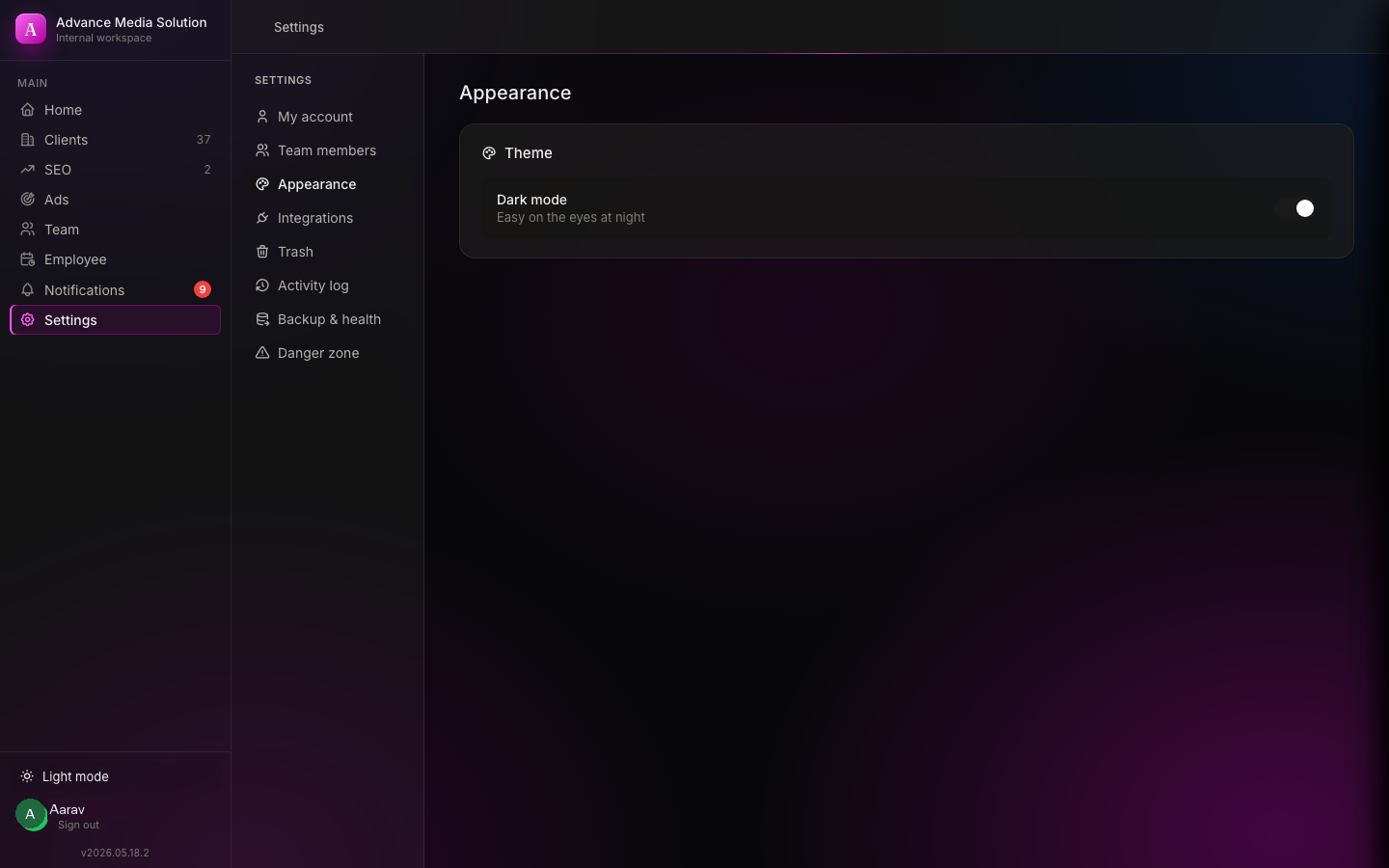
What we do now, in order:
- Day 1 — their own login, not a shared one. Role-based access to the two or three clients they will own. Never the master password; our client onboarding guide covers the access model in detail.
- Week 1 — shadow, then shadow in reverse. They watch you run one full month cycle on one account, then run the next one while you watch.
- Week 2 — one account, fully owned. Including the client call. You sit in silently. Resist rescuing them mid-call.
- Week 3–4 — second and third account, plus the written standard. This is when the gaps in your own documentation become obvious, which is exactly why every agency should have its five core SOPs written before the hire starts, not after.
- Day 30 — a real review. Two things working, two things not, and a decision about probation made honestly rather than deferred out of awkwardness.
And set the capacity expectation early. A new manager taking on six accounts in month one will do six accounts badly and then leave — which is how an agency in Lucknow or Indore ends up re-hiring the same role twice in a year, and how the client notices before you do. The early warning signs of churn and the early warning signs of an overloaded manager are very nearly the same list.
Frequently asked questions
What salary should an agency offer a social media manager in India?
In a tier-2 city, roughly ₹30,000–₹45,000 a month for someone with two to four years who can run four to six accounts without supervision. Add 30–50% in Mumbai, Bengaluru or Gurugram. Aggregator averages sit lower because they mix in interns and fresher roles with agency managers.
Should you give candidates a test task before hiring?
Yes, and pay for it. A three-hour brief on a real brand predicts performance far better than any interview, because it shows the thinking behind the work. Unpaid spec work filters out exactly the confident, employed candidates you want, and it quietly tells everyone what kind of employer you are.
Is an appointment letter legally required in India now?
Yes. Since the four labour codes took effect on 21 November 2025, appointment letters are mandatory for all workers, where earlier there was no such requirement. Central rules are still in consultation, but the obligation itself is live, so issue a letter to every hire including your first.
Should a small agency hire a generalist or a specialist first?
A generalist, almost always. Below about fifteen clients there is not enough volume to keep a dedicated copywriter or editor busy. Hire someone who can plan, write, brief a designer and talk to a client — then specialise later, when one of those four becomes a genuine bottleneck.
Sources
- PIB, Ministry of Labour & Employment, 21 November 2025 — the four labour codes made effective, rationalising 29 central labour laws; the before/after table states mandatory appointment letters for all workers, social security coverage extended to gig and platform workers, and pan-India ESIC coverage (voluntary below ten employees).
- KPMG GMS Flash Alert 2026-007 — draft central rules under all four codes published for consultation on 30 December 2025; rules not yet finalised.
- Indeed India, social media manager salaries — ₹22,007 average monthly base from 394 reported salaries, range ₹11,630–₹41,645, updated 27 July 2026. Self-reported aggregator data; treat as a band, not a benchmark.
- Storyboard18, 10 November 2025 — ad-agency workforce just over 6.5 lakh with 10–12% attrition and largely replacement-driven hiring (Anil Ethanur, Xpheno); copywriter salaries of ₹25,000–₹40,000 a month (Prathap Suthan, Bang In the Middle).
Give your next hire a workspace, not a WhatsApp group.
Role-based logins, per-client access, and a content calendar your new manager can actually be held to — from ₹999/month for your whole team. See the agency management software and the Instagram scheduler.