Every guide to jewellery Instagram says the same four things: shoot on a clean background, post styling tutorials, turn on shopping tags, use Reels. All of it is true and none of it is why one jeweller's account produces showroom footfall and the next one's produces saves from other jewellers.
Jewellery is the hardest social category I have worked in, for a reason that has nothing to do with photography. The average order value is somewhere between ₹25,000 and ₹3,00,000, the purchase is emotional and family-approved, the price changes every morning, and the product is regulated. A restaurant client can convert a viewer in six hours. A jewellery client is trying to be the brand a family remembers when a wedding date is fixed nine months from now.
This is the playbook I would hand a jewellery brand — or the agency running one — on day one.
What should a jewellery brand actually post on Instagram?
The mistake almost every jewellery account makes is that it is a catalogue. Ninety percent product-on-white, one caption pattern ("Elegance redefined ✨"), and a bio link to a website nobody clicks. The account looks premium and converts nothing, because a catalogue gives a stranger no reason to trust a ₹80,000 purchase.
Here is the mix I have found holds up across retail jewellers, D2C silver brands and bespoke studios. The percentages are share of a month's posts, not a rule.
| Content type | Share of month | What it does |
|---|---|---|
| Craft and process — the bench, the polish, the setting, the wax model | 25% | Justifies making charges. This is the single most under-produced format in Indian jewellery and it reliably outperforms product-on-white. |
| Real people wearing it — customers, staff, local faces, not only models | 20% | Answers "how does this look on someone like me", which studio shots never do. |
| Buyer education — hallmarking, purity, making charges, buyback, care | 20% | Builds the authority that survives price comparison. Saves and shares live here. |
| New arrivals and collections | 20% | The catalogue, cut to a fifth of the feed so it lands as news instead of noise. |
| Occasion and festival content | 10% | Rides demand you did not have to create. Planned months ahead, not the night before. |
| Founder or family story — three generations, the old shop photo | 5% | The moat a marketplace listing can never copy. |
Notice that product is only a fifth. The contrarian bet in jewellery is that craft content sells better than product content, because a 20-second clip of a karigar setting a stone does the one thing a catalogue photo cannot: it makes the making charge feel earned rather than extracted.
Why do jewellery reels get saves but no enquiries?
Because saving a piece of jewellery is free and asking about it is not. A save costs nothing and signals nothing except taste. The gap between a viewer who saved and a buyer who walked in is a conversation, and most jewellery accounts have no mechanism to start one.
The fix is a deliberate path from post to WhatsApp, and it needs to be the same on every single post:
- Caption ends with a specific ask, not "DM for price". Try "Reply GOLD and I'll send today's rate for this weight" — a specific instruction gets replies where a generic one does not.
- Never answer price in the comments. The moment you post a rupee number publicly, the next comment is a competitor undercutting it, and the number is stale in 48 hours anyway.
- First WhatsApp message carries three things: weight, purity, making charge — in that order. Not a brochure. Jewellery buyers compare on exactly those three variables and you want to be the one who made comparing easy.
- Second message offers the showroom, or a video call. For anything above roughly ₹50,000 the close happens in person or on video, near-universally. Your job on Instagram was to earn the visit.
- Log the enquiry against the post that produced it. Do this for one month and you will know which of the six content types above actually pays, for your brand, in your city.
That last step is the one everyone skips and the only one that changes next month's calendar. If you are running this for a client, it also becomes the strongest slide in the monthly report — enquiries traced to posts beats reach every time.
The compliance line every jewellery creative has to hold
This is the section the global guides cannot write, and it is the one that will save an Indian jewellery client from a genuinely expensive mistake.
Hallmarking is not decoration in India. The Bureau of Indian Standards requires hallmarked gold jewellery to carry three marks: the BIS Standard Mark, the purity in carat and fineness, and a six-digit HUID number. Mandatory hallmarking has been rolled out district by district — the sixth phase, effective 2 March 2026, took the count to 380 districts.
What that means for a content calendar:
- Never write a purity claim the stock cannot back. "916 hallmarked" on a piece that is not hallmarked is not a caption problem, it is a misdescription of a regulated product.
- Do not put a fixed gold price in a creative. Gold moves daily. A carousel published on Monday is wrong by Thursday, and screenshots of old creatives come back across the counter as arguments. Publish weight, purity and making charges — the variables that do not move — and quote the rate live in chat.
- Be careful with "certified", "guaranteed" and "lifetime buyback". If you say it, the terms have to exist in writing at the counter. Buyback policies in particular differ between gold, diamond and stone weight, and a caption that flattens that difference creates a dispute at exchange time.
- Lab-grown must be labelled lab-grown, every single time, including in the Reel's on-screen text, not just deep in the caption.
Why Instagram shopping tags disappoint Indian jewellers
Almost every US-written jewellery guide tells you to enable shopping tags and treat Instagram as a storefront. That advice does not transfer. Meta's own commerce eligibility documentation confirms Checkout is supported only in the United States. In India a product tag is a link: the shopper taps and lands on your website to complete the purchase.
So tags are worth setting up, but they are a traffic mechanism, not a checkout — and for a ₹1,00,000 bridal set, most Indian buyers were never going to complete on a website anyway. Which changes the priority order: the product page behind the tag matters less than the speed of the WhatsApp reply, and budget spent on a fancy catalogue integration is usually better spent on someone answering enquiries within ten minutes during showroom hours.
Silver and sub-₹10,000 fashion jewellery is the honest exception. That price point does convert on a website, cart-first, and for those brands the tag-to-product-page path is worth engineering properly.
The festival calendar that actually drives jewellery revenue
Jewellery demand in India is not evenly distributed and no amount of good content flattens that curve. It clusters around buying occasions — Akshaya Tritiya, Dhanteras and Diwali, and the wedding months from roughly November to February and again around April to June depending on the region's muhurat calendar.
The operational point is that festival content must be produced six to eight weeks early, because the shoot needs stock that is still on the shelf, the karigars are busiest exactly when you need them, and a Dhanteras campaign designed in the Dhanteras week is a campaign nobody sees.
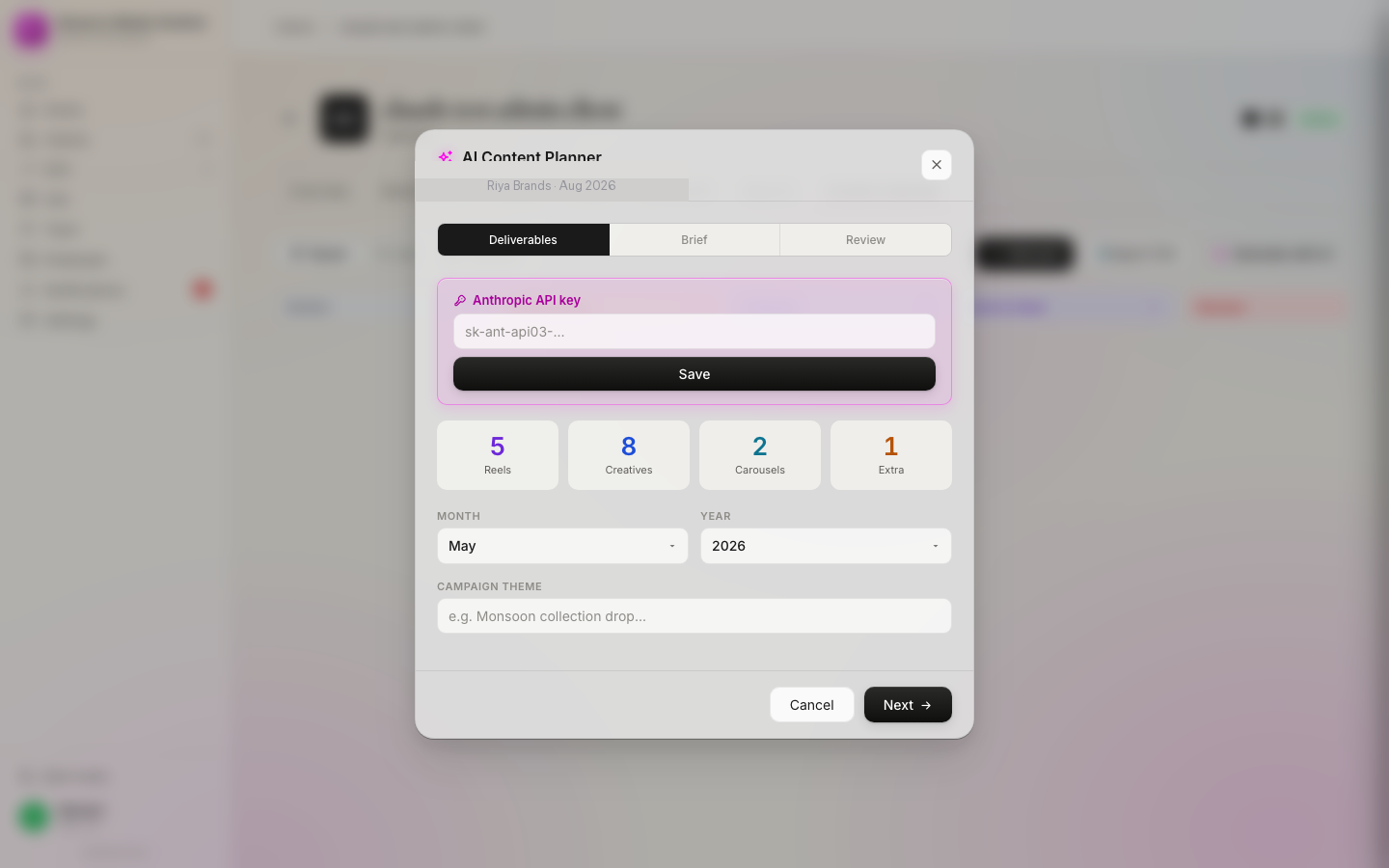
A workable rhythm for a jewellery account: block one shoot day a month, produce four weeks of posts from it, and keep two slots open per week for reactive content (a customer photo, a rate movement, an arrival). Batching matters more here than in any other niche because you cannot re-shoot gold casually — the stock moves, and the lighting setup for metal and stones is not something you improvise. If batching is new to you, the mechanics are in our guide to scheduling a month of content in one sitting, and timing specifics for Indian audiences are in best time to post on Instagram in India.
What this means if you run jewellery clients as an agency
Jewellery is one of the better retainer categories in India — the ticket size supports a real budget and the client has genuine seasonality to plan around, which makes an annual contract easy to justify. It is also demanding in a specific way: approvals matter more than in almost any other niche, because a wrong purity or a wrong price in a published post is a commercial problem, not just an embarrassment.
Three operational rules I would insist on:
- Written approval on every creative that states purity, weight or price — timestamped, from a named person at the client, before it publishes. Not a WhatsApp thumbs-up you cannot find in three months.
- One shoot day a month, contractually, with stock made available. Jewellery briefs die on stock access, not on ideas.
- Bill in a way that survives the season. Jewellery clients want to scale spend around Dhanteras and cut it in the quiet months; agree the retainer and the campaign top-up separately at the start so the invoice conversation is not a negotiation every October. Our notes on pricing social media management in India and GST invoicing for marketing services cover the mechanics.
If you are choosing where to specialise, jewellery sits alongside real estate and healthcare in the highest-value agency niches in India — and it clusters geographically. Agencies in Jaipur have gemstone and kundan brands within driving distance; Surat has diamonds; Rajkot and Coimbatore have their own silver and gold ecosystems. Local proximity genuinely matters in this niche because you will be at the showroom for shoots.
Frequently asked questions
How often should a jewellery brand post on Instagram?
Four to five posts a week plus daily Stories is the sustainable rhythm: two Reels, two static or carousel posts, and Stories carrying the day's arrivals and enquiries. Jewellery buying is slow and considered, so the job of the feed is to stay familiar until a wedding, a festival or a salary bonus creates the occasion.
Should jewellery brands put prices in Instagram posts?
Not fixed rupee prices on gold. The gold rate moves daily, so any number baked into a creative is wrong within a week and screenshots of it come back to argue with you. Publish weight, purity and making charges instead, and quote the live price in WhatsApp where you can restate it accurately.
Do Instagram jewellery posts need to mention BIS hallmarking?
There is no rule that a post must mention it, but any purity claim you make must be true and matched by the physical piece. Hallmarked gold jewellery in India must carry the BIS mark, purity in carat and fineness, and a six-digit HUID number, so say hallmarked only where the stock actually is.
Do Instagram shopping tags work for jewellery brands in India?
Product tags work, but in-app Checkout does not — Meta supports Checkout only in the United States. In India a tapped tag sends the shopper to your website, so the tag is only as good as the product page behind it. For high-ticket jewellery most enquiries still convert over WhatsApp rather than a cart.
Run jewellery clients without the approval anxiety
One calendar per brand, timestamped client sign-off on every purity and price claim, auto-publishing to Instagram, and GST invoicing in the same login. 7-day free trial, from ₹999/month.
Start Free Trial