Most Indian agencies meet this service by accident. A B2B client's founder sees a competitor's founder on LinkedIn every morning, posting about hiring, a lost deal, a factory visit, and asks the agency: "Can you do this for me too?" The agency says yes, adds "founder LinkedIn: 8 posts" to the existing retainer at a small extra charge, and gives it to the same junior writer who does the brand's Instagram captions.
Three months later the posts read like a press release, the founder has stopped approving them, and the line quietly drops off the invoice. The service didn't fail. It was scoped and priced as a deliverable when it is really a writing partnership with one very busy, very particular person.
We've covered the wider LinkedIn playbook for B2B clients (company Page, access roles, ad budgets) separately. This guide is only about the founder's personal profile: how to package it so it lasts.
Why sell founder LinkedIn as its own service?
Because the buyer, the work and the risk are all different from brand social.
- The buyer is the founder personally. They aren't judging whether the brand looks good; they're judging whether the posts sound like them. That is a much harder bar, and it is set by one person, not a marketing team.
- The work is interviewing and writing, not design. Most founder posts are text, sometimes with a photo or a simple document carousel. The cost sits in senior writer hours, not in the design team.
- The reputational risk is personal. A weak brand post is forgotten. A tone-deaf post under a founder's name gets screenshotted into their industry WhatsApp groups.
The audience is there. LinkedIn announced in February 2023 that its India membership had crossed 100 million, making India its second-largest market after the US. For a manufacturer in Pune or a SaaS founder in Bengaluru, the procurement heads, investors and senior hires they want to reach are on it.
What goes into a founder LinkedIn retainer?
Write the scope down line by line. Vague scope is how this service turns into unpaid late-night editing. This is the scope we'd put in the retainer agreement:
| Line item | What it includes | What it does not include |
|---|---|---|
| Profile refresh (month 1) | Headline, About section, Featured section, banner brief, experience cleanup | Photoshoot (quote separately) |
| Monthly interview | One 45–60 minute call, recorded with consent, plus a topic list sent two days before | Unlimited calls; ad-hoc voice notes count as extra input, not extra calls |
| Posts | 8 or 12 posts a month, written in the founder's voice, two rounds of edits each | Posts on topics the founder never spoke about |
| Visuals | Photo selection, or one document carousel a month | Video editing (a separate line) |
| Engagement prompts | A short weekly list of relevant posts the founder could comment on, with suggested angles | The agency commenting or replying as the founder |
| Monthly review | Top posts, inbound conversations the founder reports, topics to repeat or drop | Lead generation guarantees |
Two lines matter most. The monthly interview is the raw material: without it the writer is guessing, and guessed posts are what make founders stop approving. And the "does not include" column on engagement is deliberate. Comments and DMs are conversations with real people under the founder's name; the agency can suggest, but the founder types.
How does the monthly process actually work?
The rhythm that keeps a founder involved without eating their week looks like this:
- Topic list (day 1). The writer sends 8–10 prompts: a decision they made this month, a mistake, a customer question they keep answering, a hiring lesson, an industry opinion they hold that others don't.
- Interview (days 3–5). One call. Ask for stories and specifics, not abstract opinions. "Tell me about the last time a client asked for a discount" gets better material than "What do you think about pricing?"
- Drafts in a batch (days 7–12). The whole month's posts are drafted together and placed on a calendar, so the founder sees the spread of topics, not one post at a time.
- Founder approval (days 12–15). Every post is approved by the founder personally, not by their assistant or marketing head. Their name, their sign-off.
- Founder publishes. The founder posts each one from their own login on the planned day, or schedules it in LinkedIn themselves. The agency sends a reminder the morning it's due.
- Review (month end). Which posts started conversations with the right people? Those topics go on next month's interview list.
Step 5 is the one agencies try to skip by asking for the password. Don't. LinkedIn has no admin or editor role for a personal profile, and its User Agreement asks members not to share their account with anyone else. Holding a founder's login also means holding their DMs, their connections' data and a lot of liability. Pressing "Post" takes the founder thirty seconds; a reminder at the planned time makes it a habit.
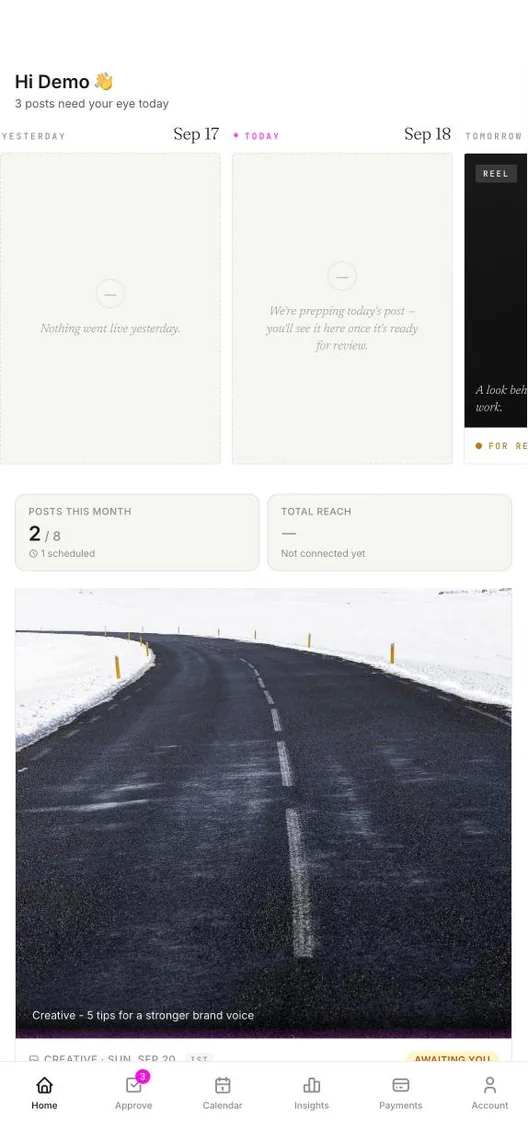
The approval step is the same one you run for brand content, just with one approver. If you already have an approval workflow, add the founder's posts to it as a separate stream so they never mix with the brand's queue.
How do you capture a founder's voice?
This is where the service lives or dies, and it is mostly listening. The habits that work:
- Keep a voice sheet. Words the founder uses ("team", not "family"; "customers", not "clients"), words they never use, their usual sentence length, whether they ever write in Hinglish, and topics they won't post about (politics, competitors, money).
- Quote, then shape. Pull their exact phrases from the interview recording and build the post around them. A draft that contains three sentences the founder actually said gets approved far more easily than a polished one that contains none.
- Track the edits. Every change the founder makes to a draft tells you something about their voice. After two months the edits should shrink. If they don't, change the writer, not the founder.
- Never invent experience. No made-up client stories, no "I failed three startups" when they failed one. If the material is thin this month, write fewer posts and say so.
AI tools help with transcription and first drafts from the interview, and that's a fair use of them. But founders spot generic AI phrasing in their own feed instantly. The final draft has to be in their words, which is why the interview can't be skipped.
How should you price a founder LinkedIn service in India?
Don't price it per post. A post that takes a senior writer 90 minutes of listening, drafting and two edit rounds is not the same unit as a brand caption, and per-post pricing invites the client to compare the two. Price it on the time it actually takes, then sell it as a monthly retainer with a three-month minimum.
Here is the arithmetic for a 12-post month. The hours are what this kind of work typically takes a competent writer; the hourly rate below is a placeholder, so plug in your own blended rate:
| Task | Hours / month |
|---|---|
| Topic list and interview prep | 1.5 |
| Interview call | 1 |
| Transcript review and drafting, 12 posts | 10 |
| Two edit rounds | 3 |
| One document carousel | 2 |
| Weekly engagement prompts | 2 |
| Monthly review and account management | 2 |
| Total | 21.5 hours |
At an example blended cost of ₹1,000 an hour, that's ₹21,500 of time before margin. Add your margin, then 18% GST on the invoice, and you have a number you can defend line by line. Charge the month-1 profile refresh as a one-time setup fee, because it's real work that doesn't repeat. If you keep a price list for add-ons, put the photoshoot, extra interview calls and LinkedIn newsletter articles on it so they never get thrown in for free.
Two pricing traps. First, don't discount the founder line to win the brand retainer; it's the line the founder personally values, so it should carry the most margin, not the least. Second, don't bury it inside a combined retainer. As a separate line it renews on its own merits; buried, it's the first thing cut. Our guide to retainer versus project pricing explains why the three-month minimum matters here.
What should you report to a founder each month?
Not likes, and not follower count as the headline. Founders buy this service for business outcomes, so ask them what came in. The useful report is short:
- Inbound DMs, connection requests and introductions from the people they want to reach (the founder tells you; you record it)
- Meetings, hiring conversations or press requests that started from a post
- The three posts that started the best conversations, and why they worked
- Topics to repeat and topics to drop next month
- Impressions and follower growth last, as context
When a founder post does well, it can be given paid reach. LinkedIn's Thought Leader Ads let a company sponsor a post that runs under the founder's name, with the author's permission. That's a natural upsell, but run it from the company's ad account and budget, not the founder line.
Run it like every other client, in one system
The operational trap is that founder content ends up living in a WhatsApp chat with the founder: voice notes, "small changes", screenshots of drafts. It works for one founder and breaks at three. Keep the founder's posts in the same content calendar as the brand's, assigned to a named writer with due dates, sent for approval in the client portal, with the voice sheet saved against the client. Our agency workspace is built for exactly that: tasks, calendar, approvals and GST invoices in one place, with the founder retainer billed as its own line.
One honest note on publishing: our scheduler auto-publishes to Instagram and Facebook, and LinkedIn Page publishing is rolling out while we wait for LinkedIn's API approval. Founder profiles stay manual by design, for the reasons above. If you're pitching B2B founders in Pune, Gurugram or Bengaluru, this is one of the easiest services to add, as long as you scope it as the writing partnership it is.
Frequently asked questions
Is it ethical for an agency to ghostwrite a founder's LinkedIn posts?
Yes, as long as the ideas, stories and opinions are the founder's own and the founder approves every post. The agency's job is to draw those ideas out in an interview and shape them into posts. Inventing experiences the founder never had, or posting without approval, is where it stops being ghostwriting and becomes misrepresentation.
Should the agency log in to the founder's LinkedIn profile to post?
No. LinkedIn has no admin or editor role for a personal profile, and its User Agreement asks members not to share their account. The clean workflow is that the agency drafts, the founder approves, and the founder publishes or schedules the post from their own login. It is slower, but nobody else holds a CXO's password.
How long before founder LinkedIn content shows results?
Set the expectation at three months before judging it. The first month goes into the profile, the interview and finding the founder's voice; months two and three show which topics bring comments and DMs from the right people. Agree the measures upfront, such as inbound conversations and meetings, so the review is about pipeline, not likes.
Give the founder line its own workflow
Plan founder and brand posts on one calendar, assign writers with due dates, get approvals in the client portal, and bill the founder retainer as its own line on a GST invoice, in one agency workspace with Instagram and Facebook auto-publishing. From ₹999/month. Try it free for 3 days, no card needed, with a 7-day money-back guarantee.