Every event planner's Instagram in India looks the same. Twenty photos of a mandap, a slow pan across a stage, a reel set to whatever audio was trending in March. It is beautiful, it is interchangeable, and it does almost nothing for the one question the buyer is silently asking: if I hand you eleven lakh rupees and 400 guests, will you keep your head?
That question is the whole category. A restaurant can be tried for ₹600. A salon can be tried for ₹1,200. An event cannot be tried at all. The client commits the entire budget, in advance, for a day that happens exactly once and cannot be re-run if you get it wrong. So they de-risk instead — by looking for evidence that you have done this before, at this size, and that nothing went sideways.
We have run social accounts for vendors in this world, and the accounts that generate enquiries look noticeably different from the accounts that generate compliments. This is what changes.
Why does an event planner's Instagram sell differently?
Three structural facts drive everything:
- The purchase is booked months ahead. For the October–March season, most decisions are made between April and August. Your November content reaches families who signed someone else in June.
- The buyer is not one person. For a wedding it is usually the couple plus a parent who controls the budget — and the parent is often on Facebook, not Instagram. For corporate work it is an HR or marketing manager who has to justify the vendor internally.
- There is no repeat purchase on the consumer side. A wedding client never buys again. Your growth comes from referrals and from strangers who saw the work. Corporate clients do repeat — which is why the corporate half matters more than most planners treat it.
That last point deserves its own section, because it is where the money quietly is.
The corporate half nobody posts
Look at where the organised money sits. In the KPMG in India and EEMA study of the Indian events and experiences industry, released at EEMAGINE 2026, organised MICE activity in 2025 is put at around ₹46,739 crore, organised live events at around ₹13,600 crore and the commercial sports economy at ₹18,864 crore. Weddings dwarf all of it at roughly ₹6.5 lakh crore — but weddings are also where every planner in your city is competing on the same three photographs.
The same study reports that 94.6% of organisers surveyed said their revenue grew over the previous two financial years, and that around 80% described obtaining event permissions as difficult. Read those two together: demand is not the constraint in this business. Operational credibility is.
The split I would run:
| Work you want | Where the buyer looks | What actually convinces them |
|---|---|---|
| Weddings & destination weddings | Instagram, then Google | Full-event walkthroughs, guest count, how many days, how many vendors you coordinated |
| Corporate offsites, conferences, MICE | LinkedIn, then your website | Headcount handled, venue type, AV and registration complexity, on-time starts |
| Birthdays, anniversaries, proposals | Instagram Reels, WhatsApp forwards | Price transparency and turnaround — these buy fast and ask "kitna hoga" first |
| Brand activations & launches | LinkedIn + Instagram | Footfall numbers, the brand names you can legally show, media coverage |
Almost no Indian event planner runs a real LinkedIn presence, which is exactly why it works. A single post a fortnight — "we ran a 600-person dealer meet in Jaipur across two venues; here is how registration was handled" — reaches a category of buyer who will never see your Reels. We wrote a full breakdown of LinkedIn for B2B clients in India; almost all of it applies here unchanged.
What should an event planner actually post?
Stop thinking in posts and start thinking in proof. Each piece of content should answer a specific doubt. Rotate these five pillars:
| Pillar | Doubt it kills | Format | Share of feed |
|---|---|---|---|
| Full-event walkthrough | "Can they do an event this size?" | 60–90s reel, one event start to finish, with scale stated on screen | 30% |
| Logistics behind the scenes | "Will they be organised on the day?" | Setup timelapse, run-sheet on a clipboard, the 4am truck arriving | 20% |
| Client reaction | "Did the family actually feel looked after?" | 15s clip of the host, or a screenshot of the message they sent after | 20% |
| Planning guidance | "Do they know more than me?" | Carousel — budget splits, season dates, what to book first | 20% |
| Team and capacity | "Is this one person with a phone?" | Your crew, your vendor panel, how many events you run in a season | 10% |
Two specifics that change results more than anything aesthetic. State the numbers on screen. "350 guests · 3 days · Udaipur · 9 vendors coordinated" does more work than any transition. And show one event completely rather than the best frame from nine events — a buyer needs to believe an entire day held together, not that you own a good camera.
The consent problem, and the audio problem
This category has two legal traps that most planners walk into without noticing.
Confidentiality. Corporate contracts routinely restrict what you can publish: attendee lists, internal announcements made on stage, budgets, sometimes even the venue. Ask for a publicity clause at contract stage that names precisely what you may show, and get sign-off on the specific frames before they go out. On the wedding side, identifiable guests — especially children — need permission, and "the photographer was there" is not permission to post on a business account. We covered this in more depth in the wedding industry playbook.
Audio. Event reels live and die on music, and this is where brand accounts get silently throttled. The trending audio available to a personal account is very often not available, or not licensed, for a business profile — and a Reel that loses its audio after the fact is a Reel that stops being watchable. Read why brand accounts can't use trending audio in India before you build a whole month around one track.
When should you publish? The off-season calendar
This is the single biggest fix available to most event planners, and it costs nothing.
You shoot everything between October and March, because that is when the events happen. You then also publish everything between October and March, because that is when you have material — and you go quiet from April, exactly when next season's clients start shortlisting. The fix is to treat the season as a shoot window and the off-season as a publishing window.
- Oct–Mar (season): capture aggressively, publish lightly. One live-ish post per event is enough; you are too busy to do more and the audience is not deciding yet.
- Apr–Jul (peak decision window): publish your strongest season footage. This is when enquiries for the next October–March season are made, and when your competitors are dormant.
- Aug–Sep: guidance and pricing content — what to book first, realistic budgets, date availability. Push the "we are filling up" message honestly.
- Year-round: corporate content on LinkedIn, because MICE and offsite budgets follow the financial year, not the wedding calendar.
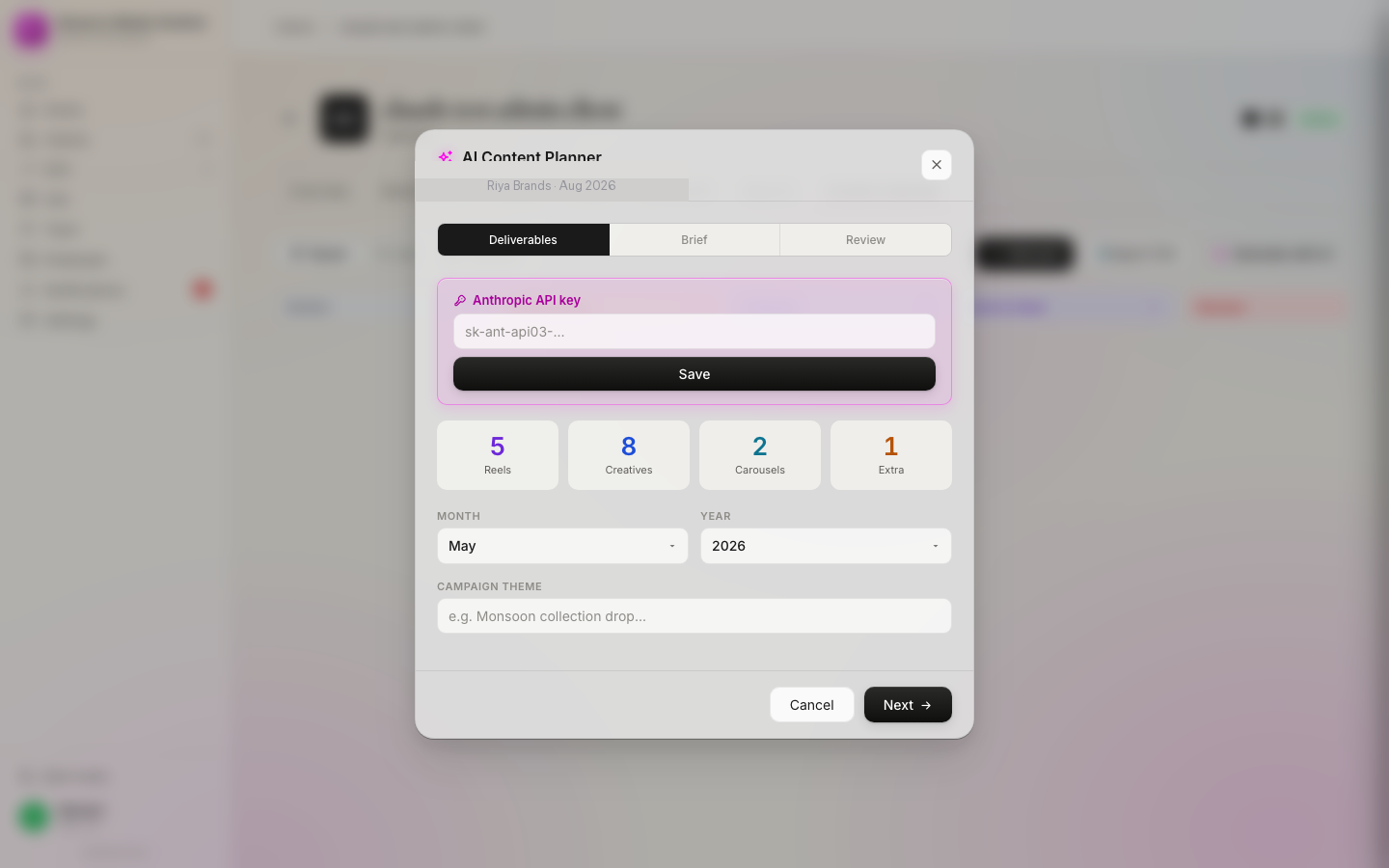
Doing that means cutting a season's worth of footage into a six-month publishing plan — which is a planning job, not a creative one. Build the calendar once, in one place, and let it run.
How do saves turn into site visits?
Event enquiries almost never come through a form. They come as a DM, usually a single line: "Hi, do you do destination weddings in Jaipur?" What happens in the next twenty minutes decides the booking.
- Reply with a question, not a rate card. Date, city, approximate guest count. A price sent before you know the scale trains the buyer to compare you on price alone.
- Move to WhatsApp deliberately, and keep it one thread. Indian clients will end up there anyway. Just make sure the thread belongs to the business, not to whoever answered — if the person who handled it leaves, the enquiry history should not leave with them. That is the whole argument in WhatsApp vs a client portal.
- Send one comparable event, not the whole portfolio. Same city, same rough scale. Comparability beats volume.
- Ask for the venue recce fast. The in-person meeting is where this category actually closes.
Keep your Google Business Profile current too. The KPMG–EEMA study found social media was the largest discovery channel for consumer event-goers at 23.3%, with word of mouth close behind at 21.4% — and in India, word of mouth usually ends with someone searching your name to check you exist.
If you run these accounts as an agency
Event planners are a good retainer client with one catch: the work is editing, not designing. A typical month is hours of vertical footage that needs cutting, not fifteen statics that need laying out. Price accordingly.
- Sell reels, not posts. Agree a number of edits per month. "12 posts" is meaningless when eight of them are 90-second cuts.
- Bill shoot days separately. On-site coverage is a different cost line from management. If you fold it into the retainer, one December kills your margin.
- Agree a post-event turnaround in writing. The 48-hour window after an event is when the client's guests are still posting; it is also when your client is exhausted and slowest to approve. Pre-approve the format so you are not waiting.
- Expect a lumpy year. Their revenue is seasonal; your retainer should not be. Either flatten it across twelve months or accept a reduced off-season scope in the contract — decide before you sign, not in April.
Handle the approvals properly and this account is profitable. Handle them over WhatsApp during wedding season and you will spend December chasing a client who is standing in a banquet hall. Our guides to faster client approvals and monthly reporting both apply; so does the rate card by city tier if you are quoting a planner in Udaipur versus Gurugram.
Frequently asked questions
Which platform works best for event planners in India?
Instagram wins social and wedding enquiries, because the buyer is choosing on look and scale. LinkedIn wins corporate and MICE work, because the buyer is an HR, admin or marketing head who checks whether you have run something this size before. Most planners do both, badly. Run Instagram weekly and LinkedIn fortnightly.
How far in advance should an event planner post for the wedding season?
Enquiries for an October to March season are largely decided between April and August, so your best portfolio content should be published in those quiet months. Posting your November work in November reaches families who have already signed someone else. Shoot during the season, publish across the off-season.
Can event planners post photos of a corporate client's event?
Only with written permission. Most corporate contracts include a confidentiality clause covering attendee lists, internal announcements, budgets and sometimes the venue. Ask for a publicity clause at contract stage that names what you may show, and get sign-off on the specific frames before anything goes out.
How much should an agency charge to run an event planner's social media?
Treat it as a content-heavy retainer, not a posting retainer. The work is editing footage from live events, not designing statics. Price the edit volume, the on-site shoot days and the post-event turnaround separately, and keep an agreed number of reels per month rather than a number of posts.
Sources
- KPMG in India and EEMA, Socio-economic impact of the Indian events and experiences industry (released at EEMAGINE 2026; based on analysis of 108 events with 18+ lakh attendees plus surveys of organisers and event-goers) — 2025 market sizes, the 94.6% revenue-growth and ~80% permissions findings, and the 23.3% social media / 21.4% word-of-mouth discovery split.
- Reported coverage of the same study: BestMediaInfo, "94.6% event organisers report revenue growth, 80% struggle with permissions".
One calendar for a season you're too busy to publish in.
Plan a whole off-season of content in one place, get it approved without a WhatsApp thread, and let it publish while you're on site. From ₹999/month for your whole team — see the agency management software and the Instagram scheduler.