This is written for the people who actually sell into Indian weddings — planners, banquet and resort venues, photographers and film teams, decorators, makeup artists, mehendi artists, choreographers, caterers — and for the agencies that run their handles. It is not a listicle about "Instagrammable mandaps."
The wedding trade is enormous and, unusually for India, reasonably well measured. The Confederation of All India Traders' research wing surveyed 75 cities between 15 and 25 October 2025 and estimated 46 lakh weddings between 1 November and 14 December 2025, worth about ₹6.5 lakh crore — against 48 lakh weddings and ₹5.9 lakh crore in 2024, and 32 lakh weddings and ₹3.75 lakh crore back in 2022. Fewer weddings, more money: the average event is getting bigger, which is exactly the direction that rewards vendors who can show their work well.
CAIT also splits that spend by category. Jewellery takes roughly 15%, apparel 10%, catering 10%, event management 5%, floral decoration 4%. Do the arithmetic on their own numbers and event management alone is on the order of ₹32,000 crore in a six-week window. That is the market your client's Instagram grid is competing in.
Why does wedding Instagram behave differently from every other niche?
Because the calendar is set by panchang, not by you.
Every other niche I have worked in has a roughly flat baseline with festival spikes on top. Weddings have hard walls. Marriage muhurats cluster, and in the gaps there are literally no weddings — no shoots, no new work, nothing fresh to post. Panchang listings for 2026 (I have used Prokerala's month-wise muhurat table; families use their own panchang or astrologer, so read this as shape rather than gospel) look like this:
| Month (2026) | Marriage muhurats | What that means for the feed |
|---|---|---|
| January | 4 | Season tail; deliver last season's films |
| February | 6 | Peak of the winter run |
| March | 1 | Sudden cliff — one date all month |
| April – June | 5, 7, 7 | The summer run; heavy shoot load |
| July | 2 | Season closes |
| Aug / Sep / Oct | 0 | No weddings — but peak enquiry season |
| November | 3 | Winter season opens |
| December | 3 | Highest-value dates of the year |
Read that table twice, because the whole strategy falls out of it. August to October has zero weddings and the highest concentration of couples researching vendors for the November–February run. Your client has maximum audience attention in exactly the quarter they have nothing new to shoot. And in December they have a camera roll full of the best work of their life and a team that has slept four hours a night for three weeks.
The single biggest operational failure in this niche is letting the feed track the shoot schedule. Vendors post nine Reels in the first week of December, vanish through March, panic-post in September. Instagram reads that as an account that stops mattering, and the couple researching in September finds a grid whose last post is eight months old.
The fix: separate capture from publishing
Treat the season as a harvest and the gap as the meal. Concretely, for every event during the season, capture a fixed content bank on the day — not "we'll pull something from the final edit later," which never happens because the final edit takes six weeks:
- Six to ten vertical detail clips — the entrance, the tablescape, the varmala moment, the bride's hands, the light at the sangeet. Ten seconds each, shot on a phone by the second shooter.
- One setup-to-reveal pair for the decor team: empty lawn at 6am, finished lawn at 6pm. This one format outperforms almost everything else we have run for decorators.
- Three vertical stills cleared for social before the full gallery is delivered.
- One line of context typed into the shared calendar the same night: venue, city, guest count band, what was hard. That line becomes the caption in April.
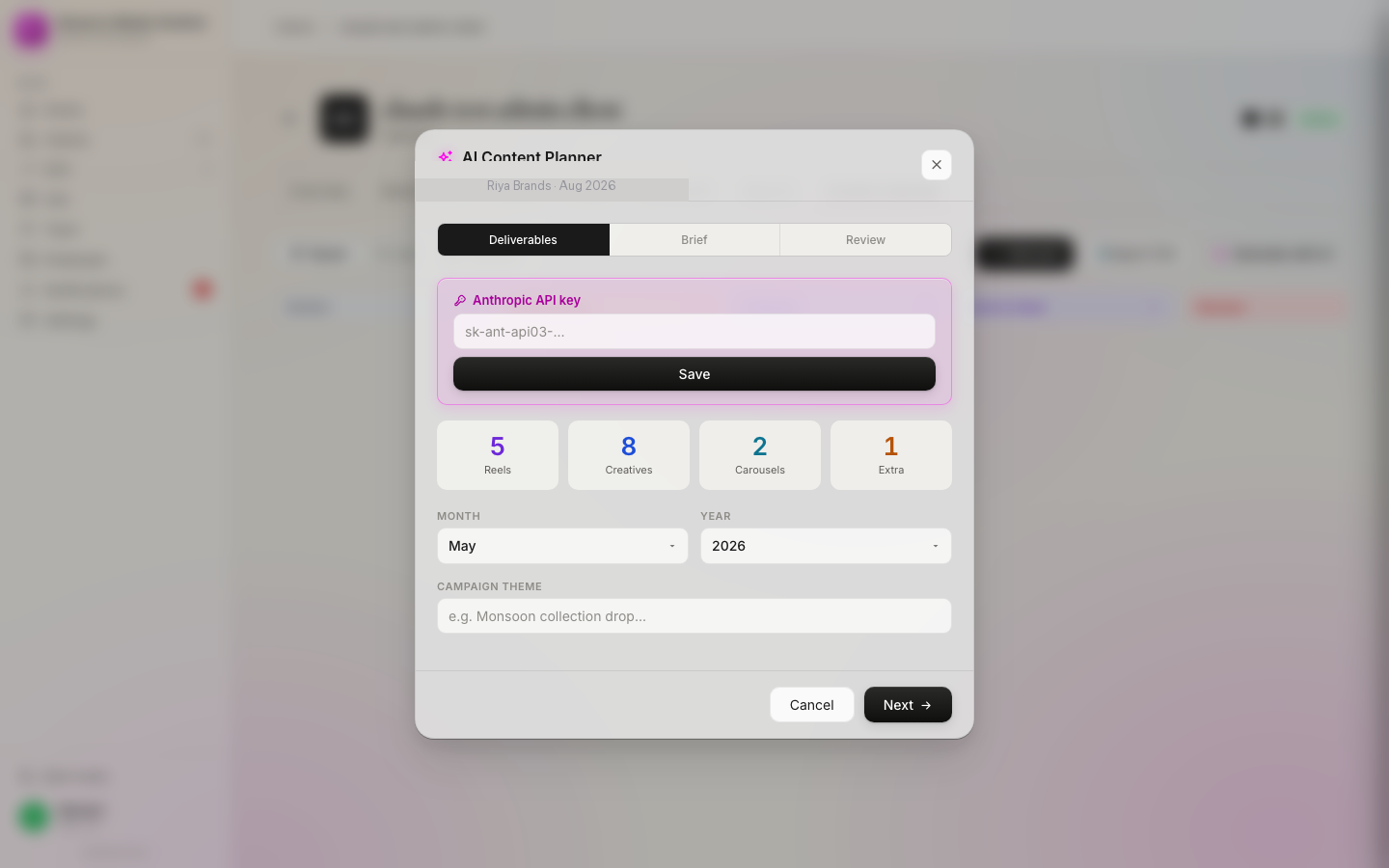
Twenty events a season at that rate is a bank of two hundred assets — enough to publish four times a week through August, September and October without shooting anything new. The mechanics of loading a bank like that into a calendar are the same as any month-in-a-day bulk scheduling workflow; the difference is that here you are scheduling four months ahead, not four weeks.
What should a wedding vendor actually post?
The instinct is to lead with the hero film. It is the wrong top-of-funnel asset: a four-minute wedding film is a closing asset, watched by people who have already shortlisted you. Discovery runs on fragments.
The mix that has worked for us, in rough order of booking value:
- Venue-specific content. A Reel titled by the actual property — the lawn at a named hotel, the haveli courtyard — because couples search venues, not vendors. This is the highest-intent content in the niche and almost nobody produces enough of it.
- Setup-to-reveal and before-after. Effort made visible. It justifies price better than any pricing post.
- Process and logistics. How you moved 4,000 flowers in June heat; the rain plan. Couples spending ₹30 lakh are buying reliability, and reliability is invisible in a pretty photograph.
- The team on camera. Weddings are bought from people. A face in Stories converts DMs faster than a perfect grid does.
- Real budgets, honestly framed. A "what a ₹12 lakh setup includes" carousel qualifies harder than any lead form.
- The full film. Last, and pinned — for the shortlist stage.
On prices: post a starting band, not a fixed number. Indian couples open a DM with budget as the first filter, and if your floor is invisible you will spend your scarcest resource — season attention — quoting people who were never going to book. Same principle we apply to jewellery brands, for the same reason: publish the shape of the price, negotiate the number in WhatsApp.
The consent problem nobody in this category talks about
Scroll the pages ranking for wedding-marketing advice in India and you will not find one that mentions this: a photograph of an identifiable person is personal data. The Digital Personal Data Protection Act, 2023 turns on identifiability, and the DPDP Rules were notified in November 2025 with a phased compliance runway. A wedding vendor's entire marketing library is other people's faces at the most private event of their lives — the couple, both families, and hundreds of guests who never signed anything.
One correction worth making, because it is repeated everywhere: the ₹250 crore figure you see attached to "posting photos without consent" is wrong. Under the Act's Schedule, ₹250 crore is the ceiling for failing to take reasonable security safeguards against a data breach; ₹200 crore covers breach-notification and children's-data failures; breach of any other provision caps at ₹50 crore. Still not a number any studio survives — but quote it correctly, because clients who catch you exaggerating the law stop believing the rest of your advice.
How do you turn DMs into bookings?
Wedding leads have a two-day life. A couple messages six vendors on a Sunday night, and the two who reply that night make the shortlist. During the season — when the team is on-site and the phone is on a charger in a hotel room — that reply does not happen. This is the real conversion leak in the niche, and it is an operations problem, not a content one.
What we insist on with wedding clients:
- One named person owns the inbox during the season, and it is never the person shooting. Even a two-line holding reply with a date-availability question keeps you on the list.
- Move to WhatsApp on the first reply, with a fixed set of questions: dates, city and venue, guest count, budget band, decision-maker. Five answers tell you whether this is a real enquiry.
- Track enquiries against dates, not against people. A vendor's inventory is calendar slots. Two couples chasing 12 December is the highest-margin conversation of your year and it should never live in a chat thread.
- Close the referral loop. Ask to be tagged, and post the couple's own content back with credit. In this trade the couple's account is distribution; the guest who liked their Reel is next year's bride.
Response-time discipline is the whole game, and it is the same failure mode as slow approvals on the agency side — a queue with no owner. We wrote up the general version of that in killing the WhatsApp approval thread.
The Jaipur–Jodhpur reality
Destination weddings concentrate geographically, and Rajasthan is the clearest case: a local vendor in Jaipur or Jodhpur is pitching the same haveli against a Delhi or Mumbai planner with a bigger brand and a bigger reel.
The local vendor's advantage is not price — it is venue depth. You have shot that property in December light and in April heat. You know which courtyard the sound bounces in and where the baraat actually forms. A library of venue-named content, published year-round, beats a metro planner's showreel for the couple who is searching the venue name at 1am. Build the content around properties, not around your own brand, and the geography stops being a disadvantage. Wedding services sit alongside jewellery and real estate in the agency niches worth specialising in, and this is why: the buying is local, high-ticket and repeat-referred.
If you run these accounts as an agency
Three things I would put in the contract, learned expensively:
- Bank content during the season or your Q3 is empty. Write the capture list into the scope so it is the client's obligation, not a favour you ask for in August.
- Price the season separately. November to February is three to four times the work of September. A flat twelve-month retainer means you subsidise the crush with the quiet months and resent it by year two — agree a base plus a season surge up front. Our India rate-card guide covers how to structure that without renegotiating every year.
- Get approvals off WhatsApp before December. During season week your client is standing in a mandap. Approvals need to be a two-tap action on a phone with a record attached, or nothing ships.
Everything above is a workflow problem before it is a creative one: a content bank, a four-month-ahead calendar, an approval trail, and an inbox with an owner. That is what agency management software is for, and why the scheduling layer matters most in the weeks your client is least reachable.
Frequently asked questions
When is the Indian wedding season for Instagram content planning?
The heavy season runs November to February, with a second run from late April through early July. CAIT's traders' survey put roughly 46 lakh weddings between 1 November and 14 December 2025 alone. Panchang listings for 2026 show no marriage muhurats at all in August, September or October, so plan those months as publishing-only.
Should wedding vendors post prices on Instagram?
Post a starting band, not a fixed number. Indian couples open a DM with budget as the first filter, so a visible floor price stops you spending season weeks quoting people who were never going to book. Keep the exact quote in WhatsApp where you can scope guest count, dates and travel properly.
Do wedding photographers in India need consent to post client photos?
Treat it as required. A photograph of an identifiable person is personal data under the Digital Personal Data Protection Act, 2023, and the DPDP Rules were notified in November 2025 with phased compliance. Put a written usage clause in the booking contract covering the couple, the family and guest faces, rather than asking after the shoot.
How often should a wedding planner post on Instagram?
Four to five posts a week year-round, with Stories daily during the season. The volume is not the hard part; the consistency through the no-muhurat months is. Vendors who go quiet in August and reappear in November lose the ranking they spent the season earning, exactly when next-season enquiries begin.
Publish through the season you are too busy to publish in
Bank a season's content, schedule it four months ahead, take client approvals on a phone, and raise the GST invoice in the same login. 7-day free trial, from ₹999/month.
Start Free Trial