Short answer: Free AI caption generators write from a text description, not from your actual creative — so they can't reference what's in the frame, the price, or the offer. For brand accounts, the working setup is creative-aware drafting plus a per-client voice brief, a human edit, and the disclosure inside the first 125 characters.
I run captions for brands across food, jewellery, real estate and clinics, and I've tested nearly every free generator on this SERP. They're not bad. They're just answering a smaller question than the one an agency has. Their question is "give me words for a photo." Yours is "give me a caption this specific brand would post, that sells the specific thing this post is for, that the client will approve without three rounds."
What do free AI Instagram caption generators actually do?
Look at the inputs, because the inputs are the whole story. SocialPilot's free tool asks you to "Write a short description of your post", plus optional keywords, a language and one of eleven tones — and states it is "powered by ChatGPT from OpenAI". Planable's takes a post type, a writing style, a length and a number of variations, and sells itself on friction: "No fluff. No login." (Checked 20 August 2026.)
Neither takes your image or video. You describe the creative in a sentence, and the model writes a caption for that sentence — which means it is captioning your description, not your post. That's why the output has a texture you learn to spot: a rhetorical question, a tidy tricolon, three emojis, eight hashtags, and nothing a competitor couldn't have posted.
These tools also exist to sell the paid product behind them — SocialPilot's page routes you to signup the moment you click Share Now. That's fair. It just means the free tool is optimised for a satisfying ten seconds, not for a brand's twelfth post of the month.
Why do AI captions sound the same for every brand?
Because five things a caption depends on are missing from the prompt:
- The creative itself. Whether the reel opens on a hand, a face or a price card changes the first line completely.
- The offer. "₹1,999 for a bridal trial, only until Karwa Chauth" is a different caption from "book now".
- The objection. Every purchase has one — is it too expensive, is it authentic, will it fit, do you deliver to my pincode. Good captions answer it in a line.
- The brand's actual voice. Not "friendly and professional", which describes every brand on earth. Voice is banned words, sentence length, whether the brand uses Hinglish, and whether it uses exclamation marks.
- What already worked. Last month's three best-performing captions are better instruction than any tone dropdown.
Give a model those five and the generic-ness largely disappears. Give it none and you get an average of the internet, which is exactly what an average of the internet sounds like. The same failure shows up one level higher when agencies auto-generate whole months of ideas — I wrote about that in AI content calendar generators.
The 125-character rule that decides whether the caption works
Instagram allows 2,200 characters per caption, but only the first 125 characters appear before a reader has to tap "more", and the hashtag ceiling is 30 per post (Sendible's limits guide lays these out). Almost every AI caption I've reviewed spends those 125 characters on a warm-up sentence.
| Caption zone | What belongs there | Common AI failure |
|---|---|---|
| Characters 1–125 (above the fold) | The hook, the specific claim or price, and any paid-partnership disclosure | A rhetorical question — "Looking for the perfect gift?" |
| Body | The proof, the detail, the objection answered | Restating the image in words |
| Close | One call to action matched to how the brand actually sells | "Link in bio" for a brand that sells over WhatsApp |
| Hashtags | 3–8 relevant tags; the limit is 30 but relevance beats volume | A 25-tag block, disclosure buried inside it |
The compliance rule every caption generator ignores
This is the part that has no equivalent on any free-tool page, and it applies the moment your client works with creators. ASCI's Guidelines for Influencer Advertising in Digital Media say disclosure "must be upfront and prominent so that it is not missed by an average consumer", that disclosures "are likely to be missed if they appear only on an ABOUT ME or profile page, or bios, at the end of posts or videos, or anywhere that requires a person to click MORE", and that disclosure "should not be buried in a group of hashtags or links".
Read that against the 125-character fold and the rule writes itself: on a paid-partnership post, the disclosure has to sit inside the first 125 characters — not in the hashtag block at the bottom, which is exactly where every AI generator puts it by default. The guidelines also define material connection broadly enough to include "free products with or without any conditions attached including those received unsolicited, discounts, gifts, contest and sweepstakes entries, trips or hotel stays, media barters", and require disclosure "even if the evaluations are unbiased or fully originated by the influencer". The gifted-hamper post counts. I'm a founder, not a lawyer — but this is a two-second fix that no tool will make for you. We cover the same compliance layer per vertical in Instagram marketing for restaurants and choosing an agency niche in India.
What else AI gets wrong for Indian brands
- Hinglish. Ask for Hindi and you often get textbook Devanagari no one speaks; ask for casual and you get American slang. Transliterated Hinglish — "sirf aaj ke liye" — is what most D2C brands actually post, and you have to show the model examples rather than name the register.
- Money. Models drift into "$" or write 1,50,000 as 150,000. Indian grouping and the ₹ symbol have to be in the brief.
- The CTA. A huge share of Indian conversion happens in DMs and on WhatsApp, not through a link. "Link in bio" is a default that quietly costs enquiries.
- The calendar. AI does not know when Navratri falls this year, when the client's city has a shaadi season lull, or that a discount post on the 3rd of the month lands differently from one on the 28th. Timing is your job — see the best time to post in India.
The five-step caption workflow we run
- Write the brand brief once. Voice, banned words, three approved past captions, the standard CTA, and how the brand sells. This is per-client and it is the single highest-leverage document in the account.
- Draft from the creative, not a description. The model should see the image or reel frame. A caption that references the third slide of the carousel reads as human because a human-level input produced it.
- Edit for one specific thing. Add the number, the objection or the local detail only you know. Ninety seconds per caption, and it's what separates a shipped caption from a generated one.
- Send for approval with the creative attached. Clients approve captions in context or not at all — the mechanics are in faster client approvals.
- Schedule it with the post. If the approved caption and the approved creative live in different places, someone eventually publishes v2 of the image with v1 of the words. Keeping them together is half the reason to schedule for multiple clients in one calendar.
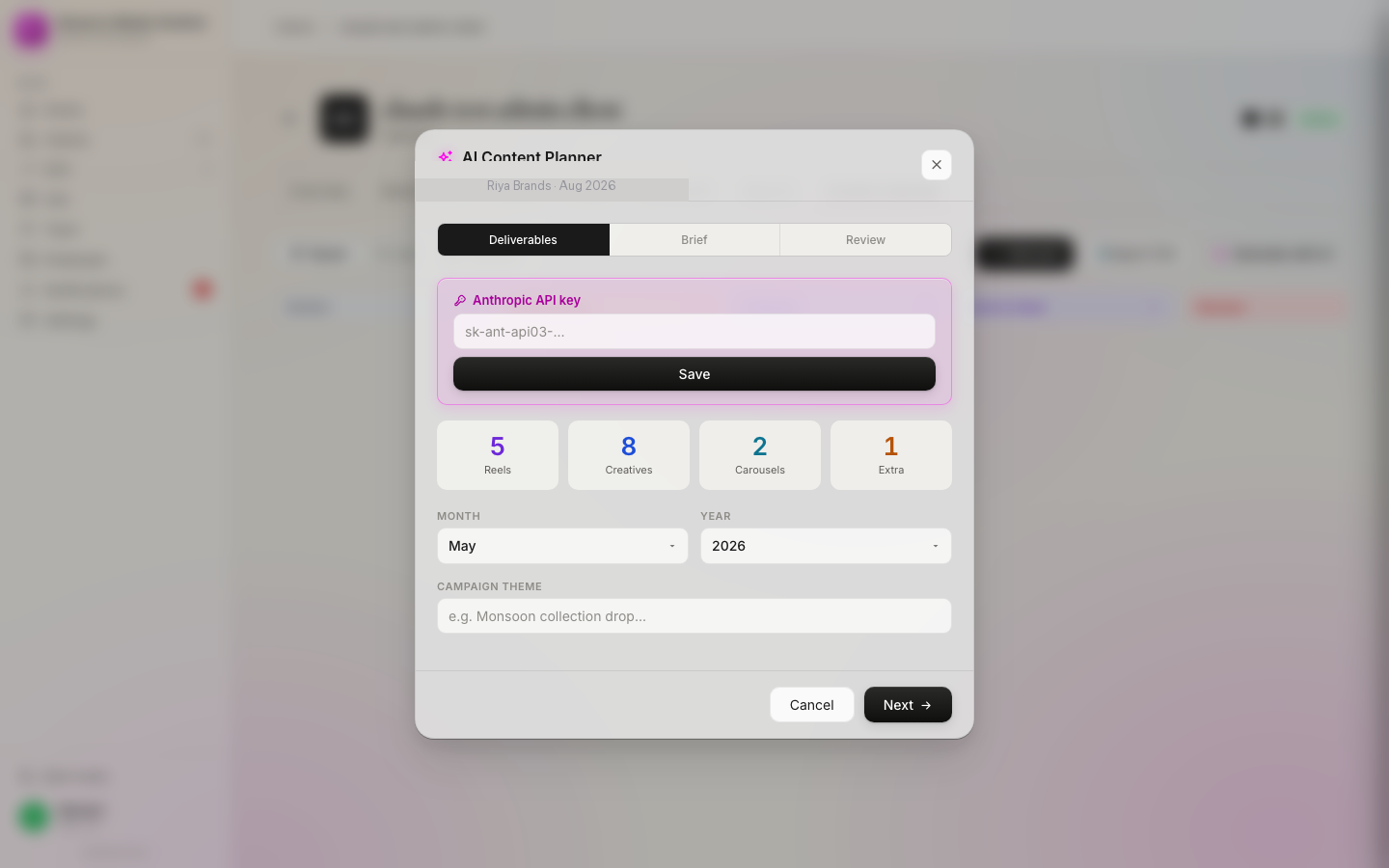
That's the workflow our own AI caption feature is built around, and I'll be precise about what it does: it drafts from the actual creative using a per-client prompt you control, then a human edits and the client approves inside the same calendar the post publishes from. It does not post unreviewed captions, and I'd be sceptical of anything that offers to. Agencies working across several cities can see how the rest of the stack fits on our agency software page or the Jaipur agency page.
Frequently asked questions
Are free AI Instagram caption generators any good for brands?
They are fine for a first draft and useless as a finished caption. Most take only a text description, not your actual creative, so they cannot reference what is in the image, the offer, the price or the objection the post is meant to answer. Treat the output as raw material.
How long should an Instagram caption be for a brand?
Instagram allows 2,200 characters, but only the first 125 show before the reader has to tap "more". Write the hook and any disclosure inside those 125 characters, then use as much length as the post genuinely needs. Short captions are not automatically better; unread ones are worse.
Does an AI-written caption need a paid partnership disclosure?
If there is a material connection between advertiser and creator, yes, and who wrote the caption is irrelevant. ASCI requires disclosure to be upfront and prominent, not buried in hashtags and not below the "more" fold — which means it must sit inside the first 125 characters.
How do agencies keep AI captions on brand across many clients?
By giving the model a per-client brief rather than a generic prompt: the brand voice, banned words, three approved past captions, the standard call to action, and how the brand actually sells. Then a human edits every caption before it reaches the client for approval.
Will clients notice a caption was written by AI?
They notice unedited AI — the rhetorical opener, the emoji tricolon, the caption that describes the image instead of selling. They rarely notice a draft that a person then sharpened with a real number or a local detail. The edit pass is the entire difference.
Captions drafted from the creative, approved in one place.
AI drafts against the actual post, your team edits, the client approves, and it publishes on schedule — with reports and GST-ready invoicing behind it. From ₹999/month, with a 7-day money-back guarantee.