ClickUp is the tool agency founders pick when they've read one too many "Asana vs monday" threads and want the one that does everything. And it nearly does. Docs, whiteboards, forms, time tracking, Gantt charts, AI, chat — ClickUp's pitch is that you can cancel five subscriptions.
For a social media agency, that pitch is half true, and the half that isn't true is the half your clients see. This review sorts the two halves, using ClickUp's own pricing page and help documentation rather than a feature-checkbox table.
What does ClickUp genuinely do well for a social media agency?
Credit first, because some of this is better than what purpose-built social tools offer.
- Proofing on the creative itself. You can drop a comment on a specific spot of an image or a frame of a video, and assign that comment to the designer as an action item. "Logo too close to the edge, here" beats "change the logo thing" in a WhatsApp thread every time. For internal creative review, this is the best feature in the category.
- Per-client templates. Build a List for one brand — twelve statics, eight Reels, four carousels, each with its checklist — and stamp it out for the next month or the next client in seconds. Monthly retainer work is repetitive, and ClickUp is built for repetition.
- One hierarchy for the whole agency. Workspace → Space → Folder → List → Task maps cleanly to Agency → Client → Month → Format → Post. Once it's set up, a designer sees only their queue and a manager sees everything.
- Price per feature. Nothing else gives you this much surface area at $7 a seat.
If your bottleneck is production — briefs getting lost, designers not knowing priorities, revisions scattered — ClickUp fixes it. Most agencies' bottleneck turns out to be somewhere else, which is where the review turns.
What does ClickUp cost an Indian agency?
From ClickUp's pricing page today: Free Forever at $0, Unlimited at $7 per user per month billed yearly or $10 monthly, Business at $12 yearly or $19 monthly, and Enterprise on quote. AI is a separate per-user add-on — the page lists Brain AI at $9 per user per month. At ₹88 to the dollar, for a six-person team:
| Plan (6 users) | Billed yearly | Billed monthly | Automation executions / month |
|---|---|---|---|
| Free Forever | ₹0 | ₹0 | 100 (60MB storage) |
| Unlimited | $42 · ₹3,696/mo | $60 · ₹5,280/mo | 1,000 |
| Business | $72 · ₹6,336/mo | $114 · ₹10,032/mo | 5,000 |
| + Brain AI add-on | $9 × 6 = $54 · ₹4,752/mo more | — | |
Two rupee-specific notes. The gap between yearly and monthly is large — on Business it's 58% more to stay flexible — so small agencies that pay monthly "until we're sure" often pay the premium for a year. And it's a dollar subscription on a card: forex markup, plus IGST under reverse charge on an imported service, claimable as input credit but still a cashflow line (see GST input credit on agency expenses).
The automation meter is the number to watch
Here's the finding that matters more than the seat price. ClickUp meters automations by executions, and its help documentation on automation limits describes what happens at the cap: the workspace's automations pause for the rest of the month.
Picture that in an agency. Every "status → In Review, assign to account manager", every "due date tomorrow, notify designer", every "approved, move to Ready" is an execution. Twelve clients, 25 posts each, four or five status changes per post — that's 1,200–1,500 executions before a single reminder. Unlimited's 1,000 runs out around the 20th. And nothing visibly breaks: the board looks normal, but the designer stopped getting assignments and nobody got the "approved" ping. You discover it when a post misses its date. Either price Business from day one, or design your workflow so it doesn't depend on automations.
What can't ClickUp do for a social media agency?
Four jobs, and they're the four your clients actually pay for.
1. It doesn't publish anything
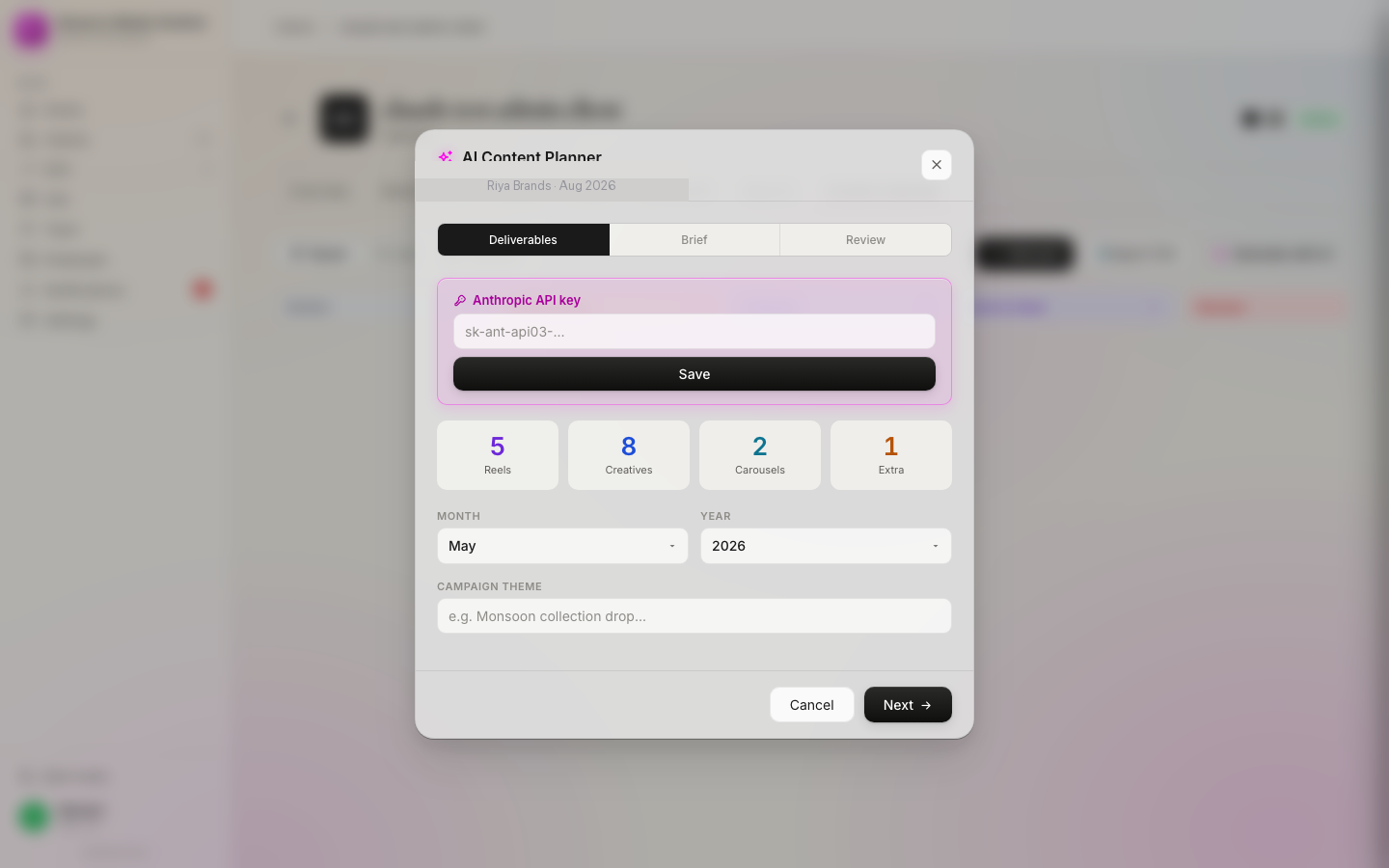
ClickUp posts to no social account natively. Its "Instagram Post Scheduling" template is a planning board with a date field. On Friday at 7 PM, a task marked Scheduled does nothing; someone downloads the file, copies the caption and posts from the phone. Connectors like PostFlow bridge it, but that's another subscription and another token to expire. This is the core difference between a production tool and an Instagram scheduler that actually publishes — and why the calendar view shouldn't lull you.
2. Client approvals need a login your client won't use
Internal proofing is ClickUp's best feature. External approval is its weakest. Clients come in as guests, guest seats are rationed by plan, and ClickUp's help documentation describes a paid member seat being added once you run out of permission-controlled guest seats. Price aside, the real blocker is behavioural: the jeweller in Jaipur or the clinic manager in Ahmedabad is not going to create a ClickUp account and learn a sidebar to say "theek hai, post kar do". They'll reply on WhatsApp — and now the approval lives outside the system that's supposed to record it. We laid out a workable version in the content approval workflow template.
3. It reports on your team, not your client's results
ClickUp's dashboards are excellent at throughput: tasks completed, time tracked, workload per designer. They cannot show reach, saves, profile visits or follower growth, because ClickUp never touched the Instagram account. So the monthly client report — the document that decides whether the retainer renews — is still built by hand from Insights screenshots.
4. There's no money layer
ClickUp will track that an invoice is due. It won't raise a GST tax invoice with your GSTIN and SAC code, split CGST/SGST from IGST by place of supply, account for a client deducting 10% TDS under 194J, or collect by UPI. The mechanics are in GST invoices for digital marketing services and recurring billing with Razorpay.
Is ClickUp too complex for a small agency?
Often, yes — and it's worth saying plainly because it's ClickUp's most common complaint and it's structural, not a bug. The same breadth that lets ClickUp replace five tools means five tools' worth of settings: views, statuses per List, custom fields, ClickApps, permissions at every level of the hierarchy.
The failure pattern is predictable: the founder builds a beautiful workspace over a long weekend, the team uses a third of it, and six months later there are three status systems because three people set up three clients. It's the same config tax we described in monday.com vs agency management software, with more knobs. If you go with ClickUp, write one "how we use ClickUp" page on day one and lock statuses at the Space level so nobody can invent new ones.
ClickUp vs an agency-shaped tool, side by side
| Job | ClickUp | Agency management software |
|---|---|---|
| Brief → design → revision production | Excellent | Good |
| Pinned comments on creatives | Excellent | Usually simpler |
| Auto-publish to Instagram/Facebook | No — third-party connector | Yes, native |
| Client approval without a login | No — guest seat required | Yes, phone link |
| Instagram performance report | No | Yes |
| GST invoice, TDS, UPI collection | No | Yes |
| Automations keep running all month | Until the execution cap | Built-in workflow, no meter |
| Setup effort | A weekend, then ongoing | An afternoon |
Who should use ClickUp — and who shouldn't
- Use it if you're a content production studio — you make creatives and Reels, and the client or a separate team publishes. ClickUp is exactly right.
- Use it alongside a delivery tool if you have 6+ designers and editors and production coordination is the real pain. The split that works: production inside ClickUp; calendar, approvals, publishing, reports and billing in a system built for them.
- Skip it if you're 2–4 people handling everything end to end. You'll spend more time configuring ClickUp than it saves, and you still need a scheduler and an invoicing tool.
- Skip it if your pain is client-facing — slow approvals, late payments, renewal reports. ClickUp doesn't touch any of those.
- Price Business, not Unlimited, if automations are why you're buying. The execution cap is where Unlimited quietly fails.
We've run this same comparison from the other directions too: Asana (task model mismatch) and Notion (approval evidence that expires). For a consolidated view in rupees, see the agency management software page, or what agencies in Ahmedabad are running.
FAQ
Can ClickUp publish posts to Instagram or LinkedIn?
No. ClickUp does not publish to any social account natively. Its Instagram templates are planning boards, and actual posting needs a separate scheduler or a third-party connector such as PostFlow. A task marked "Scheduled" in ClickUp is a status label, not a queued post, so someone still has to publish it.
How much does ClickUp cost for a small Indian agency?
ClickUp's pricing page lists Unlimited at $7 per user per month billed yearly or $10 monthly, and Business at $12 yearly or $19 monthly. A six-person team on Business paying monthly spends $114, roughly ₹10,000 a month, before the per-user AI add-on and before any scheduling or invoicing tool.
What happens when ClickUp automations hit the monthly limit?
ClickUp's pricing page caps automation executions at 1,000 a month on Unlimited and 5,000 on Business. Its help documentation says that once the limit is exceeded, the workspace's automations pause for the rest of that month, so designer and approval notifications can silently stop mid-cycle until the counter resets.
Is ClickUp good for client approvals?
For internal review it is excellent, because comments can be pinned to a spot on an image and assigned as tasks. For clients it is weaker: they need a guest login, guest seats are rationed by plan, and most Indian clients approve on WhatsApp rather than opening a project-management tool.
Sources
- ClickUp pricing page — per-user rates (yearly and monthly), Free plan storage, automation executions by plan, and AI add-on pricing.
- ClickUp help: Automations feature availability and limits — how executions are counted and what happens when the monthly limit is exceeded.
- ClickUp help: pricing per user role and plan — how guests and limited members are billed.
- Rupee figures converted at ₹88 to the US dollar, the rate we use across these comparisons. Check the live rate and your card's forex markup before budgeting.
Keep ClickUp for production. Deliver from here.
Multi-client calendar, one-tap approval on your client's phone, auto-publishing to Instagram, monthly performance reports, GST invoices and UPI collection — one login, no execution meter, priced in rupees from ₹999/month.
Start Free Trial