Every agency owner knows the month-3 message. It usually arrives on WhatsApp, often after 10 PM: "Bhai, three months ho gaye. Followers wahi ke wahi hain. Sales mein koi farak nahi." The work hasn't got worse. The posts went out on time. But somewhere between the sales call and today, the client built a picture of what you promised, and it doesn't match what you're delivering.
I've run a social media agency in India across 63+ brands, and almost every client we lost early was lost in the first two weeks, not the third month. The third month is just when the bill for a vague kickoff arrives. This guide is the kickoff we now run with every new brand, the one-page expectations sheet we send after it, and the scripts we use when expectations drift anyway.
Why do client expectations go wrong in month 3?
Because the client and the agency are measuring different things and nobody noticed. The agency measures output: 20 posts, 8 reels, all approved, all posted on time. The client measures outcome: phone calls, footfall, sales. Both are reasonable. Neither was written down.
Surveys of why clients fire agencies keep pointing at the same gap. In Digiday's research among client-side marketers, 77% named underperforming or low-quality campaigns as a reason they ended an agency relationship. "Underperforming" is only meaningful against an agreed target, and most small-business retainers in India don't have one. HubSpot, citing the Agency Management Institute, lists not getting enough attention or responsiveness as the second most common reason after results. Both are expectation problems before they are performance problems.
Three things make it worse in India specifically:
- The sales call is done by the owner, the work by the team. The founder says "we'll grow your page" to close the deal. The account manager inherits a promise they never heard.
- WhatsApp has no office hours. If you reply at 11 PM in week one, you've just set the response-time expectation for the next year.
- The client compares you with their nephew. Someone in the family "got 10K followers in a month". Unless you explain how, that becomes your benchmark.
What should you agree in the kickoff conversation?
Hold the kickoff as its own call, after the contract is signed and before the first post is made. Not on the sales call, where the client is still being sold to, and not by email. Invite the decision-maker, not just the person who'll send you photos. Sendible's guide makes the same point: set expectations early, then revisit them often.
We walk through one table and send it as a PDF the same evening. This is the actual structure:
| Topic | What we promise | What we don't promise |
|---|---|---|
| Deliverables | The exact count each month: e.g. 12 statics, 6 reels, 2 carousels, posted on Instagram and Facebook | "Daily posting" or "as many as needed" |
| Calendar | Next month's plan shared by the 20th; festival posts already in it | Same-day posts for occasions not raised a week ahead |
| Approvals | Finished posts at least 2 working days before the posting date | Posting on time if approval comes late; the post moves, it doesn't get rushed |
| Revisions | Two rounds of changes per post | Unlimited rounds, or a new concept after approval |
| Response time | Reply within 4 working hours, Mon–Sat, 10 AM–7 PM IST | Instant replies at night or on Sundays (real emergencies excepted, and we define them) |
| Results | The two numbers we'll track, where they come from, and a monthly trend | A follower count, a viral post, a reach figure, or sales from organic posts alone |
| Ads | Campaign setup and reporting if included in the plan | Results without an ad budget the client pays to Meta separately |
| Out of scope | A written list: DM replies, Google reviews, website edits, print designs | "Small favours" that quietly become weekly work |
| Reporting | A monthly report on a fixed date, with what worked and what we'll change | Screenshots on request every other day |
The numbers in that table are ours; use your own. What matters is that every row has both columns filled in. The right-hand column is the one clients remember three months later, because it's the one they'll be tempted to argue with. Agree it while everyone is still excited. Your retainer agreement should hold the legal version; the expectations sheet is the human version the client actually reads.
What results can a client realistically expect in 90 days?
This is the row that causes the month-3 message, so we give it its own slide. Here's the timeline we share for an organic-only retainer with a local business:
- Month 1: consistency. Judge us on whether every promised post went out on its date, the profile looks like one brand, and approvals moved quickly. Numbers this month are a baseline, not a verdict.
- Month 2: early signals. Saves, shares, profile visits and reel watch time should start moving. These tell us which topics work, so we do more of them.
- Month 3 onward: business signals. DM enquiries, calls from the profile, "saw you on Instagram" at the counter. Ask the staff to note that last one; it's the most honest number a small business has.
Then say the sentence most agencies avoid: organic social media alone rarely produces sales quickly; ads do, if they're funded. If the client wants enquiries in 30 days, the answer is an ad budget, not more posts. Say it in the kickoff and you've earned the right to say "as we discussed" later. We go deeper on which numbers survive a business owner's scrutiny in how to prove social media ROI to clients.
Pick two numbers per brand, not ten. Saves and DM enquiries suit a jewellery store. Calls and direction requests suit a clinic. Admission enquiries suit a school. Two numbers a client can remember beat a dashboard they never open.
The kickoff script we use
We open with the hardest row, not the easiest. Roughly:
That last question is the whole point. If the answer is "Actually, I need sales by Diwali", you've just found the month-3 churn in week zero. Better to adjust the plan (add an ad budget, change the offer) or walk away now than spend a quarter disappointing someone who was never going to be satisfied. If that does happen later, our guide on firing a bad client covers the exit.
How do you handle "why no sales yet?"
Even with a good kickoff, the message comes. A competitor ran a sale, a cousin said something, the month was slow. Don't defend the posts. Go back to the sheet.
- Reply on the same day, by phone if you can. A long WhatsApp defence reads as nervous. A call reads as confident.
- Show the agreed numbers first. "We agreed to watch saves and enquiries. Saves are up from 40 to 110; enquiries went from 3 to 9. Here's where they came from."
- Separate what's yours from what's theirs. If nine people asked for the price and none bought, that's a pricing or follow-up conversation, not a content one. Say so kindly.
- Offer one change, not a new strategy. "Next month we'll shift two posts to offer-led reels and test a ₹5,000 ad budget on the best one." One change you can measure beats a panicked overhaul.
- Put it in writing after the call. Three lines on WhatsApp or email: what we discussed, what changes, when we'll review.
Keep the expectations visible after the kickoff
A kickoff fades in about six weeks. What keeps it alive is the client seeing the agreement in action, without having to ask.
- The calendar is always visible. When the client can see next month's posts planned on their dates, "what are you even doing?" stops being a question.
- Approvals have a home. When a post moves because approval came late, the record shows when it was sent and when it was approved. No argument needed. (Revisions spiralling? See handling client revisions.)
- The report repeats the agreement. The first line of every monthly report restates the two numbers you agreed to watch. It sounds repetitive. That's exactly why it works.
- Re-run the kickoff every quarter. Fifteen minutes: is the plan still right, did the goal change, is anyone new reviewing? Businesses change faster than retainers.
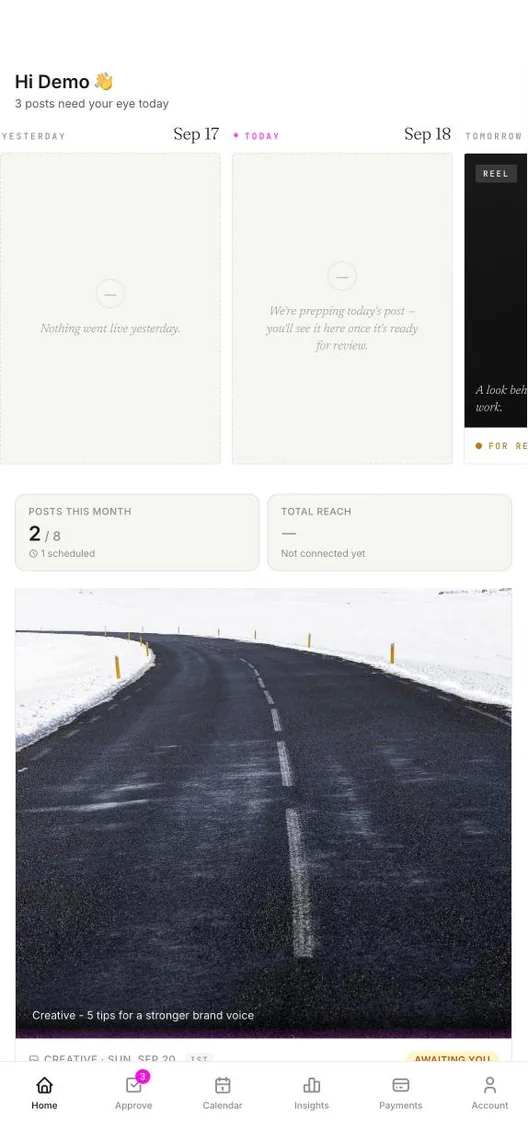
We built this into My Digital Sevak because we needed it ourselves. Clients get a mobile portal where finished posts wait for approval with their posting dates, and they approve or ask for changes with quick presets like "Change copy" or "Reschedule", or approve several posts at once. For clients who want to see the plan early, there's an optional read-only Plan view of upcoming posts. Their results sit in an insights tab, and posts go out through the Instagram scheduler once approved. It doesn't run the kickoff for you, and clients type their feedback (there are no voice notes), but it means the expectations you agreed are on the client's screen instead of in your memory.
The kickoff is one part of a wider retention system; the rituals that keep a client past month twelve are in how to reduce agency client churn, and the paperwork that comes before the kickoff is in how to onboard a new social media client. Agencies in smaller cities like Lucknow or Dehradun often win against bigger names on exactly this: a clear, written promise the client can hold them to.
Frequently asked questions
When should a social media agency set client expectations?
Before the first invoice, in a dedicated kickoff call, and again in writing the same day. The sales call is too early because the client is still being sold to. By month two it is too late, because the client has already formed a picture of what you promised and will hold you to it.
How long before a client sees results from organic social media?
Tell clients to judge consistency in month one, early signals like saves, shares and profile visits in month two, and business signals like DM enquiries and calls from month three onward. Sales from organic content alone usually take longer, and paid ads speed things up only if the client funds them separately.
What should an agency never promise a social media client?
Never promise a follower number, a viral post, a fixed reach figure or a sales figure from organic posts alone. You do not control the algorithm or the client's pricing, product and follow-up. Promise what you control: the number of posts, the posting dates, response times and an honest monthly report.
Sources checked on 25 November 2026: Digiday Research on why clients leave agencies; HubSpot's "Why you're losing clients" (citing the Agency Management Institute); Sendible's step-by-step guide to establishing client expectations. The timelines, response times and deliverable counts above are from our own agency practice, not industry benchmarks. Product details describe My Digital Sevak as of November 2026.
Put the promise where the client can see it
A client portal with the calendar, approvals and results for every brand, connected to the agency workspace your team already works in. From ₹999/month. Try it free for 3 days, no card needed, with a 7-day money-back guarantee.