Two years ago a CA firm in Dehradun asked us to run their Instagram. We said yes, wrote a month of calendar, and then spent the first review call watching the senior partner strike out half of it. Not because the copy was bad — because every line that a normal brand would call "marketing" was, for him, a disciplinary risk.
That call taught me the thing most agencies learn expensively: professional-services clients are not a niche with a different tone of voice. They are a niche with a regulator. And in 2026, the two biggest professional-services categories in India — chartered accountants and advocates — moved in opposite directions within four months of each other. If you're pitching either, you need to know which way.
What changed for chartered accountants in 2026?
ICAI approved a rewrite of its Code of Ethics at its Council meeting in December 2025, and the revised 13th edition is applicable with effect from 1 April 2026 (one provision, on social impact and CSR assessment, came in earlier on 11 December 2025). It is the most consequential change to how a CA firm may present itself in a generation.
What ICAI itself described, in its announcement of the amendment, was "more flexibility of content, advertisement through contemporary form in write-up, enabling websites for network firms and changes intended to enhance the visibility of firms and facilitate the dissemination of information through digital platforms" (reported December 2025). Two specifics matter for anyone planning a calendar:
- Push mode is now permitted for non-exclusive services. Previously a CA firm's website essentially had to sit and wait to be found — "pull" only. The revision allows proactive promotion of services that are not exclusively reserved to the profession: consultancy, accounting, advisory work. Statutory audit and the other reserved functions are a different matter.
- Network firms registered with ICAI may maintain their own websites. A small but real unlock for multi-office firms that previously had to funnel everything through individual member pages.
What did not change: the profession's core objection to soliciting work. Flexibility in how a firm describes itself is not permission to chase clients. Practically, that means a CA calendar can say what the firm does and teach what the law says. It cannot say "limited slots for GST registration this month, DM now."
What changed for advocates — and why it went the other way
Rule 36 of the Bar Council of India Rules has long barred advocates from advertising or soliciting work. What's new is that the BCI stopped treating social media as a grey area.
In July 2026 the Supreme Court issued notice in Anil Pandey & Anr. v. Bar Council of India, a writ petition concerning promotional reels, monetised legal content, influencer collaborations and client testimonials by advocates — the petition arguing that these amount to indirect solicitation prohibited under Rule 36 (LiveLaw, 14 July 2026). Days later, on 17 July 2026, the BCI issued Social Media and Digital Ethics Guidelines.
Per SCC Online's summary of those guidelines, advocates may engage in responsible legal-awareness content, academic discussion, neutral case-law updates and accurate legal reporting, provided it is not misleading, promotional or sensational. The guidelines caution against creating or circulating "reels, videos, short clips, memes, promotional posts" depicting court premises or judicial proceedings inconsistently with professional ethics, and against disclosing confidential material — case strategy, pleadings, drafts, settlement communications. AI-generated or deepfake content depicting judicial figures is squarely prohibited. The BCI reiterated that advocates cannot use social media for direct or indirect advertising, solicitation, client acquisition or commercial self-promotion.
So: the "legal influencer" format — courtroom-corridor reel, robes on, "5 rights you didn't know you had, DM for consultation" — is the exact thing the regulator named. If a client asks you to make those, the right answer is no, in writing.
The permitted-content map
Here is the table I now put in front of every professional-services prospect on the first call. It saves an hour of arguing later.
| Content type | CA firm | Advocate / law firm |
|---|---|---|
| Explainer on a deadline, circular or rule change | Yes — the strongest format | Yes — framed as awareness, not advice |
| Neutral judgment / case-law update | Where relevant | Yes, if neutral and non-sensational |
| Firm capability and service listing | Yes, with the new flexibility for non-exclusive services | Limited — Rule 36 governs; websites carry narrow permitted particulars |
| Client testimonials / reviews | Avoid | No — named in the BCI's concerns |
| "Won ₹X crore for a client" results posts | No | No |
| Fee, pricing or offer posts | No | No |
| Reels shot in court premises, in robes | n/a | No — specifically cautioned against |
| Recruitment and team posts | Yes | Yes |
| Paid ads promoting professional services | Tread carefully; check the Code first | No |
Notice what survives in both columns: teaching. An explainer on the new TDS rate, a plain-English note on what a particular judgment actually decided, a "what documents you need before your first hearing" carousel. It is the only content type that is simultaneously compliant, useful, and — because it demonstrates competence rather than claiming it — genuinely good marketing. This is the same principle that makes social media for doctors and clinics work under the NMC's advertising restrictions: you cannot claim outcomes, so you teach instead.
How to price and scope a professional-services client
Three things about these accounts that surprise agencies coming from restaurants and D2C:
- Volume is lower, approval cycles are longer. A CA firm posting twelve times a month with a partner reviewing every line is more work than a café posting thirty. Price on review load, not post count. If you're benchmarking, our note on what to charge for social media management in India holds, but add a compliance-review premium of roughly 20–30%.
- The partner is the brand. Personal profiles of senior partners typically outperform the firm handle several times over — but a personal profile is bound by the same code as the firm page. Same rules, more reach.
- LinkedIn does the heavy lifting. For both categories, LinkedIn is where the referral network lives. Instagram is a credibility artefact more than a lead source. We go deeper on that split in LinkedIn marketing for B2B clients.
One practical consequence for your team: the calendar for a CA or law client has to carry a visible compliance state, not just a content state. We tag every post in these accounts with the regulator concern it touches, so the person writing next month's batch can see at a glance why a previous post was struck.
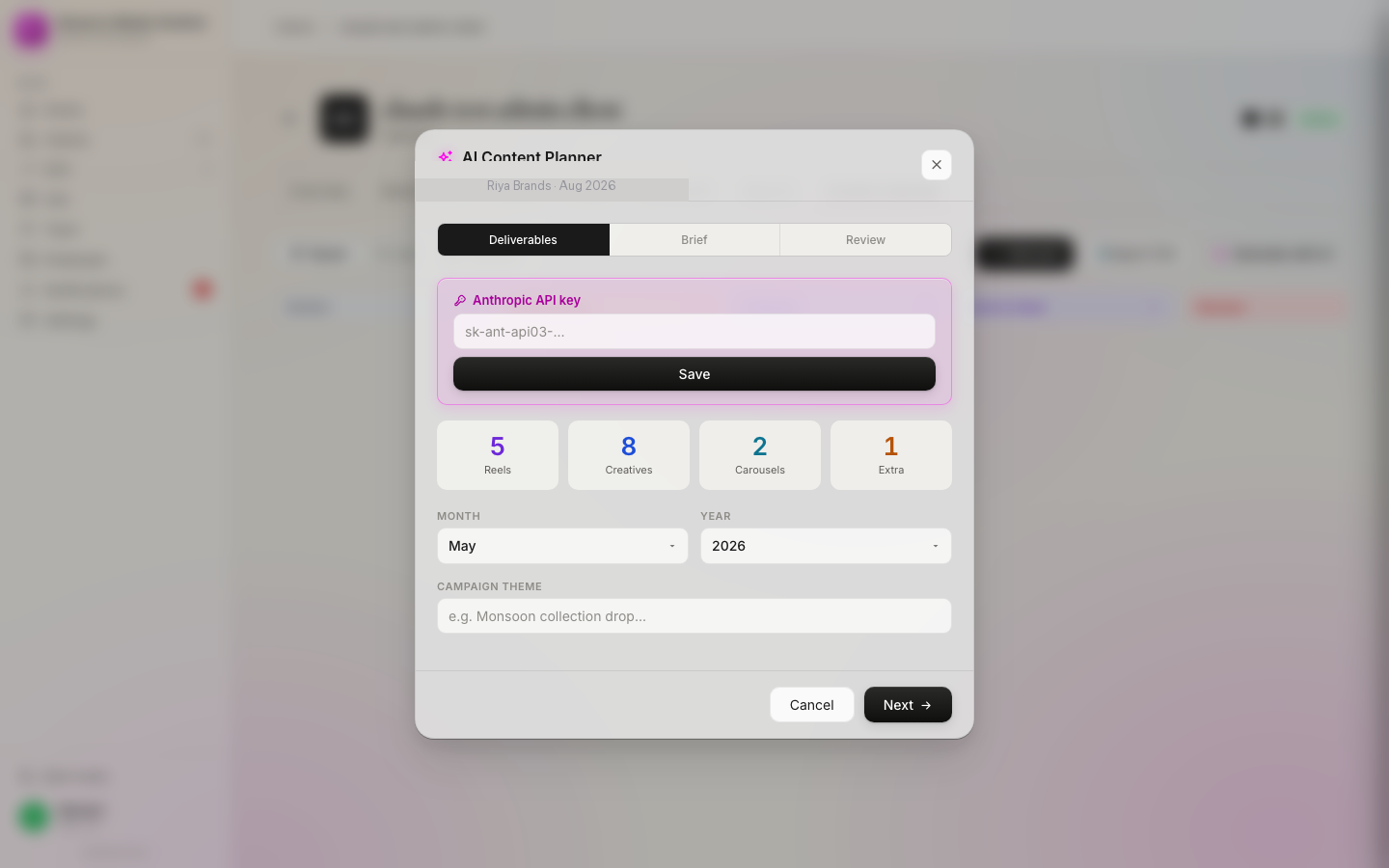
The approval trail is the whole job
For a restaurant client, a missed approval means a slightly off post. For a CA or advocate, an unapproved post is a professional-conduct exposure for your client and a client-loss event for you. So the workflow changes shape:
- Named approver in the contract. Not "the firm" — a specific partner or the compliance-designated member, by name. Add a compliance clause stating that the professional's approval is the final word on whether a post complies with their code, and that the agency will not publish without it. Our retainer agreement guide has the surrounding structure.
- Approval in a system, not on WhatsApp. A WhatsApp "ok" from an unnamed number is not a record you want to rely on if a complaint is ever filed. Every approval should be timestamped against the exact creative and caption that went live — which is exactly why we moved our own clients off chat approvals (WhatsApp vs a client portal).
- Freeze on approval. The version approved is the version published. If a caption is edited after approval, it goes back for approval. No exceptions, and the tool should enforce this rather than your project manager remembering.
- Keep the trail after the engagement ends. Complaints surface late. Retain the approval log for the full limitation period your client's regulator works to, and hand over a copy at offboarding.
If you've built this rigour for one CA firm, you can sell it to the next twenty. It's the strongest reason a professional-services client picks a specialist agency over the cheapest quote in the city — and it's a defensible niche in a market where everyone else competes on price. Agencies in professional-services-dense markets like Pune and Delhi NCR are in the best position to build it.
Where this goes next
Two things worth watching. First, the Supreme Court's notice in Anil Pandey was returnable in September 2026 — whatever comes out of that matters more than any guideline, because it will settle how far Rule 36 reaches into ordinary online presence. Second, ICAI's liberalisation is new enough that the Ethical Standards Board's interpretation will keep evolving through its first year; what a firm can safely do in April 2026 and in April 2027 may not be identical.
The practical stance for an agency: write for the rule as it stands today, keep the approval record, and re-read the source documents every quarter rather than trusting a blog post — including this one. It's the same discipline the ASCI influencer guidelines and the DPDP Act demand of everyone else. Professional-services clients just make the cost of getting it wrong visible.
Frequently asked questions
Can chartered accountants advertise on social media in India?
Yes, within limits. ICAI's revised 13th-edition Code of Ethics, applicable from 1 April 2026, gives CA firms more flexibility in advertisement content and allows push-mode promotion of services that are not exclusive to the profession. Soliciting professional work remains restricted, so read the current Code before signing any CA client.
Can advocates in India run Instagram reels for their practice?
Advertising and solicitation by advocates is barred under Rule 36 of the Bar Council of India Rules. In July 2026 the BCI issued social media and digital ethics guidelines permitting legal awareness and academic content while cautioning against promotional reels, client testimonials and influencer collaborations. Educational content is the safe lane.
Who is liable if a professional-services post breaches a regulator's code?
The disciplinary consequence falls on the professional, not the agency, because the code binds the member. Commercially, though, a client facing a complaint will look at whoever wrote the post. Put approval-in-writing and a compliance clause in the retainer before the first post goes live.
What social media content is safe for a CA or law firm?
Explainers on deadlines and rule changes, neutral case-law or circular updates, team and office milestones, recruitment posts, and firm capability information stated factually. Avoid results claims, client names, fee comparisons, urgency hooks and anything that reads as a pitch for professional work.
An approval trail your compliance-heavy clients can rely on.
Named approvers, timestamped sign-off against the exact creative that publishes, and a record that survives the engagement. Plus scheduling, reports and GST invoicing in one login.