Most travel agency Instagram accounts in India look the same: a Maldives water villa, a Swiss train, a Kashmir houseboat, "DM for best price." Every competitor can post the same stock photos, and the traveller knows it. The photo sells the destination. It doesn't sell you.
That's the difference between this vertical and hospitality. A hotel sells a place you can see. A travel agency sells a promise: flights, hotels, transfers and a guide, all owned by someone else, paid for in advance. We've written separately about social media for hotels and resorts. This post is for the business in between the traveller and the hotel.
Why is a travel agency harder to market than a hotel?
Three things make it harder:
- The traveller pays before anything happens. An advance for a Europe group tour can be lakhs of rupees, paid months ahead to a business the traveller has only seen on a phone.
- Fear of being cheated is the main objection. Everyone has a relative with a story about a fake agent, a missing hotel booking or a "package" that fell apart on arrival. Your content either answers that fear or ignores it.
- The quote is the product. Two agencies selling the same Bali itinerary are separated by how fast, clear and believable their quote is. Social media's job is to get people into that conversation already trusting you.
What should a travel agency post?
Build the calendar on pillars that each answer a traveller's doubt. Destination content still has a place, but as the smallest slice, not the whole feed.
| Content pillar | Example | The doubt it answers |
|---|---|---|
| Departure-day proof | This morning's Vietnam group at Delhi T3, named tour leader in frame | "Do these trips actually happen?" |
| Itinerary carousels | Day 1 to Day 7, hotel category and drive times on each slide | "What exactly am I paying for?" |
| Inclusions breakdown | "What your ₹X per person covers, and what it doesn't" | "Will there be hidden charges?" |
| Paperwork explainers | Visa timelines, passport validity, TCS on overseas packages | "Is this going to be a hassle?" |
| Traveller stories | A family's own video from the trip, shared with consent | "Did people like me enjoy it?" |
| The team | The person who answers WhatsApp at 11 pm when a flight is delayed | "Who do I call if something goes wrong?" |
| Destination-in-season | "Why Kashmir in April, not May" | "When should I go?" |
Credentials belong in the mix too. If the agency is recognised by the Ministry of Tourism, accredited by IATA, or a member of a trade body, show it on the profile and in a pinned post. It's a small thing, and it directly answers the fake-agent fear.
One consent rule: get written permission before posting a traveller's face, especially families with children. A WhatsApp "yes, you can post it" saved to the client's file is the minimum. It's also the kind of approval a client approval workflow should record, not someone's memory.
How do you plan a travel content calendar?
Plan around when people decide, not when they travel. By the time a Diwali trip is visible in the calendar, the families who book early have already booked. This is the rough shape we work from. Adjust it to the agency's own enquiry dates, which are better evidence than any general guide:
| Trip type | Start promoting | Why that early |
|---|---|---|
| International with a visa (Europe, UK, US) | Three to five months before | Visa appointments and processing set the real deadline |
| Domestic summer holidays | Two to three months before | Families plan around school calendars |
| Diwali and year-end holidays | Two to three months before | Flight fares rise as dates approach; early bookers want certainty |
| Honeymoons | Alongside wedding season | Couples book the trip while planning the wedding |
| Pilgrimage and yatra circuits | Before registration opens | Slots, permits and helicopter bookings sell out |
| Long weekends | Two to four weeks before | Short trips, decided late |
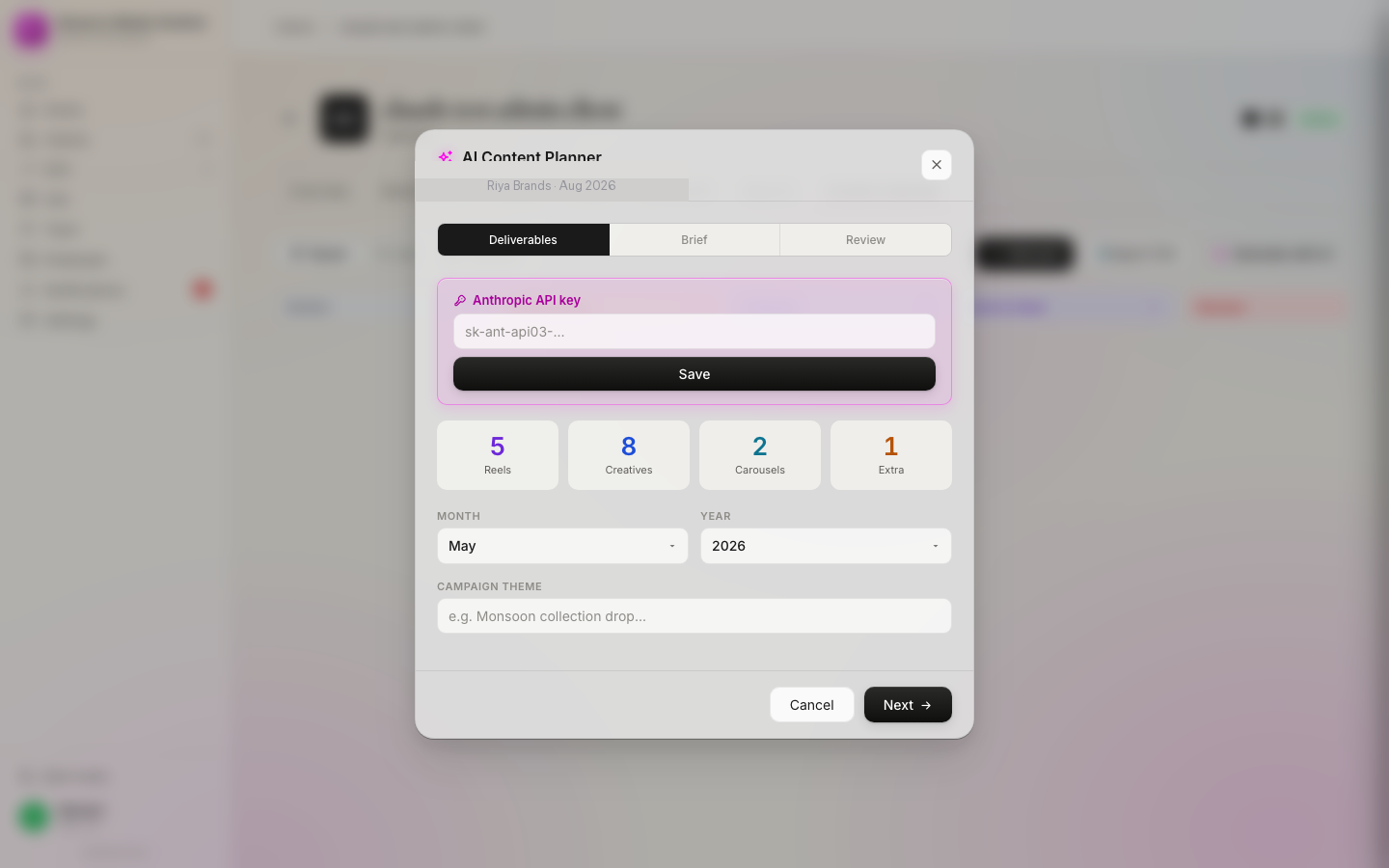
A calendar this far ahead needs the client to approve content well before the season. Build a monthly approval cycle into the retainer so nobody signs off on Diwali posts in October. Bulk-scheduling a month at a time keeps that manageable.
How do you turn Instagram DMs into bookings?
Almost every travel enquiry in India ends up on WhatsApp. The agency that wins isn't the one with the prettiest feed. It's the one that sends a clear quote first. Build the flow like this:
- Collect three facts in the first reply: travel dates (or month), number of adults and children, and the departure city. Without these, any quote is a guess.
- Quote the same day, in one format. A single PDF or image with the itinerary, hotel names or category, inclusions, exclusions, per-person price and payment schedule. The same template every time builds trust, while a wall of text in chat loses it.
- Follow up twice, then stop. Once after 48 hours and once a week later. More than that feels like pressure.
- Log where every lead came from. Reel, ad, story, referral or Google. At the end of the season this is the only data that tells the owner which content paid off.
Click-to-WhatsApp ads are well suited to this flow, and they work especially well for pilgrimage and family trips aimed at older travellers. That's one place where Facebook still earns its place. For higher enquiry volume, our WhatsApp Business API guide covers templates, opt-in and costs.
How should package prices appear in posts?
"Thailand 5N/6D from ₹29,999" is the most common travel creative in India, and it's often misleading. Is that per person or per couple? Twin sharing or single? Flights included? Ex-Delhi or land-only? The Central Consumer Protection Authority's Guidelines for Prevention and Regulation of Dark Patterns, 2023 prohibit drip pricing, where a low price is shown first and mandatory charges are added later. A MediaNama report notes that an ASCI and Parallel study found nine of twelve deceptive patterns in travel booking. Regulators are watching this sector.
The rule we follow for travel clients: the creative itself says per person, twin sharing, from which city, and whether flights are included. If the caption has to explain the price, the creative is wrong.
There's also a 2026 change worth posting about. The Union Budget 2026-27 set tax collected at source on overseas tour packages at a flat 2% from 1 April 2026, with no amount threshold. It replaced the earlier 5% rate, and 20% above ₹10 lakh. Travellers see TCS on the invoice and read it as an extra charge. A plain-language post explaining that it's collected upfront and can be adjusted against their income tax is useful content that shows the agency knows its job. Keep it factual and suggest checking with a tax adviser for individual cases. The ASCI guidelines also apply to any influencer who travels on a free or discounted trip: that's a material connection, and it needs a label.
If you run travel accounts as an agency
Travel clients are seasonal, and the retainer should reflect that. Content load peaks two to three months before each season, not during it. Agree a year-round base and a heavier pre-season production block up front. Don't let the client pause in the off-season and expect a full launch the week before Diwali.
Report on what the owner cares about: enquiries by source, quotes sent and bookings by departure, not follower growth. An owner who sees "Reels about the Kashmir itinerary brought in 38 enquiries and 9 bookings" renews. An owner who sees "reach up 12%" asks what they're paying for. Our monthly report template adapts well to this.
Travel is also a good specialism for smaller agencies, especially in feeder cities such as Amritsar, Ahmedabad or Kochi, which have many travel businesses and few agencies that understand them. If you're choosing a niche, our guide to agency niches in India covers how to test demand before committing.
Frequently asked questions
Which social media platform is best for a travel agency in India?
Instagram for discovery and proof, WhatsApp for the actual conversation and quote, and Facebook mainly through ads for older family and pilgrimage travellers. YouTube helps agencies with long itineraries to explain. Most small agencies should do Instagram and WhatsApp well before adding anything else.
What should a travel agency post on Instagram?
Proof that trips actually happen: real groups on departure day, day-by-day itinerary carousels, clear breakdowns of what a package includes, visa and paperwork explainers, and the team who picks up the phone. Stock destination photos alone don't sell an agency, because every competitor can post the same ones.
How far in advance should a travel agency promote a trip?
Work back from when travellers decide, not from the departure date. International trips needing a visa should be promoted three to five months ahead. Domestic summer and Diwali holidays need two to three months, and long-weekend trips two to four weeks. Check the agency's own enquiry dates to fine-tune this.
What is the TCS on overseas tour packages in 2026?
From 1 April 2026, the Union Budget 2026-27 set tax collected at source on overseas tour packages at a flat 2%, with no amount threshold. It replaced the earlier 5% and 20% slabs. TCS can be adjusted against the traveller's income tax, so agencies should explain it clearly, not hide it.
Sources
- Outlook Money, Budget 2026: how the TCS cut changes the maths for foreign travel (Union Budget 2026-27, effective 1 April 2026).
- MediaNama, Travel aggregators report zero dark patterns despite independent studies finding violations (November 2025), on the CCPA Dark Patterns Guidelines, 2023.
Plan every departure a season ahead.
Draft the season's calendar, get client approval weeks early, and report enquiries and bookings by trip rather than likes. From ₹999/month for your whole team — see the agency management software and the Instagram scheduler.