Every page ranking for this question says the same reassuring thing: AI replaces tasks, not roles, so learn the tools and you'll be fine. It's true, and it's useless — because it doesn't tell you which tasks, what the remaining job is worth, or what you're now legally on the hook for.
I run an agency. I've shipped content for 63+ brands, and we built AI drafting into our own product. So I'm biased, and you should read this as evidence rather than verdict. But I can tell you the specific thing that changed in India this year, which none of the ranking pages mention, and which matters more to an Indian social media manager's job security than any capability announcement.
What is AI actually doing to the job right now?
The best current numbers I found come from Sociality.io's 2026 AI in Social Media Marketing Report, published 26 January 2026, surveying social and marketing professionals across agencies, in-house teams and freelance roles:
- 89.7% use AI daily or several times a week — 64.1% daily.
- 78.4% apply moderate or extensive editing before publishing.
- 71.1% say time savings are the biggest improvement.
- 44.7% say AI-assisted content performs better.
- 61.1% cite originality and plagiarism risk as their top concern; 50% cite accuracy and reliability.
Sit with the first and second numbers together. Near-universal adoption, and four in five people still rewriting the output substantially. That's not a workforce being replaced. That's a workforce that got a fast, unreliable junior and now spends its day supervising one.
This is a single vendor-published survey, not government data, and the vendor sells social media software. Treat the direction as reliable and the decimal places as marketing.
Why "AI won't replace you" is the wrong question
Nobody was ever going to fire a social media manager and hire a model. What actually happens is quieter: the client asks why a deliverable that used to take three days now takes three hours, and whether the invoice should reflect that.
That's the real threat, and it isn't automation — it's price compression on the part of your work that got easy. If your rate card is denominated in posts or hours, you have a problem, because both of those units just got cheaper to produce and your client reads the same AI headlines you do.
The managers losing work in 2026 aren't the ones who refused to use AI. They're the ones whose entire value proposition was volume of output — 20 statics a month, on time. That was always the most substitutable thing they sold. It just got substituted.
The India rule that just created work AI can't do
Here's what no page on this SERP mentions. On 10 February 2026, MeitY notified the Information Technology (Intermediary Guidelines and Digital Media Ethics Code) Amendment Rules, 2026 (Gazette notification G.S.R. 120(E)), which came into force on 20 February 2026.
The amendment brings synthetically generated information (SGI) into the compliance regime. Per Freshfields' reading of the notified text, SGI is defined as "audio, visual, or audio-visual information that is artificially or algorithmically created, generated, modified or altered using a computer resource". Non-prohibited SGI must be "clearly and prominently labelled". Khaitan & Co's summary adds the operational detail: visual SGI labels must be "prominent, easily noticeable, and adequately perceivable", audio SGI needs "a prominently prefixed audio disclosure", and significant social media intermediaries must "obtain a declaration from users regarding whether the content is SGI" and deploy technical measures to verify those declarations.
Now the distinction that actually governs your daily work, and it's a sharp one:
| What you made with AI | Is it SGI? | What that means for you |
|---|---|---|
| AI-drafted Instagram caption | No — text is excluded from the SGI definition | No SGI label needed. Ordinary rules on unlawful or misleading content still apply. |
| AI-generated product image or background | Yes | Label it, and answer the platform's declaration prompt truthfully. |
| AI voiceover on a reel | Yes | Needs a prefixed audio disclosure. |
| AI-upscaled or AI-retouched real photo | Likely — "modified or altered" is in the definition | Get a view on it per client. This is the grey zone. |
| AI-generated face or voice of a real person | Yes, and highest risk | Consent plus labelling. Deepfake takedown windows are the tightest in the rules. |
Freshfields notes explicitly that "text generated by AI does not fall within SGI". So the reflexive agency assumption — captions are the risky bit, visuals are just design — is exactly backwards under this law.
Here's why that's a job, not a nuisance. Someone at your agency has to know, for every asset going out for every client, whether it contains synthetic material, has to answer a platform declaration truthfully on the brand's behalf, and has to be able to prove months later what was declared and who signed off. A model can generate the image. A model cannot be the party that made a declaration to a platform about a client's content. That accountability has to sit on a named human, and 2026 just made it a compliance obligation rather than a nicety.
I'm a founder, not a lawyer, and this is a fast-moving area — MeitY has continued to refine the labelling guidance since February. Get your own advice before you write it into a client contract.
This is the fifth or sixth time an India-specific rule has quietly redefined part of this job — ASCI's influencer disclosure requirements did it for captions on paid partnerships, FSSAI did it for restaurant claims, and the DPDP framework is doing it for lead data. None of these show up in globally-written "future of the SMM role" essays, and all of them are billable expertise.
What AI still can't do on an Indian account
I've written elsewhere about why AI-generated calendars come out generic, so I'll keep this at the level of the role rather than the output:
- Deciding when to break the brand voice. A model trained on your tone guide will faithfully reproduce your tone guide during a product recall. Knowing that today is the day to sound different is a judgement call with a career attached to it.
- Reading the room on a festival calendar. Not "post on Diwali" — every tool knows that. Knowing that this particular Rajasthan jewellery client should go quiet during a local mourning period, or that a Karwa Chauth creative will land badly with half their Bengaluru audience, requires knowing the client's actual customers.
- Absorbing a client's anxiety at 11pm. A large share of this job is a WhatsApp conversation where a founder is worried and needs a person, not a dashboard. See WhatsApp vs a client portal for how we structure that without living inside it.
- Owning the outcome. When the quarter underperforms, someone sits in the review and explains it. That role is definitionally human, and it's the one that renews the retainer — the mechanics of which I covered in reducing agency client churn.
What does this do to your rate card?
Some honest arithmetic, labelled as mine. PayScale puts the average social media manager salary in India at ₹360,681 a year (237 profiles, last updated 20 June 2026) — about ₹30,057 a month, or roughly ₹171 an hour at 22 eight-hour days.
Say AI genuinely halves drafting time on a 12-post month: maybe 6 hours saved per client, about ₹1,030 of salary cost. If you bill that client ₹15,000 a month and you priced per post, your client's fair question is why the invoice hasn't moved. If you priced the retainer as strategy, approvals, compliance sign-off, publishing and reporting, then nothing about the invoice needs to change — you just got 6 hours back to spend on the client's actual business.
So the repricing move isn't to discount. It's to move the unit of sale off production:
| If you sell… | AI's effect | What to do |
|---|---|---|
| Posts per month | Price falls to the cost of generation | Stop. This is the exposed position. |
| Hours | Fewer billable hours for identical work | Convert to a fixed monthly retainer. |
| A managed channel | Neutral — you absorb the gain as margin | Keep, and reinvest the hours visibly. |
| Outcomes + accountability | Strengthens — AI raises volume, not judgement | Move here. Add compliance sign-off explicitly. |
Practically: add a line to your scope of work saying you review, label and declare synthetic media per the IT Amendment Rules 2026, and maintain the approval record. It costs you almost nothing — you're doing it anyway — and it re-anchors the conversation from "how many posts" to "who is responsible". My template for the rest of that document is in the social media retainer agreement for Indian agencies, and the pricing groundwork is in what to charge for social media management in India.
The five-part job that's left
- Strategist. What this brand should say, to whom, and why now. AI has no access to the client's margin structure or their offline sales conversation.
- Editor. The 78.4% number is your job description. You're the taste layer between a generic draft and something a specific brand can sign.
- Compliance owner. ASCI disclosure, SGI labelling, sector rules. Newly formalised, genuinely billable, and almost nobody is claiming it yet.
- Relationship holder. The reason the retainer renews.
- System operator. Whoever runs the calendar, approvals, publishing and reporting rails runs the account. See how many clients one manager can handle — AI raises that ceiling, but only if the coordination layer is solved too, which is the entire job of agency management software.
Notice that four of the five got more valuable this year, not less. The one that shrank — production volume — is the one that was always going to.
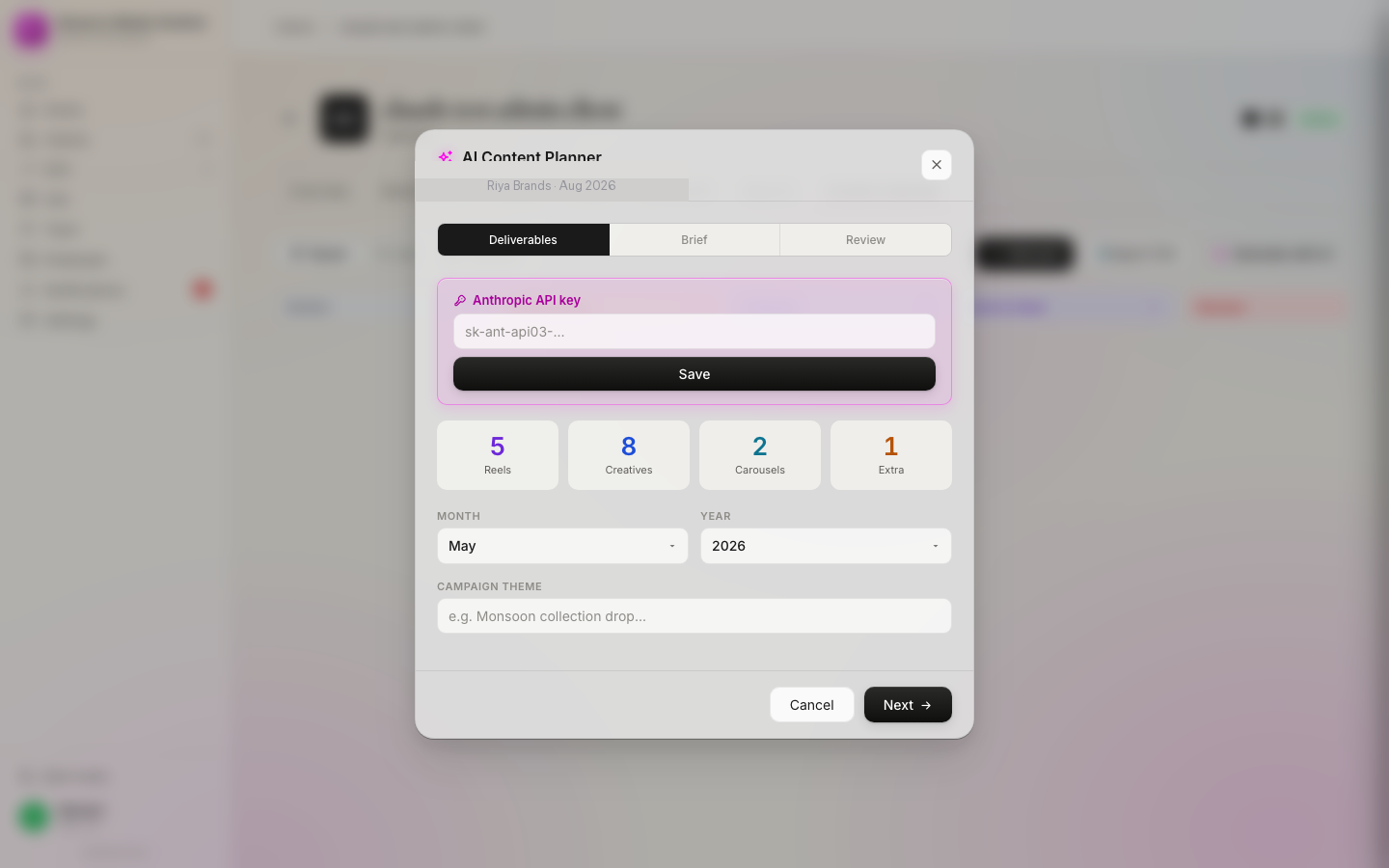
None of that requires you to be an early adopter. It requires the drafting, the approval and the publish record to live in one place, so the person accountable can actually see what went out and prove it. That's how our own Instagram scheduler and AI planner are wired — draft, human edit, client approval, then publish — and it's the shape I'd recommend whatever tool you use. If you run an agency in a market like Indore or Surat, where clients are price-sensitive and quick to ask what AI changed about your invoice, having that record is also your best answer.
Frequently asked questions
Will AI replace social media managers in India?
No, but it is redistributing the work. Sociality.io's 2026 report found 89.7% of social professionals already use AI at least several times a week, while 78.4% apply moderate or extensive editing before publishing. The production half of the job is shrinking and the judgement, compliance and client-relationship half is growing.
Do I have to label AI-generated content in India?
For visuals, effectively yes. India's IT Amendment Rules 2026, in force from 20 February 2026, require synthetically generated information to be clearly and prominently labelled, and require large platforms to collect a declaration from users about whether content is synthetic. The definition covers audio, visual and audio-visual content; AI-generated text is excluded.
Does an AI-written Instagram caption need a label?
Under the SGI definition in the 2026 amendment, no — text generated by AI falls outside synthetically generated information. But an AI-generated image, an AI voiceover on a reel, or an AI-altered video of a real person does fall inside it, and other obligations around unlawful or misleading content still apply to text.
Should agencies cut prices because AI makes content faster?
Only if you are selling hours. If your rate card is priced per post or per hour, faster production logically means a lower invoice and clients will notice. The defensible move is to price the outcome and the accountability — strategy, approvals, compliance, reporting — none of which got faster because a model got better at drafting.
AI drafts. Your team decides. The client approves.
An AI planner that writes into your calendar, an approval gate nothing publishes without, and a permanent record of who signed off on what. 7-day free trial, from ₹999/month for your whole team.
Start Free Trial