Most hook lists online are written for creators: "I quit my job and here's what happened." A brand can't say that. A jeweller in Jaipur or a dental clinic in Dehradun needs hooks that stop the scroll without sounding like a creator pretending to be a person, and without breaking advertising rules.
This is the hook system we use across our clients' reels: what counts as the hook, seven formulas that fit brands, examples by industry, and how to tell whether a hook is working. (Captions are a separate job, covered in our guide to AI caption generators for brands. This post is only about the opening seconds of the video.)
Why do the first three seconds matter so much now?
Because Instagram now measures them. In December 2025 Meta added a Reels skip rate metric to its Instagram API, defined as "the percentage of views where viewers skip a Reel within the first 3 seconds," which Meta says "can indicate how engaging the beginning of a Reel is." Professional accounts see it in each reel's insights, next to the retention graph.
That number changed our client conversations. Before, a reel with weak views led to vague debates about the algorithm, the posting time, the music. Now we open insights: if the skip rate is high, the problem is the opening, and no amount of hashtags will fix it. If the skip rate is fine but retention falls off at second 12, the hook did its job and the middle is the problem.
What counts as the hook in a reel?
Three layers, all landing in the same three seconds:
- The visual hook. The first frame. It should already show the subject: the dish, the bride, the before-photo, the flat's balcony view. A slow logo build or a blank wall while someone walks in is three wasted seconds.
- The text hook. One line of on-screen text, readable in a second, placed clear of the caption and buttons at the bottom of the frame. It matters because many people scroll with the sound off.
- The spoken or audio hook. The first sentence of voiceover, or the first beat of the track. Spoken lines under ten words work best.
The strongest openings make all three say the same thing. The weakest ones have a pretty visual, unrelated text, and a voiceover that starts with "Hi everyone, welcome back."
Seven hook formulas that work for brands
| Formula | Template | Brand example |
|---|---|---|
| 1. Result first | Show the finished outcome, then how | A finished bridal look in frame one, then the 40-minute process |
| 2. The mistake | "Stop doing X if you want Y" | "Stop buying a sofa before you measure this" |
| 3. The number | "[Number] [things] before [decision]" | "3 questions to ask before you book a wedding photographer" |
| 4. The price reveal | "What ₹X gets you at [place]" | "What ₹499 gets you at our café" |
| 5. Process curiosity | Open on the strangest step | Molten gold being poured, no explanation yet |
| 6. The customer's question | Read a real DM or comment on screen | "Do you deliver to Haldwani?" over a packing shot |
| 7. Myth vs fact | "Everyone says X. Here's the truth." | "Everyone says gold is cheaper in Dubai. Let's do the maths." |
Formulas 1, 4 and 5 are visual-first and work with the sound off, which makes them the safest default for brands. Formulas 2, 3 and 7 need confident on-screen text and a believable claim behind them.
Reel hook examples by industry
These are first-three-second openings we've used or adapted for Indian SMB categories. Each line is frame + text.
| Industry | Opening frame | On-screen text |
|---|---|---|
| Restaurant / café | Cheese pull or tadka hitting the pan | "Only 40 of these made every day" |
| Salon | The "after" shot, then hard cut to "before" | "She walked in with box-dye damage" |
| Real estate | Balcony view at golden hour | "This is the view from a 2BHK under ₹60 lakh" |
| Jewellery | Close-up of the piece being worn | "22K vs 18K: which one should you buy?" |
| Coaching institute | A student's marked answer sheet | "The mistake that costs 5 marks in every exam" |
| Clinic / CA firm | The professional mid-explanation, no intro | "Most people get this wrong about their ITR" |
| D2C skincare | Texture shot of the product on skin | "How to layer this with your sunscreen" |
| Wedding photographer | The best frame from the shoot | "How we got this shot in a crowded baraat" |
Two cautions. Price and result claims must be true for the brand: a "₹60 lakh" hook on a flat that's ₹72 lakh with charges is a complaint waiting to happen. And regulated categories have extra rules. Doctors, CAs and lawyers can't use "best in the city" style hooks (our guides for clinics and CAs and lawyers cover this), and skincare and wellness claims must be backed up under ASCI's code. "Visible results in 7 days" is a claim, not a hook formula.
Where do brand reels lose the hook?
The same five mistakes cause most of the high skip rates we see:
- Logo first. An animated logo tells the viewer an ad is starting. Even exchange4media's look at influencer ads quotes an agency executive pushing back on briefs that demand the logo in the first three seconds. Put the brand at the end and in the caption.
- The slow text build. Words appearing one at a time over four seconds. Show the whole line at once.
- "Hi guys" openings. Greetings and introductions belong after the hook, if at all.
- A hook the reel doesn't pay off. "3 mistakes" followed by one mistake teaches the audience to skip next time.
- Text under the buttons. Lines placed at the bottom of the frame get covered by the caption and username. Keep the bottom fifth of the frame clear.
How do you test hooks without reshooting?
Hooks are the cheapest part of a reel to test, if you plan for it on shoot day.
- Shoot two or three openings. The result shot, the process shot and the talking-head line. It costs ten extra minutes on set and gives the editor options later.
- Change one thing at a time. Same video, different first three seconds. Otherwise you can't tell what moved the number.
- Use trial reels. Instagram's trial reels show a reel to non-followers first, so you can try a riskier hook without it sitting on the brand's grid.
- Compare against the account, not the internet. There's no official "good" skip rate. Compare a reel with the same brand's last ten reels.
- Post at the same slot. Testing hooks at different times mixes two variables. Our IST posting-time guide helps you pick one slot and keep it.
Write the hook into the brief, not the edit
The biggest change we made wasn't a formula. It was moving the hook earlier. When the hook is decided in the edit, the editor is hunting through footage that was never shot for it. When it's written into the content calendar before the shoot, the camera person knows the first frame they need.
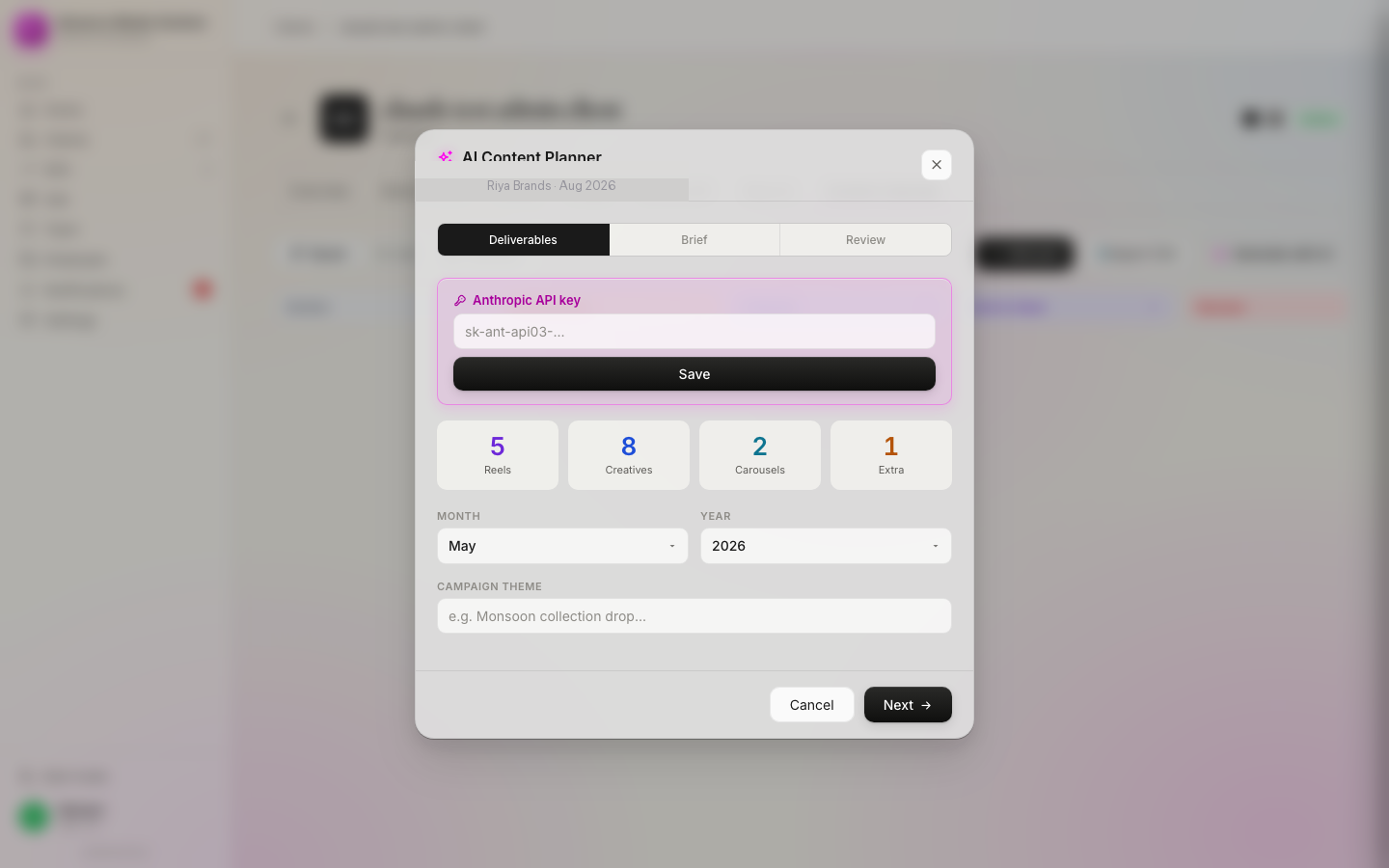
In our workspace, the AI content planner drafts a hook line and on-screen text for every post along with the concept and editor notes, and the team rewrites them in the brand's voice before the shoot. The approved reel then goes through the same approval and auto-publishing flow as everything else.
Whether your clients are cafés in Bengaluru or jewellers in Jaipur, the habit is the same: decide the first three seconds first, then shoot to them.
Frequently asked questions
How long should a reel hook be?
Plan for the first three seconds, because that is the window Instagram's skip rate measures. In practice the hook is one spoken line of under ten words, one short line of on-screen text, and an opening frame that already shows the subject. If any of the three needs explaining, it is too long.
Should the brand logo appear in the first three seconds of a reel?
Usually not. A logo sting tells viewers an ad is starting, and the first seconds are when they decide to stay. Show the product or the result first and let the brand become obvious through the content. Put the logo, handle or offer in the last few seconds and the caption instead.
How do you know if a reel hook is working?
Check the reel's skip rate in Instagram insights, which Meta defines as the share of views that skipped within the first three seconds. Compare it with the same account's recent reels rather than any industry figure, and only change the opening between tests so you know the hook caused the difference.
Decide the hook before the shoot
Plan each month with drafted hooks and on-screen text, get client approval in one place, and auto-publish approved reels to Instagram and Facebook, in the same agency workspace as your reports and GST invoices. From ₹999/month. Try it free for 3 days, no card needed, with a 7-day money-back guarantee.